


From the Pagham Mountain -- home of the Afghani brook salamander -- to the Nyanga Mountain -- lair of the Inyanga toad in Zimbabwe -- some 595 sites around the world have been identified as the sole home of at least one endangered species.
Identifying these locations provides a front-line list of places that need to be protected because, if the site is lost it will spell the doom of the plants or animals that make their home only there, said Mike Parr of the American Bird Conservancy.
Parr is co-author of a paper discussing these locations and the need to protect them. It's being published next Monday in the online edition of "Proceedings of the National Academy of Sciences."
Many endangered species make their homes on isolated islands, where they have evolved to differ from the mainland ancestors, Parr said, and many other sites are "mountain islands," isolated pockets of forest on mountain areas that have not been logged.
"We felt it was important that the human race have a global map of where single-species sites are," he said in a telephone interview.
"At least this puts up a marker for sites that, if we lose them, we absolutely are going to lose the species," he said.
Several of the 595 sites are home to more than one endangered species, the authors said, with a total of 794 endangered species living at these locations.
The researchers estimated that among the five major groups they studied, 245 extinctions have occurred since the year 1500.
"We therefore risk losing three times as many species as are known to have been lost in these same [animal and plant groups] ... over the last 500 years," they said.
Their study focused on five groups -- mammals, birds, amphibians, conifers and certain reptiles.
With 63 locations, Mexico has more sites where endangered species are concentrated than any other country.
Many are isolated islands along the coast of Baja California, Parr said. A good example is Socorro Island, part of a small group of volcanic islands south of Baja. It's protected by Mexico, and contains the only populations of unusual types of parakeet and mockingbird. A native dove is to be reintroduced to the area, he said.
While that site, managed by the Mexican navy, is protected, that's not the case for all the homes of endangered species.
Indeed, the paper notes that of the 595 sites 257 are completely unprotected and the status of another 48 could not be determined. Some 204 sites are under protection and for 86 at least part of the site is protected, the researchers said.
But with 508 the sites in developing countries, degrees of protection vary and money is not always available to monitor the areas.
The US is represented with 18 sites on the list, including the Arkansas National Wildlife Refuge in Texas, the only wintering site for the whooping crane, and the Torrey Pines State Reserve in California, home of the torrey pine.
Among the many sites around the world with several endangered species, none has more than Haiti's Massif de la Hotte, the only location where one can find some 13 unusual species of amphibians.

‘IN A DIFFERENT PLACE’: The envoy first visited Shanghai, where he attended a Chinese basketball playoff match, and is to meet top officials in Beijing tomorrow US Secretary of State Antony Blinken yesterday arrived in China on his second visit in a year as the US ramps up pressure on its rival over its support for Russia while also seeking to manage tensions with Beijing. The US diplomat tomorrow is to meet China’s top brass in Beijing, where he is also expected to plead for restraint as Taiwan inaugurates president-elect William Lai (賴清德), and to raise US concerns on Chinese trade practices. However, Blinken is also seeking to stabilize ties, with tensions between the world’s two largest economies easing since his previous visit in June last year. At the

UNSETTLING IMAGES: The scene took place in front of TV crews covering the Trump trial, with a CNN anchor calling it an ‘emotional and unbelievably disturbing moment’ A man who doused himself in an accelerant and set himself on fire outside the courthouse where former US president Donald Trump is on trial has died, police said yesterday. The New York City Police Department (NYPD) said the man was declared dead by staff at an area hospital. The man was in Collect Pond Park at about 1:30pm on Friday when he took out pamphlets espousing conspiracy theories, tossed them around, then doused himself in an accelerant and set himself on fire, officials and witnesses said. A large number of police officers were nearby when it happened. Some officers and bystanders rushed

Beijing is continuing to commit genocide and crimes against humanity against Uyghurs and other Muslim minorities in its western Xinjiang province, U.S. Secretary of State Antony Blinken said in a report published on Monday, ahead of his planned visit to China this week. The State Department’s annual human rights report, which documents abuses recorded all over the world during the previous calendar year, repeated language from previous years on the treatment of Muslims in Xinjiang, but the publication raises the issue ahead of delicate talks, including on the war in Ukraine and global trade, between the top U.S. diplomat and Chinese
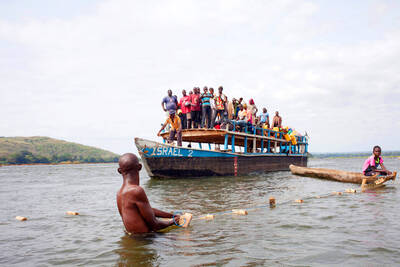
RIVER TRAGEDY: Local fishers and residents helped rescue people after the vessel capsized, while motorbike taxis evacuated some of the injured At least 58 people going to a funeral died after their overloaded river boat capsized in the Central African Republic’s (CAR) capital, Bangui, the head of civil protection said on Saturday. “We were able to extract 58 lifeless bodies,” Thomas Djimasse told Radio Guira. “We don’t know the total number of people who are underwater. According to witnesses and videos on social media, the wooden boat was carrying more than 300 people — some standing and others perched on wooden structures — when it sank on the Mpoko River on Friday. The vessel was heading to the funeral of a village chief in


 RSS
RSS