


US Secretary of State Condoleezza Rice faced further questions over US treatment of detainees at a NATO meeting yesterday, the final leg of a European trip dogged by criticism of US detention policies.
Despite Rice's efforts to defuse the issue, critics accuse the CIA of running secret prisons in eastern Europe and covertly transporting detainees in its war against terrorism. Rights groups say incommunicado detention often leads to torture.
Several countries raised the matter with Rice at a dinner for NATO and EU foreign ministers on the eve of the meeting proper. Some emerged more satisfied after what one source described as a frank but respectful exchange.
"I think NATO and EU ministers were able to raise their concerns that we should not diverge from one another on the interpretation of international law," German Foreign Minister Frank-Walter Steinmeier told reporters.
"Secretary Rice promised that international agreements are not interpreted any differently in the United States than they are in Europe. That, at least, is a good statement," he told reporters as he arrived for the meeting yesterday.
Dutch Foreign Minister Bernard Bot, who signalled earlier this week that the Netherlands would raise the matter during the talks, said he was "very satisfied" with Rice's responses.
A source briefed on the dinner, which was tightly restricted to foreign ministers, said Rice made a presentation repeating arguments made earlier on her trip, notably that Washington had respected international law.
A NATO spokesman earlier said the reports of CIA prisons was not on the formal agenda of the meeting to prepare alliance moves to bolster international peacekeeping efforts in Afghanistan, but added he "wouldn't be surprised if it came up."
European allies are seen having little appetite for a heads-on confrontation with Rice over allegations which could explode in their face if any complicity emerged on their part.
Poland, a staunch US ally in Iraq, has also said it wants answers from Rice on allegations -- which it has already denied -- that it has harbored secret CIA prisons on its territory.
"The matter needs to be resolved in the near future, no doubt about that," Polish Foreign Minister Stefan Meller told reporters on Wednesday.
If Rice did not address the allegations, he would raise them in a trip to Washington next week, he added.
Rice sought to deflect criticism of US policy before leaving for Europe on Monday, saying that European intelligence agencies had helped Washington extract information from suspects and urging allies to see "we are all in this together."
NATO expansion
However, the Netherlands -- which is considering whether to send a further 1,100 troops to Afghanistan as part of the NATO expansion there -- has said it wants additional assurances over how the NATO force will treat any detainees.
NATO foreign ministers were set to approve military plans yesterday to send up to 6,000 troops into southern Afghanistan, a major expansion of the alliance's peacekeeping mission into some of the most dangerous parts of the country.
The deployment next year of mostly European and Canadian troops will free up US forces to focus on counterinsurgency operations against Taliban and al-Qaeda fighters in Afghanistan's volatile south and east.
It should allow the US to scale down its about 18,000-strong military presence almost five years since it invaded the country in the wake of the Sept. 11 attacks on the US. The Pentagon, however, has yet to say how many troops it will withdraw.
The expansion of the Afghan mission will take NATO's peacekeeping mission to about 16,000 and make it responsible for security in about three-quarters of the country. The separate US-led combat force will keep the lead role in the eastern sector where Taliban holdouts have been most active.
NATO's plan also sets out closer cooperation with the US-led mission by appointing an officer who will serve jointly as the peacekeepers' deputy commander for security and chief of combat missions for the US force.
The command arrangements are a response to concerns expressed by France, Germany and other European allies.
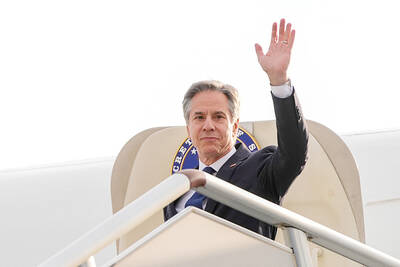
‘IN A DIFFERENT PLACE’: The envoy first visited Shanghai, where he attended a Chinese basketball playoff match, and is to meet top officials in Beijing tomorrow US Secretary of State Antony Blinken yesterday arrived in China on his second visit in a year as the US ramps up pressure on its rival over its support for Russia while also seeking to manage tensions with Beijing. The US diplomat tomorrow is to meet China’s top brass in Beijing, where he is also expected to plead for restraint as Taiwan inaugurates president-elect William Lai (賴清德), and to raise US concerns on Chinese trade practices. However, Blinken is also seeking to stabilize ties, with tensions between the world’s two largest economies easing since his previous visit in June last year. At the
Nearly half of China’s major cities are suffering “moderate to severe” levels of subsidence, putting millions of people at risk of flooding, especially as sea levels rise, according to a study of nationwide satellite data released yesterday. The authors of the paper, published by the journal Science, found that 45 percent of China’s urban land was sinking faster than 3mm per year, with 16 percent at more than 10mm per year, driven not only by declining water tables, but also the sheer weight of the built environment. With China’s urban population already in excess of 900 million people, “even a small portion

UNSETTLING IMAGES: The scene took place in front of TV crews covering the Trump trial, with a CNN anchor calling it an ‘emotional and unbelievably disturbing moment’ A man who doused himself in an accelerant and set himself on fire outside the courthouse where former US president Donald Trump is on trial has died, police said yesterday. The New York City Police Department (NYPD) said the man was declared dead by staff at an area hospital. The man was in Collect Pond Park at about 1:30pm on Friday when he took out pamphlets espousing conspiracy theories, tossed them around, then doused himself in an accelerant and set himself on fire, officials and witnesses said. A large number of police officers were nearby when it happened. Some officers and bystanders rushed

Beijing is continuing to commit genocide and crimes against humanity against Uyghurs and other Muslim minorities in its western Xinjiang province, U.S. Secretary of State Antony Blinken said in a report published on Monday, ahead of his planned visit to China this week. The State Department’s annual human rights report, which documents abuses recorded all over the world during the previous calendar year, repeated language from previous years on the treatment of Muslims in Xinjiang, but the publication raises the issue ahead of delicate talks, including on the war in Ukraine and global trade, between the top U.S. diplomat and Chinese


 RSS
RSS