


South Africa was stunned on Wednesday after its most famous opera singer, Deon van der Walt, was found shot dead on his family's wine estate. The 47-year-old tenor was shot twice in the chest, apparently by his father, in a domestic tragedy that left the opera world distraught and baffled.
Charles van der Walt, 78, was named by police as the main suspect after he was found dead with a single gunshot wound to the temple.
Police declined to speculate on the motive and there were no immediate reports of a feud between father and son, leaving the country guessing as to why it had lost one of its greatest musical talents.
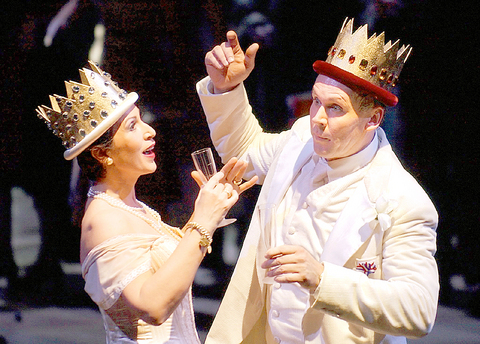
PHOTO: AP
The bodies were found in separate bedrooms of the family home near Paarl, in Western Cape province, on Tuesday afternoon by the singer's mother, Sheila.
The opera world mourned the passing of the first South African to do the "grand slam" of performing at Milan's La Scala, London's Covent Garden, New York's Metropolitan and Vienna's state opera house.
"He had a special gift. He was sensitive and expressive as an artist," said South Africa's culture minister, Pallo Jordan. "Those who knew him speak of his generosity and kindness."
The chief executive of Cape Town's opera, Michael Williams, said the country had lost a role model for what South Africans could accomplish abroad.
Police said their investigation was not yet a murder inquiry and declined to speculate about motives.
"It is alleged the father killed the 47-year-old man, Deon, and then himself," said a spokesman.
The son had gunshot wounds to his chest and the father had a single gunshot wound to his temple. They were thought to have died at about 2pm on Tuesday. Forensic experts were examining a gun removed from the scene. South African media reported that it was found beside the father. The family was expected to issue a statement through lawyers.
Van der Walt never reached the popular acclaim of Placido Domingo or Luciano Pavarotti, but was well known and respected within the opera fraternity.
He made his debut as Jaquino in Fidelio at the Kapstadt opera house while still a music student at the University of Stellenbosch, part of the Afrikaner ivy league. In 1981 he won the international Mozart competition in Salzburg and his career took off with invitations to opera houses and festivals across Europe and the US.
Van der Walt made his Covent Garden debut in 1985 as Almaviva in Rossini's Barber of Seville. He performed at Munich, Barcelona and Hamburg under conductors including Riccardo Muti.
It was the era of apartheid sanctions and white South Africans were not always welcomed abroad, but the easy-going tenor was still able to carve a name for himself. A role as Tamino in The Magic Flute under Sir Georg Solti in 1991, the year after Nelson Mandela was released, earned particular acclaim.
A specialist in recitals, he showed his versatility by moving from Italian to French for the role of Romeo in Gounod's Romeo et Juliette at the Zurich opera house. While on tour in France Van der Walt would sometimes meet his professional golfer brother, Marcel, at vineyards to share their lifelong love of wine.
In 1988 they opened their own wine estate, Veenwouden, specializing in Merlot and Cabernet, in a valley near spectacular views over the Klein-Drakenstein mountains 56km outside Cape Town.

An American scientist convicted of lying to US authorities about payments from China while he was at Harvard University has rebuilt his research lab in Shenzhen, China, to pursue technology the Chinese government has identified as a national priority: embedding electronics into the human brain. Charles Lieber, 67, is among the world’s leading researchers in brain-computer interfaces. The technology has shown promise in treating conditions such as amyotrophic lateral sclerosis and restoring movement in paralyzed people. It also has potential military applications: Scientists at the Chinese People’s Liberation Army have investigated brain interfaces as a way to engineer super soldiers by boosting
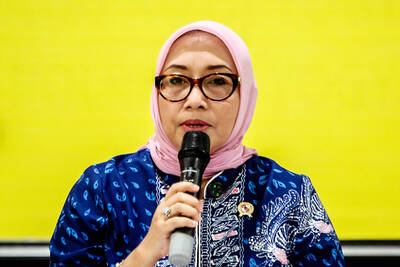
Indonesian police have arrested 13 people after shocking images of alleged abuse against small children at a daycare center went viral, sparking outrage across the nation, officials said on Monday. Police on Friday last week raided Little Aresha, a daycare center in Yogyakarta on Java island, following a report from a former employee. CCTV footage circulating on social media showed children, most younger than two, lying on the floor wearing only diapers, their hands and feet bound with rags. The police have confirmed that the footage is authentic. Police said they also found 20 children crammed into a room just 3m by 3m. “So
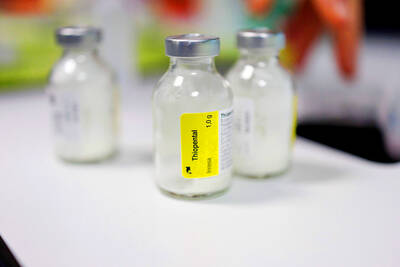
A grieving mother has ended her life at a clinic in Switzerland four years after the death of her only child. Wendy Duffy, 56, a physically healthy woman, died at the Pegasos clinic in Basel after struggling to cope with the death of her 23-year-old son, Marcus. The former care worker, from the West Midlands, England, had previously attempted to take her own life. The case comes as assisted dying would not become law in England and Wales after proposed legislation, branded “hopelessly flawed” by opponents, ran out of time. Ruedi Habegger, the founder of Pegasos, described Duffy’s death as

From post offices and parks to stations and even the summit of Mount Fuji, Japan’s vending machines are ubiquitous, but with the rapid pace of inflation cooling demand for their drinks, operators are being forced to rethink the business. Last month beverage giant DyDo Group Holdings announced it would remove about 20,000 vending machines — about 7 percent of their stock nationwide — by January next year, to “reconstruct a profitable network.” Pokka Sapporo Food & Beverage, based in Nagoya, also said last month it would sell its 40,000-machine operation to Osaka-based Lifedrink Co. “The strength of the vending machine


 RSS
RSS