


Giant snowflakes tumble down outside the Kaikanten bar. Inside, Mustafa Mirreh from Somalia stares down his pool cue, trying to pot the black. His opponent, Italian engineer Pier Luigi Poletto, has turned to the slot machine. The Kilkenny beer has run out. There is only canned Guinness. This could be grounds for a fight, but French fishermen J.P. and Max have been distracted by the rare sight of a woman crossing the floor.
These are the Klondikers of global warming: men from all over the world who have come to Hammerfest, gateway to the Barents Sea, to make their fortune from new resources -- oil, gas, fish and diamonds -- made accessible by the receding ice.
It is the dark season here -- two months from November to January when the sun never rises above the snow-laced rocks around Hammerfest, ice-free thanks to the Gulf stream. In the horseshoe-shaped port, trawlers from all over the world wait for favorable weather to head back into the Barents Sea. Hammerfest, with its colorful wooden houses, feels cosy. But it is a nerve center of the scramble for the Arctic's wealth that raises urgent questions.
The 14 million km2 Arctic Ocean is home to 25 percent of the planet's unextracted oil and natural gas. With a population of 4 million, the region is much more stable than the Middle East. Global warming, in combination with the current high price of oil, makes it ever more accessible. Yet the bordering countries -- Russia, Canada, the US, Norway and Danish Greenland -- have yet to agree on who owns what. Long-forgotten bays, waterways and islands are moving to the top of the international agenda.
Mirreh, 19, has spent eight months as a cleaner at Snow White, a giant liquefied natural gas plant at Hammerfest, one of the world's biggest building sites.
"The wage is ?20 [US$34] an hour. I have saved ?20,000. The problem is there is nothing to do and not enough women," he said.
French trawler skipper Pascal Verdiere has had no trouble filling his Grande Hermine trawler's 250-tonne cod quota.
"Cod likes a water temperature below two degrees, so whereas, three years ago we did our fishing around 75 degrees north, we now have to go as far as 80 degrees, which means Spitzbergen and bad storms," he said.
But each of his 35 crew earns ?15,000 for 12 weeks at sea.
Trawlers are frequently at the center of territorial disputes. Whereas the Antarctic was carved up in 1959, no international treaty exists to determine the extent of each Arctic nation's ownership.
A Russian mine on Svalbard is already extracting high-quality coal. De Beers, the mining giant, and about 60 other prospecting companies are searching for diamonds beneath frozen lakes in northern Canada. In the US, there is pressure to increase oil exploration. A dispute between Denmark and Canada this year over Hans Island -- an uninhabited rock off Greenland -- centers on the potential for oil in the Nares Strait. There are outstanding disputes between the US and Canada over the North West Passage and the Beaufort Sea.
The Russian parliament has yet to ratify a 1990 agreement with the US dividing the Bering Sea. Only a small international body, the Arctic Council, exists to mediate. Its main focus is the welfare of 4 million mainly nomadic people. The only legal tool, the Convention on the Law of the Sea, has not been ratified by the US.
Meanwhile, evidence suggests the Klondikers are right to head north. According to data published last month, the area covered by ice in September -- 5.3 million km2 -- was the lowest since records began in 1978. In August the Akademik Fyodorov became the first ship to reach the North Pole unassisted by an icebreaker.
Opposite the Kaikanten bar, Alf-Birger Olsen sits in the council offices counting the benefits of global warming to the 9,300 population.
"Hammerfest, ice-free all year, was proclaimed a town in 1789. We were a base for polar bear hunters and cod fishermen. But in recent times the Norwegian government had to give people incentives to live in the region," said the trade and industry director.
When talk turns to the Snow White gas project, Olsen's eyes light up.
"Building the plant has required 2,000 people of 57 nationalities ... The population of Hammerfest has increased and dozens of spin-off businesses created," he said.
The project will come on stream in 2007 to deliver 2.4 billion cubic meters of liquefied natural gas to the US and Spain among others.
Property tax paid by Statoil, the company which owns the ?5.8 billion Snow White terminal, has provided funding for a new Arctic Culture Center.
"We are really thankful to Statoil," said culture chief Gerd Hagen, "but this development is not all good. When 2,000 men suddenly descend on a little town, it changes things."

‘IN A DIFFERENT PLACE’: The envoy first visited Shanghai, where he attended a Chinese basketball playoff match, and is to meet top officials in Beijing tomorrow US Secretary of State Antony Blinken yesterday arrived in China on his second visit in a year as the US ramps up pressure on its rival over its support for Russia while also seeking to manage tensions with Beijing. The US diplomat tomorrow is to meet China’s top brass in Beijing, where he is also expected to plead for restraint as Taiwan inaugurates president-elect William Lai (賴清德), and to raise US concerns on Chinese trade practices. However, Blinken is also seeking to stabilize ties, with tensions between the world’s two largest economies easing since his previous visit in June last year. At the

UNSETTLING IMAGES: The scene took place in front of TV crews covering the Trump trial, with a CNN anchor calling it an ‘emotional and unbelievably disturbing moment’ A man who doused himself in an accelerant and set himself on fire outside the courthouse where former US president Donald Trump is on trial has died, police said yesterday. The New York City Police Department (NYPD) said the man was declared dead by staff at an area hospital. The man was in Collect Pond Park at about 1:30pm on Friday when he took out pamphlets espousing conspiracy theories, tossed them around, then doused himself in an accelerant and set himself on fire, officials and witnesses said. A large number of police officers were nearby when it happened. Some officers and bystanders rushed

Beijing is continuing to commit genocide and crimes against humanity against Uyghurs and other Muslim minorities in its western Xinjiang province, U.S. Secretary of State Antony Blinken said in a report published on Monday, ahead of his planned visit to China this week. The State Department’s annual human rights report, which documents abuses recorded all over the world during the previous calendar year, repeated language from previous years on the treatment of Muslims in Xinjiang, but the publication raises the issue ahead of delicate talks, including on the war in Ukraine and global trade, between the top U.S. diplomat and Chinese
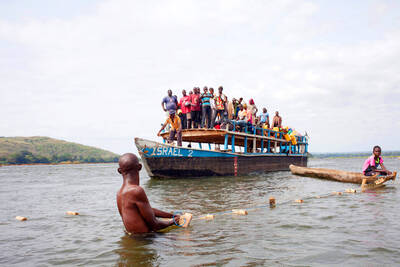
RIVER TRAGEDY: Local fishers and residents helped rescue people after the vessel capsized, while motorbike taxis evacuated some of the injured At least 58 people going to a funeral died after their overloaded river boat capsized in the Central African Republic’s (CAR) capital, Bangui, the head of civil protection said on Saturday. “We were able to extract 58 lifeless bodies,” Thomas Djimasse told Radio Guira. “We don’t know the total number of people who are underwater. According to witnesses and videos on social media, the wooden boat was carrying more than 300 people — some standing and others perched on wooden structures — when it sank on the Mpoko River on Friday. The vessel was heading to the funeral of a village chief in


 RSS
RSS