


After Hurricane Katrina floored this city, there was widespread hope that Mardi Gras would yank New Orleans back to its feet, helping to reclaim its spirit, its tourists and its economy.
The two weeks of Mardi Gras parades and parties have for decades been the city's binding cord, bringing together all segments of society and thousands of outsiders for a mix of the sacred and the profane.
But with planning for the February Carnival season now under way, Mardi Gras has been plagued by harsh financial realities, indecision, lowered expectations and the possibility that this year's parade lineup could be absent some of its most popular krewes, or social clubs.
After the city announced plans for smaller and fewer Mardi Gras parades, dissatisfied krewes protested.
Responding to the pressure, an advisory panel to Mayor Ray Nagin recommended on Wednesday that an additional weekend be included in an abbreviated Mardi Gras parade season.
The mayor is expected to agree to a pre-Lenten Carnival season of eight days, instead of the customary 12, culminating Feb. 28 on Mardi Gras Day [known in English as Fat Tuesday].
Yet while city officials and merchants are desperate for symbols of recovery and renewal, some residents are concerned about the message that will be projected when New Orleans holds a giant party in a hurricane's catastrophic wake.
The coming Mardi Gras will celebrate 150 years of New Orleans's parade tradition and, officials hope, provide a fiscal Bloody Mary for a hung-over economy that has suffered a shutdown of vital tourism and a layoff of half of the municipal work force.
Mardi Gras pumps US$1 billion directly and indirectly into the local economy each year according to city officials.
While Carnival is intended to signal that New Orleans is open for business again, residents say they also need the celebration for themselves, to affirm the city's essence -- a piquant improvisation evident in the food, music, irreverence and self-indulgence.
"If not one tourist comes to town, Mardi Gras will still serve its initial purpose -- entertaining local people," said Ed Muniz, founder and captain of the Krewe of Endymion, which holds one of the largest and most lavish Mardi Gras parades.
"I think the locals need a celebration of life. The funeral has got to end and the recovery has got to begin," he said.
City and Mardi Gras officials say they are confident that the Carnival season can be of high quality. But several issues, mostly financial, remain unresolved.
At a tense planning meeting on Monday, Warren Riley, the acting police superintendent, said his department welcomed Mardi Gras, understood its social and financial importance and could provide adequate protection for paradegoers.
But Riley also said there was no money budgeted to pay overtime to New Orleans's 1,442 police officers. All parades will have to follow one route, down St. Charles Avenue, and each day's parading could last no longer than eight hours, he said.
"We do not have US$5 for overtime," Riley said, explaining that such costs ran as high as US$300,000 to US$400,000 on weekends during Mardi Gras.
The city reconsidered that position on Wednesday, saying it was seeking to raise an additional US$1.5 million to extend Mardi Gras over two weekends and to pay for overtime on several days.
Krewes have agreed to relax a prohibition on corporate sponsorship of Mardi Gras, but say they will not allow corporate logos on floats.
Wednesday's recommendation came after warnings by krewes that 10 parades might be canceled or moved. Muniz, the Endymion captain, said on Monday that plans to trim Mardi Gras were sending a message to tourists "not to come." He threatened to move his parade to adjacent Jefferson Parish.
"I want to be in New Orleans, but if I've got to cut my parade in half, I'm not going to parade in New Orleans," said Muniz, whose krewe has 2,300 members.
On Wednesday, Muniz said he felt assured that overtime money would be raised to accommodate his parade in full.
The Krewe of Zulu, established in 1909 and representing a cross section of African-American society, will decide on Dec. 4 whether to participate in the coming Mardi Gras.
Many of the krewe's 500-plus members lived in the heavily damaged New Orleans East section and remain out of town and out of contact, said Andrew Pete Sanchez, the club's chairman of Carnival activities.
"The feeling is mixed," Sanchez said. "Those who have returned home support participation. Those in opposition want to be able to come home first."
Decorated coconuts thrown by Zulu's members are among the most distinctive and sought-after Mardi Gras trinkets.
"There's no Mardi Gras without Zulu," said Arthur Hardy, a Carnival historian and publisher of a definitive Mardi Gras guide. "They're just too much part of the celebration."
If African-American participation is severely curtailed, Mardi Gras may run the risk of further delineating the class and racial divide exposed after the hurricane.

‘IN A DIFFERENT PLACE’: The envoy first visited Shanghai, where he attended a Chinese basketball playoff match, and is to meet top officials in Beijing tomorrow US Secretary of State Antony Blinken yesterday arrived in China on his second visit in a year as the US ramps up pressure on its rival over its support for Russia while also seeking to manage tensions with Beijing. The US diplomat tomorrow is to meet China’s top brass in Beijing, where he is also expected to plead for restraint as Taiwan inaugurates president-elect William Lai (賴清德), and to raise US concerns on Chinese trade practices. However, Blinken is also seeking to stabilize ties, with tensions between the world’s two largest economies easing since his previous visit in June last year. At the

UNSETTLING IMAGES: The scene took place in front of TV crews covering the Trump trial, with a CNN anchor calling it an ‘emotional and unbelievably disturbing moment’ A man who doused himself in an accelerant and set himself on fire outside the courthouse where former US president Donald Trump is on trial has died, police said yesterday. The New York City Police Department (NYPD) said the man was declared dead by staff at an area hospital. The man was in Collect Pond Park at about 1:30pm on Friday when he took out pamphlets espousing conspiracy theories, tossed them around, then doused himself in an accelerant and set himself on fire, officials and witnesses said. A large number of police officers were nearby when it happened. Some officers and bystanders rushed

Beijing is continuing to commit genocide and crimes against humanity against Uyghurs and other Muslim minorities in its western Xinjiang province, U.S. Secretary of State Antony Blinken said in a report published on Monday, ahead of his planned visit to China this week. The State Department’s annual human rights report, which documents abuses recorded all over the world during the previous calendar year, repeated language from previous years on the treatment of Muslims in Xinjiang, but the publication raises the issue ahead of delicate talks, including on the war in Ukraine and global trade, between the top U.S. diplomat and Chinese
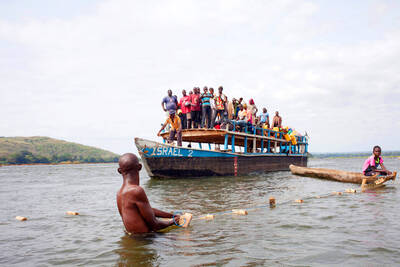
RIVER TRAGEDY: Local fishers and residents helped rescue people after the vessel capsized, while motorbike taxis evacuated some of the injured At least 58 people going to a funeral died after their overloaded river boat capsized in the Central African Republic’s (CAR) capital, Bangui, the head of civil protection said on Saturday. “We were able to extract 58 lifeless bodies,” Thomas Djimasse told Radio Guira. “We don’t know the total number of people who are underwater. According to witnesses and videos on social media, the wooden boat was carrying more than 300 people — some standing and others perched on wooden structures — when it sank on the Mpoko River on Friday. The vessel was heading to the funeral of a village chief in


 RSS
RSS