


China confirmed its second human death from bird flu and Vietnam reported an infection in a 15-year-old boy yesterday, as Japan's Health Ministry warned that local governments had stockpiled only a fraction of the antiviral Tamiflu necessary to fight an outbreak in its citizens.
The latest Chinese fatality was a 35-year-old farmer identified only by her surname, Xu, who died on Tuesday after developing a fever and pneumonia-like symptoms following contact with sick and dead poultry, the official Xinhua news agency said, citing the Health Ministry.
The woman, from Xiuning County in the eastern province of Anhui, tested positive for the H5N1 virus, Xinhua said.
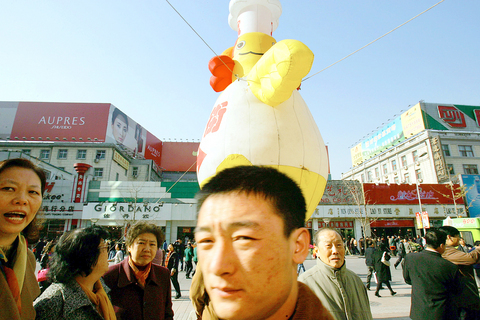
PHOTO: AP
The area is about 100km northwest of Zongyang County, where the country's first human bird flu death was reported.
The 24-year-old woman, also a farmer, died on Nov. 10 with the same symptoms as Xu after coming in contact with sick chickens and ducks at home.
China's only other confirmed human bird flu case was a nine-year-old boy in the central province of Hunan, who fell ill but recovered.
In Vietnam, the country hardest-hit by the disease, health authorities said a 15-year-old boy from northern port city of Haiphong was the latest person to test positive for the deadly H5N1 strain of the virus.
The boy remains hospitalized but was expected to fully recover, said Nguyen Van Binh, deputy director of the Ministry of Health's Preventive Medicine Department.
The Tourism Administration of Vietnam also ordered all tour operators not to take foreigners near areas where bird flu outbreaks have been reported, said Vu The Binh, director of the central Tourism Department.
Meanwhile, Japan's Asahi Shimbun newspaper reported yesterday that current stockpiles of Tamiflu held by 41 of the country's 47 prefectures were sufficient for approximately 37,400 people -- amounting to just 0.4 percent of what the country's Health Ministry has recommended.
The newspaper report was based on interviews with officials overseeing local anti-bird flu efforts.
The ministry's bird flu action plan unveiled on Nov. 15 calls for prefectures to be able to treat 10.5 million people against the disease.
Five prefectures reported no stockpiles at all, the newspaper said, while a sixth did not make its information public.
Bird flu hit Japan last year for the first time in decades. There has been one confirmed human case, but no reported human deaths.
Also yesterday, the state-run China Daily newspaper reported that China was "within days" of testing a bird flu vaccine on people. There are currently no human vaccines against the disease.
China, which has the world's largest number of chickens, has called bird flu a "serious epidemic." Outbreaks in poultry are still being reported almost daily.
The leadership recently made efforts to be more aggressive and open after being reticent about releasing information during its outbreak of severe acute respiratory syndrome.
Meanwhile, a UN food agency said on Wednesday it supports China's launching a massive animal vaccination program to combat bird flu, but cautioned that quality control on vaccines made in China must be assured.
Joseph Domenech, chief veterinary officer at the UN Food and Agriculture Organization, said agency officials would be among those visiting Chinese laboratories to check that correct procedures were being used to manufacture vaccines.
In other news, hundreds of chickens in Indonesia's tsunami-ravaged Aceh province have died of bird flu, the country's agriculture ministry said yesterday.
Chickens have been infected with the H5N1 strain in at least three districts of the province, said Sjamsul Bahri, the Agriculture Ministry's director of animal health.
"Hundreds of chickens have died," he said.

Crowds in Bangladesh are flocking to snap photographs with an unlikely social media star — an albino buffalo with flowing blond hair nicknamed “Donald Trump” that is due to be sacrificed within days. Owner Zia Uddin Mridha, 38, said his brother named the 700kg bull over its flowing helmet of hair resembling the signature look of the US president. “My younger brother picked this name because of the buffalo’s extraordinary hair,” he said at his farm in Narayanganj, just outside the capital, Dhaka. Mridha said that a constant stream of curious visitors — social media fans, onlookers and children — have come throughout

The Bolivian government on Friday struck a deal with protesting miners, but was still grappling with blockades and demonstrations by other workers across La Paz. Other groups are still blocking access roads into the city, which is also the seat of the government. Police on Thursday prevented the miners from entering the main square by using tear gas, while the demonstrators hurled stones and explosives with slingshots. Protests against the policies of Bolivian President Rodrigo Paz have convulsed the Andean nation since early this month, and roadblocks were choking routes into La Paz throughout Friday, the national road authority said. Miners demanded that Paz
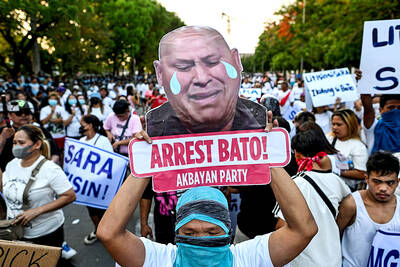
The Philippines said it has asked the country’s Supreme Court to allow it to arrest former Philippine president Rodrigo Duterte’s chief drug war enforcer to stand trial in an international tribunal. The International Criminal Court (ICC) last week unsealed an arrest warrant against Philippine Senator Ronald dela Rosa, accusing him along with Duterte and other “coperpetrators” of the “crime against humanity of murder.” Dela Rosa briefly sought refuge in the Philippine Senate last week while asking the Philippine Supreme Court to stop an ongoing attempt by government agents to arrest him. “By his own conduct, he has placed himself outside the protection of

The researchers in Ireland looked at their computer screen, marveling at a medieval book tracked down in a Roman library. They flipped through its digitized pages and found their sought-after treasure: the oldest surviving English poem. “We were extremely surprised. We were speechless. We couldn’t believe our eyes when we first saw that,” said Elisabetta Magnanti, a visiting research fellow at Trinity College Dublin’s school of English. The poem was also within the main body of Latin text, she said, calling it “extraordinary.” Composed in Old English by a Northumbrian agricultural worker in the 7th century, Caedmon’s Hymn appears within some copies of


 RSS
RSS