


After being held three years without charges, a US citizen who had allegedly planned to build a radioactive "dirty" bomb was charged on Tuesday with aiding terrorists and conspiracy to commit murder, US Attorney General Alberto Gonzales said.
The 11-count federal indictment -- the first brought against Jose Padilla since his arrest on May 8, 2002 -- accused him and four other men of running a US support cell providing money and recruits for a jihad campaign overseas.
It included no reference to previous accusations against Padilla, made with great fanfare by US officials, that he plotted with al-Qaeda to set off a radioactive "dirty bomb" in the US and blow up apartment buildings using natural gas.
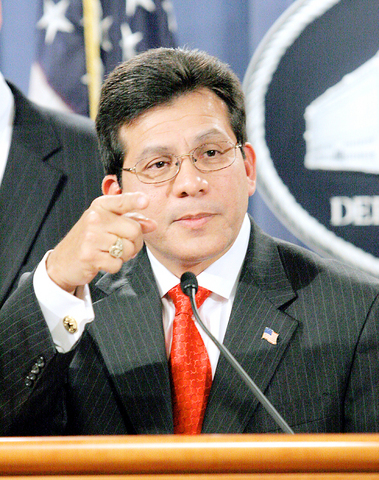
PHOTO: EPA
Padilla was arrested at Chicago's O'Hare International Airport after returning from Pakistan at a time of high alert following the Sept. 11, 2001, attacks, when US troops were fighting al-Qaeda militants and supporters in Afghanistan.
Human rights activists and some lawmakers and lawyers questioned the government's authority to detain him without charges indefinitely as an "enemy combatant." Padilla's lawyers asked the Supreme Court last month to limit this authority.
The main charges against the men were conspiracy to murder, kidnap and maim people in a foreign country; conspiracy to provide material support for terrorists, and providing material support for terrorists -- all between October 1993 and about Nov. 1, 2001. They could face life in prison if convicted.
The indictment said Padilla traveled abroad to receive militant training, but did not say where.
"All of these defendants are alleged members of a violent terrorist support cell that operated in the United States and Canada," Gonzales told a news conference.
Gonzales declined to comment on the previous dirty bomb or apartment bombing claims, saying they were outside Tuesday's indictment. Justice Department officials said the outlined charges did not back away from previous statements and did not rule out other charges in the future.
Padilla's lawyer, Donna Newman, said in New York that her client denied all of the allegations and looked forward to being vindicated at trial.
"We are very happy about this indictment. It's what we've asked for. You don't hold American citizens without charges," Newman said. "Now we can go to court and challenge the government's assertions."
Jennifer Daskal, of advocacy group Human Rights Watch, said the indictment "is a welcome development, albeit three years too late. Anyone picked up outside the combat environment should be charged or released."
As part of the proceedings, US President George W. Bush authorized Padilla's transfer from military to Justice Department control. Gonzales said Padilla was "no longer being detained ... as an enemy combatant."
Padilla, a former Chicago gang member and convert to Islam, had been held as an enemy combatant in a South Carolina military brig under the sweeping presidential powers enacted after the Sept. 11 attacks.
Indicted with him were Adham Amin Hassoun, who is detained in Florida; Mohamed Hesham Youssef, who is in prison in Egypt; Kifah Wael Jayyousi, who is also detained in Florida, and Kassem Daher, who is outside the US.

‘CROSSING THE LINE’: China’s embassy in Seoul criticized US Forces Korea Commander General Xavier Brunson, asking if his ‘hostile’ remarks were authorized by Washington South Korea and the US are in talks over recent public remarks by the commander of US Forces Korea, Seoul’s presidential office said yesterday, after the comments drew sharp criticism from China. In a recent podcast interview, US Forces Korea Commander General Xavier Brunson described South Korea as “the dagger in the heart of Asia” from China’s east coast, prompting the Chinese embassy in Seoul to say that he had “truly crossed the line.” The interview came amid growing speculation that Washington might seek to expand the role of US Forces Korea in countering the growing regional influence of China, a key

SEEKING ORDER: Rodrigo Paz said that ‘anyone who wants to destroy the nation will have to deal with this president and the full force of the constitution’ Bolivian President Rodrigo Paz on Wednesday said that the nation was at a “breaking point” after nearly a month of protests that have caused shortages of food, fuel and medicine. Paz, who took office six months ago amid the worst economic crisis there in four decades, is battling a groundswell of fury over his policies. The political capital, La Paz, has been besieged by low-income workers and members of the indigenous majority calling for his resignation. “The country needs order and is reaching breaking point,” the 58-year-old said at a public event in La Paz, renewing his appeal for dialogue. On Tuesday, the Bolivian

Through the noise of rushing papers and whirring belts at a print factory in Kyoto, two creators watch their photo essay come to life in broadsheet form — part of an effort to win new audiences in the age of artificial intelligence (AI). Despite the decline of the publishing industry, self-publication and handmade “zine” magazines are growing in popularity in Japan, reflecting the nation’s enduring love of paper in the digital era. While speaking to Agence France-Presse at the plant, his hands black with ink, one of the creators, Kazuma Obara, said: “I think [paper] is a medium that engages all five

Australian researchers have trained lab-grown brain cells on a silicon computer chip to play the 1990s shooter game Doom and said they are just scratching the surface of what the neurons could be capable of doing. It is the science-fiction work of biotech boffins at Cortical Labs, who researched and developed the technology that harnesses the workings of the brain’s networking system. Each so-called “biological computer” contains about 200,000 living human brain cells, grown from stem cells that were harvested from blood donations. Having mastered the simple computer game Pong, where a paddle is moved up and down to send a ball


 RSS
RSS