


The UN's chief torture investigator has praised China's leaders for acknowledging the widespread abuse of prisoners in the nation's jails, as he began a historic 12-day fact-finding mission.
Manfred Novak, the UN Human Rights Commission's special rapporteur on torture, said Beijing had offered him freer access to detainees than the US was prepared to give him on a recently scrapped trip to Guantanamo Bay.
"There is a growing awareness that torture is quite widely practised in the common criminal proceedings [in China] by the police and that something needs to be done," Nowak said in an interview with the BBC aired yesterday.
"I see my visit also as part of this growing awareness."
Nowak arrived in Beijing on Monday for an unprecedented trip after receiving government assurances it would cooperate with him and allow him unannounced visits to prisons and private talks with prisoners.
"I'm very grateful to the Chinese government that they did invite me and also that they accepted my terms of reference," he said on the BBC.
"I see this as an opening up of governmental policy in relation to UN special procedures and I had very good first meetings [on Monday] with the officials from the ministry of foreign affairs and justice."
However Nowak did not try to gloss over the widespread human rights abuses in China's jails.
"China is a huge country and it has of course a long tradition of torture and ill treatment and you can't change that from one day to the other, so it is a policy of taking small steps," Nowak said.
"People have been sentenced to death and afterwards it turned out that the `victims' actually were alive, so it was clear that the only reason why they have been sentenced to death and executed was that their confession had been extracted by torture."
Aside from prisons in Beijing, Nowak will visit the Tibetan capital of Lhasa, before going onto Urumqi and Yining in the Uighur Muslim-populated Xinjiang region.
Police in both regions have engaged in long-standing crackdowns on separatism, and human rights groups regularly report widespread abuse of detainees there.
The visit by Nowak, who is the first special rapporteur on torture to visit China, comes after years of negotiations between the UN and China on allowing unfettered access to prisons, private talks with detainees and no retaliation on prisoners.
In the early 1990s, a UN special rapporteur on arbitrary detention visited prisons in Tibet. But prisoners were punished for what they told the investigator, rights group say.
"They were given longer sentences and some were even beaten," Nicholas Becquelin, Hong Kong director for Human Rights in China, said.
"The UN does not want to see this happen again, so that is why it has taken so long to get this visit again."
Nowak said that the terms of reference for his visit to China were better than what the US had offered on a proposed visit to Guantanamo Bay in Cuba, where prisoners from the wars in Iraq and Afghanistan are being held.
"It was made clear by the Pentagon that they would not be willing to accept my terms of reference, so there was no other option than to finally cancel the mission," Nowak said.
Nowak last week cancelled his scheduled Dec. 6 visit to Guantanamo Bay.
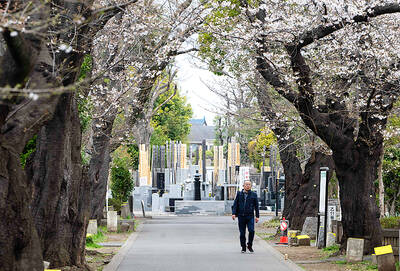
ROCKY RELATIONS: The figures on residents come as Chinese tourist numbers drop following Beijing’s warnings to avoid traveling to Japan The number of Chinese residents in Japan has continued to rise, even as ties between the two countries have become increasingly fractious, data released on Friday showed. As of the end of December last year, the number of Chinese residents had increased by 6.5 percent from the previous year to 930,428. Chinese people accounted for 22.6 percent of all foreign residents in Japan, making them by far the largest group, Japanese Ministry of Justice data showed. Beijing has criticized Tokyo in increasingly strident terms since Japanese Prime Minister Sanae Takaichi last year suggested that a military conflict around Taiwan could

A retired US colonel behind a privately financed rocket launch site in the Dominican Republic sees the project as a response to China’s dominance of the space race in Latin America. Florida-based Launch on Demand is slated to begin building a US$600 million facility in a remote region near the border with Haiti late this year. The project is designed to meet surging demand for the heavy-lift rockets needed to put clusters of satellites into orbit. It is also an answer to China’s growing presence in the region, said CEO Burton Catledge, a former commander of the US Air Force’s 45th Operations

Germany is considering Australia’s Ghost Bat robot fighter as it looks to select a combat drone to modernize its air force, German Minister of Defense Boris Pistorius said yesterday. Germany has said it wants to field hundreds of uncrewed fighter jets by 2029, and would make a decision soon as it considers a range of German, European and US projects developing so-called “collaborative combat aircraft.” Australia has said it will integrate the Ghost Bat, jointly developed by Boeing Australia and the Royal Australian Air Force, into its military after a successful weapons test last year. After inspecting the Ghost Bat in Queensland yesterday,
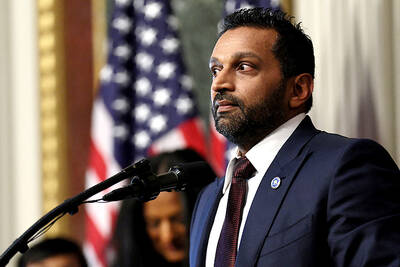
A pro-Iran hacking group claimed to breach FBI Director Kash Patel’s personal e-mail inbox and posted some of the contents online. The e-mails provided by the hacking group include travel details, correspondence with leasing agents in Washington and global entry, and loyalty account numbers. The e-mail address the hackers claim to have compromised has been previously tied to Patel’s personal details, and the leaked e-mails contain photos of Patel and others, in addition to correspondence with family members and colleagues. “The FBI is aware of malicious actors targeting Director Patel’s personal email information,” the agency said in a statement on


 RSS
RSS