


As the teacher, a career Chinese diplomat, spoke, his class of African diplomats scribbled furiously. At the UN, China opposed the US invasion of Iraq and has defended the right of Iran and other developing countries to use civilian nuclear power, said the teacher, Yuan Shibin. China, he noted pointedly, swept aside US objections to making an African the secretary-general.
There was nothing subtle about his message, which will be repeatedly hammered home to the African diplomats during their three month, all-expenses paid stay at the Foreign Affairs University here.
"China will always protect its own interests as well as those of other developing countries," Yuan said. By contrast, "US national interests are not often in conformity with those of other nations, including China."
The classes are one element in a campaign by Beijing to win friends around the world and pry developing nations out of the US' sphere of influence. Africa, with its immense oil and mineral wealth and numerous UN votes, lies at the heart of that effort. Since 2000, Chinese trade with Africa has more than tripled, reaching nearly US$30 billion in 2004. Beijing has signed at least 40 oil agreements with various African countries. Medical teams from China are training counterparts in numerous African countries and providing free equipment and drugs to help fight AIDS, malaria and other scourges.
"China is making a determined effort to make sure that its interests are represented," said Drew Thompson, a China scholar at the Center for Strategic and International Studies in Washington.
"They are making sure they have a seat at the table, and that their relationships are comprehensive and not just economic. It isn't competitive in the way the Cold War was. It's more a case of seeing to it that their message is on one of the many cable channels out there," he added.
China's attempts to cultivate African ties date to the earliest days of the independence era on the continent, when Beijing armed and trained liberation movements and sent its workers by the thousands to build roads, railways and stadiums. Today, Chinese bankers and oil executives are as common a sight as Westerners in many African capitals.
Meanwhile, several Chinese ministries, including science and technology, agriculture, commerce and education, are working with African governments to train officials and develop human resources.
While the aid seems aimed at winning African hearts, the classes in diplomacy, constantly refined over the past decade, seem aimed more at swaying African minds. Also, to impart a sympathetic view of China, they put forth a distinctly Chinese view of the world about everything from economic development and history to democracy.
"Soft power is said to be coercive, persuading people to do what you'd like them to do, as opposed to hard power, which means forcing them to do what you want to do," said Qin Yaqing, vice president of the Foreign Affairs University, a state-run school that trains China's own diplomats and works with foreign trainees. "In traditional Chinese philosophy we have something similar to this, and it is called moral attraction."
China's appeal to Africa and much of the Third World centers on the idea that nations will be drawn to an emerging superpower that does not lecture them about democracy and human rights or otherwise interfere in what Beijing construes as "internal affairs."
The other pole of attraction is, of course, China's remarkable quarter century of economic performance, which has lifted it from the ranks of the poorest to make it one of the world's largest and most powerful economies.
For developing countries, many of which have grown disenchanted with the so-called Washington consensus, a mixture of lowered trade barriers, privatization, democracy and free markets, there is intense interest in trying to learn from China. There is increasing talk of a rival "Beijing Consensus," which emphasizes innovation and growth through a social-market economy, placing less emphasis on free markets and democracy. China denies it's promoting a competing program.
"Yes, a lot of African countries have been coming to China," said Liu Jianchao (

When a hiker fell from a 55m waterfall in wild New Zealand bush, rescuers were forced to evacuate the badly hurt woman without her dog, which could not be found. After strangers raised thousands of dollars for a search, border collie Molly was flown to safety by a helicopter pilot who was determined to reunite the pet and the owner. A week earlier, an emergency rescue helicopter found the woman with bruises and lacerations after a fall at a rocky spot at the waterfall on the South Island’s West Coast. She was airlifted on March 24, but they were forced to
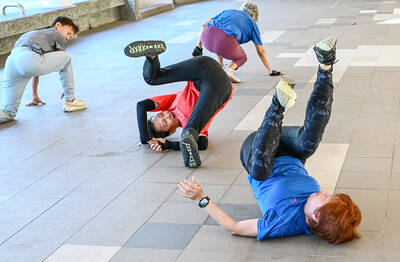
CONFIDENCE BOOSTER: ’After parkour ... you dare to do a lot of things that you think only young people can do,’ a 67-year-old parkour enthusiast said In a corner of suburban Singapore, Betty Boon vaults a guardrail, crawls underneath a slide, executes forward shoulder rolls and scales a steep slope, finishing the course to applause. “Good job,” the 69-year-old’s coach cheers. This is “geriatric parkour,” where about 20 retirees learned to tackle a series of relatively demanding exercises, building their agility and enjoying a sense of camaraderie. Boon, an upbeat grandmother, said learning parkour has aided her confidence and independence as she ages. “When you’re weak, you will be dependent on someone,” she said after sweating it out with her parkour classmates in suburban Toa Payoh,
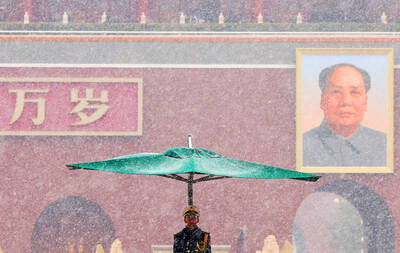
Chinese dissident artist Gao Zhen (高兟), famous for making provocative satirical sculptures of former Chinese leader Mao Zedong (毛澤東), was tried on Monday over accusations of “defaming national heroes and martyrs,” his wife and a rights group said. Gao, 69, who was detained in 2024 during a visit from the US, faces a maximum three-year prison sentence, said his wife, Zhao Yaliang (趙雅良), and Shane Yi, a researcher at the Chinese Human Rights Defenders group which operates outside the nation. The closed-door, one-day trial took place at Sanhe City People’s Court in Hebei Province neighboring the capital, Beijing, and ended without a
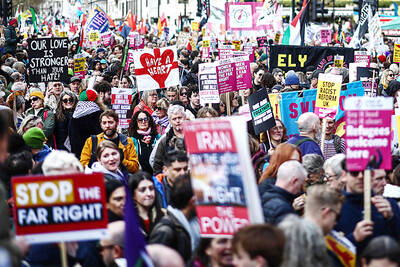
‘TOXIC CLIMATE’: ‘I don’t really recognize Labour anymore... The idea that you can implement far-right ideas in order to stop the far right is nonsense,’ a protester said Tens of thousands of people on Saturday marched through central London to protest against the far right, weeks ahead of local elections and six months after Britain saw one of its largest far-right demonstrations. Organized by hundreds of civic groups, including trade unions, anti-racism campaigners and Muslim representative bodies, Saturday’s Together Alliance event was billed as the biggest in UK history to counter right-wing extremism. A separate pro-Palestinian march had also converged with the main rally. While organizers claimed 500,000 had turned out in total, the police gave a figure of about 50,000. Protesters carrying placards with slogans such as


 RSS
RSS