


Troubled by news accounts of medical participation in coercive interrogations at Guantanamo Bay and the resulting unease in the professional medical community, the Pentagon led an intense one-day tour of the detention camp last month, several participants said in recent days.
The purpose of the trip last Oct. 19, some of the participants said, was for the military leadership to convince the ethicists, psychiatrists, psychologists and others who visited the detention camp at the US Naval Station in Guantanamo Bay, Cuba, that what was occurring there did not violate medical ethics and was necessary to strengthen the nation's security.
But many participants seem not to have been convinced.
Steven Sharfstein, president of the American Psychiatric Association, who went on the trip, said that the group's members' assembly voted unanimously on Saturday to recommend a strict code against participation in some of the activities described in news reports.
Sharfstein said that the recommendation was certain to be adopted by the association's board next month, making it official policy.
He said the main concern was the use of military psychiatrists as members of Behavioral Science Consultation Teams, known as biscuit teams, to advise interrogators at Guantanamo.
"Our position is very direct," he said. "Psychiatrists should not participate on these biscuit teams because it is inappropriate."
He said the military hosts, who included the commanding general at Guantanamo, the US surgeon general and the medical personnel at Guantanamo, said they had sought to use psychiatrists and psychologists only for advice aimed at building rapport with detainees during interrogation. They said the professional advice was not used to harm detainees.
That description is at odds with some news accounts.
The New York Times reported in June that former interrogators at Guantanamo had described in interviews how military doctors had helped them in refining coercive interrogations, including providing advice on how to increase stress levels and exploit fears.
Pentagon officials have not made medical personnel available for interviewss, but have said they believe that military doctors are not asked to do anything that violates professional ethics.
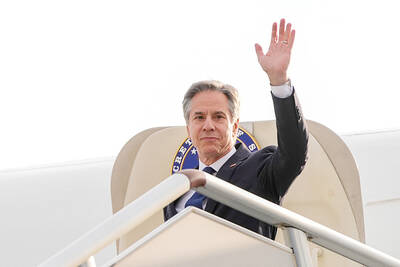
‘IN A DIFFERENT PLACE’: The envoy first visited Shanghai, where he attended a Chinese basketball playoff match, and is to meet top officials in Beijing tomorrow US Secretary of State Antony Blinken yesterday arrived in China on his second visit in a year as the US ramps up pressure on its rival over its support for Russia while also seeking to manage tensions with Beijing. The US diplomat tomorrow is to meet China’s top brass in Beijing, where he is also expected to plead for restraint as Taiwan inaugurates president-elect William Lai (賴清德), and to raise US concerns on Chinese trade practices. However, Blinken is also seeking to stabilize ties, with tensions between the world’s two largest economies easing since his previous visit in June last year. At the

UNSETTLING IMAGES: The scene took place in front of TV crews covering the Trump trial, with a CNN anchor calling it an ‘emotional and unbelievably disturbing moment’ A man who doused himself in an accelerant and set himself on fire outside the courthouse where former US president Donald Trump is on trial has died, police said yesterday. The New York City Police Department (NYPD) said the man was declared dead by staff at an area hospital. The man was in Collect Pond Park at about 1:30pm on Friday when he took out pamphlets espousing conspiracy theories, tossed them around, then doused himself in an accelerant and set himself on fire, officials and witnesses said. A large number of police officers were nearby when it happened. Some officers and bystanders rushed

Beijing is continuing to commit genocide and crimes against humanity against Uyghurs and other Muslim minorities in its western Xinjiang province, U.S. Secretary of State Antony Blinken said in a report published on Monday, ahead of his planned visit to China this week. The State Department’s annual human rights report, which documents abuses recorded all over the world during the previous calendar year, repeated language from previous years on the treatment of Muslims in Xinjiang, but the publication raises the issue ahead of delicate talks, including on the war in Ukraine and global trade, between the top U.S. diplomat and Chinese

RIVER TRAGEDY: Local fishers and residents helped rescue people after the vessel capsized, while motorbike taxis evacuated some of the injured At least 58 people going to a funeral died after their overloaded river boat capsized in the Central African Republic’s (CAR) capital, Bangui, the head of civil protection said on Saturday. “We were able to extract 58 lifeless bodies,” Thomas Djimasse told Radio Guira. “We don’t know the total number of people who are underwater. According to witnesses and videos on social media, the wooden boat was carrying more than 300 people — some standing and others perched on wooden structures — when it sank on the Mpoko River on Friday. The vessel was heading to the funeral of a village chief in


 RSS
RSS