


South Asian leaders, holding a summit in the Bangladeshi capital yesterday, acknowledged their regional forum has achieved little in 20 years and needed to be overhauled.
The 13th summit of the South Asian Association for Regional Cooperation (SAARC) is also being held in the shadow of a blunt warning by India that failed states could emerge in the region, one of the poorest in the world
"The honest answer is that regional economic cooperation in South Asia has fallen far short of our expectations," Indian Prime Minister Manmohan Singh said.
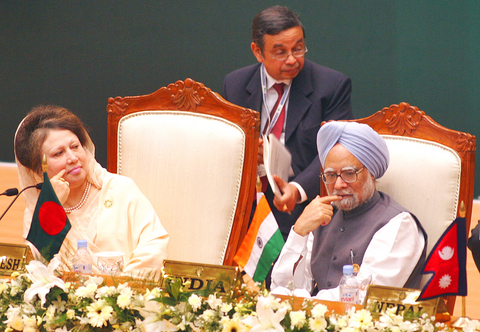
PHOTO: AP
"We cannot be the crossroads of Asia but remain disconnected within our own region," he added.
The SAARC includes India, Pakistan, Bangladesh, Sri Lanka, Nepal, Bhutan and the Maldives -- a region which is home to 1.5 billion people, about a third of whom live in poverty.
India has about 70 percent of SAARC's people, wealth and land area. But its differences with other members, notably Pakistan, have hurt any effectiveness the group might have had.
"Factors affecting effective regional cooperation are mindsets and perceptions emanating from the past," said Bangladeshi Prime Minister Khaleda Zia.
She said the group had to look beyond rifts among members and move toward economic cooperation, even without political progress.
SAARC was formed in 1985, but its aim of bringing regional prosperity through cooperation has failed to get off the ground. It has taken few multilateral initiatives, and many of its summits have been postponed, at times for years, because of discord among members.
On Friday, shortly before leaving for Dhaka, Singh made an unusually blunt criticism of security in South Asia.
"The danger of a number of failed states emerging in our neighborhood has far-reaching consequences for our region and our people," he said.
"We see signs of the ills of disaffection, alienation and conflict not only in India, but also across our neighborhood," he said.
Singh did not refer to a specific country, but much of Nepal is in the grip of Maoist rebels while both Pakistan and Bangladesh have been fighting Islamic militancy.
The South Asian leaders are expected to sign agreements on setting up a disaster management center in India and are also likely to put the finishing touches to an earlier decision to set up a free trade area in SAARC from next year.
Also on the agenda this year are proposals to allow Afghanistan to join as a member and give China observer status.

‘IN A DIFFERENT PLACE’: The envoy first visited Shanghai, where he attended a Chinese basketball playoff match, and is to meet top officials in Beijing tomorrow US Secretary of State Antony Blinken yesterday arrived in China on his second visit in a year as the US ramps up pressure on its rival over its support for Russia while also seeking to manage tensions with Beijing. The US diplomat tomorrow is to meet China’s top brass in Beijing, where he is also expected to plead for restraint as Taiwan inaugurates president-elect William Lai (賴清德), and to raise US concerns on Chinese trade practices. However, Blinken is also seeking to stabilize ties, with tensions between the world’s two largest economies easing since his previous visit in June last year. At the
Nearly half of China’s major cities are suffering “moderate to severe” levels of subsidence, putting millions of people at risk of flooding, especially as sea levels rise, according to a study of nationwide satellite data released yesterday. The authors of the paper, published by the journal Science, found that 45 percent of China’s urban land was sinking faster than 3mm per year, with 16 percent at more than 10mm per year, driven not only by declining water tables, but also the sheer weight of the built environment. With China’s urban population already in excess of 900 million people, “even a small portion

UNSETTLING IMAGES: The scene took place in front of TV crews covering the Trump trial, with a CNN anchor calling it an ‘emotional and unbelievably disturbing moment’ A man who doused himself in an accelerant and set himself on fire outside the courthouse where former US president Donald Trump is on trial has died, police said yesterday. The New York City Police Department (NYPD) said the man was declared dead by staff at an area hospital. The man was in Collect Pond Park at about 1:30pm on Friday when he took out pamphlets espousing conspiracy theories, tossed them around, then doused himself in an accelerant and set himself on fire, officials and witnesses said. A large number of police officers were nearby when it happened. Some officers and bystanders rushed

Beijing is continuing to commit genocide and crimes against humanity against Uyghurs and other Muslim minorities in its western Xinjiang province, U.S. Secretary of State Antony Blinken said in a report published on Monday, ahead of his planned visit to China this week. The State Department’s annual human rights report, which documents abuses recorded all over the world during the previous calendar year, repeated language from previous years on the treatment of Muslims in Xinjiang, but the publication raises the issue ahead of delicate talks, including on the war in Ukraine and global trade, between the top U.S. diplomat and Chinese


 RSS
RSS