


They are gathered, as every night, on the edge of the car park at the foot of the block. Far enough into the shadows not to be easily seen; close enough to the stairwell to leg it inside if the police come near.
Sylla, Sossa, Karim, Rachid, Mounir and Samir are the names they give. The oldest is 21, the youngest 15. One is an apprentice plumber; another is on work experience as a cook at a cafe in nearby Aulnay-sous-Bois; one is claiming benefit; two are (sort of) at school. Three are "known to the police."
This estate, the Rougemont in Sevran, about 25km north of Paris, was one of the first to flare in France's outbreak of rolling urban violence.
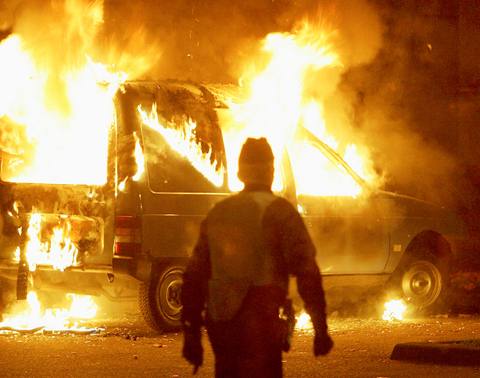
PHOTO: EPA
There are many reasons for the violence.
"Because we hate, because we're mad, because we've had it up to here," said Rachid, parka hood up against the cold. "Look around you. This place is shit, it's a dump. We have nothing here. There's nothing for us."
Sylla, 18, has a more specific target for his rage.
"Les keufs, man, the cops. They're Sarkozy's and Sarkozy must go, he has to shut his mouth, say sorry or just fuck off. He shows no respect. He calls us animals, he says he'll clean the cities with a power hose. He's made it worse, man. Every car that goes up, that's one more message for him."
The interior minister's forces, of which there are some 9,500 on duty around the country, are loathed.
"They harass you, they hassle you, they insult you the whole time, ID checks now, scooter checks next. They call you nigger names," said Karim, 17. "I got caught the other week smoking on the train. Ok, you shouldn't smoke on the train. But we get to Aulnay station, there are six cops waiting for us, three cars. They did the search, they had me with my hands on the roof of the car. One said: `Go back home, Arab. Screw your race.'"
On Monday, the government approved emergency measures imposing curfews at local authorities' discretion.
On the streets after midnight on Monday, the measure provoked disbelief.
"It's bad, it's really serious," said Djaoued, 21, a couple of kilometers away near the Chene-Pointu estate in Clichy-sous-Bois, where the riots began on Oct. 27.
"On the radio they said the last time they used that law was in the Algerian war. Is that stupid or what? Ninety percent of the people who live here are Arabs. What does that tell them? Fifty years later, you're still different? We're not allowed outside, and everyone else is?"
Back in Sevran, someone was attempting to set fire to George-Brassens college. Sirens wailed as half a dozen police cars and fire engines screamed along the Avenue Andre Rousseau.
"It's so easy," said Ali, 16. "You need a beer bottle, a bit of petrol or white spirit, a strip of rag and a lighter. Cars are better, though, when the tank goes. One of you smashes a window, the other lobs the bottle."
Ali's friend was an Arsenal fan.
"Thierry Henry, man! But he never scores for France." Does he feel French? "We hate France and France hates us," he spat, refusing to give even his first name. "I don't know what I am. Here's not home; my gran's in Algeria. But in any case France is just fucking with us. We're like mad dogs, you know? We bite everything we see. Go back to Paris, man."
Sylla summed it up.
"We burn because it's the only way to make ourselves heard, because it's solidarity with the rest of the non-citizens in this country, with this whole underclass," he said.
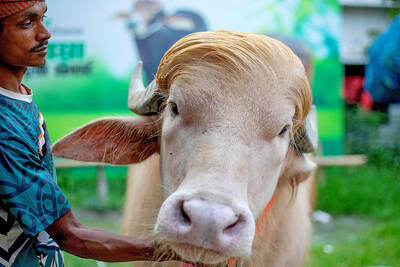
Crowds in Bangladesh are flocking to snap photographs with an unlikely social media star — an albino buffalo with flowing blond hair nicknamed “Donald Trump” that is due to be sacrificed within days. Owner Zia Uddin Mridha, 38, said his brother named the 700kg bull over its flowing helmet of hair resembling the signature look of the US president. “My younger brother picked this name because of the buffalo’s extraordinary hair,” he said at his farm in Narayanganj, just outside the capital, Dhaka. Mridha said that a constant stream of curious visitors — social media fans, onlookers and children — have come throughout
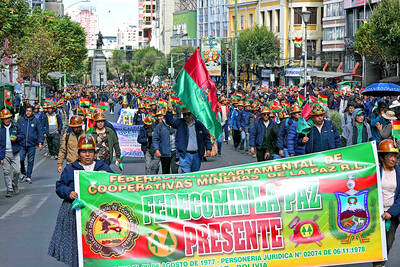
The Bolivian government on Friday struck a deal with protesting miners, but was still grappling with blockades and demonstrations by other workers across La Paz. Other groups are still blocking access roads into the city, which is also the seat of the government. Police on Thursday prevented the miners from entering the main square by using tear gas, while the demonstrators hurled stones and explosives with slingshots. Protests against the policies of Bolivian President Rodrigo Paz have convulsed the Andean nation since early this month, and roadblocks were choking routes into La Paz throughout Friday, the national road authority said. Miners demanded that Paz
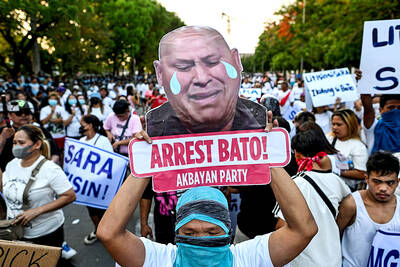
The Philippines said it has asked the country’s Supreme Court to allow it to arrest former Philippine president Rodrigo Duterte’s chief drug war enforcer to stand trial in an international tribunal. The International Criminal Court (ICC) last week unsealed an arrest warrant against Philippine Senator Ronald dela Rosa, accusing him along with Duterte and other “coperpetrators” of the “crime against humanity of murder.” Dela Rosa briefly sought refuge in the Philippine Senate last week while asking the Philippine Supreme Court to stop an ongoing attempt by government agents to arrest him. “By his own conduct, he has placed himself outside the protection of
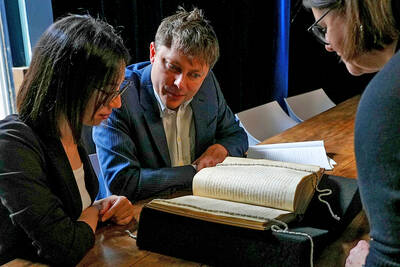
The researchers in Ireland looked at their computer screen, marveling at a medieval book tracked down in a Roman library. They flipped through its digitized pages and found their sought-after treasure: the oldest surviving English poem. “We were extremely surprised. We were speechless. We couldn’t believe our eyes when we first saw that,” said Elisabetta Magnanti, a visiting research fellow at Trinity College Dublin’s school of English. The poem was also within the main body of Latin text, she said, calling it “extraordinary.” Composed in Old English by a Northumbrian agricultural worker in the 7th century, Caedmon’s Hymn appears within some copies of


 RSS
RSS