


Thousands of protesters set off on a march through Azerbaijan's capital yesterday, answering the call by Azerbaijan's main opposition movement to come into the streets to defend their right to free and fair elections.
The protest was the first test of the opposition's ability to mobilize supporters following last week-end's flawed parliamentary elections, and the movement hoped it would generate unstoppable mom-entum. However, only several thousand people took part at the march's beginning, far short of the 30,000 to 50,000 the opposition had hoped to assemble. Others could join the march as it approaches one of the city's main squares.
The rally, which authorities have limited to three hours, is likely to provide several gauges of how the political climate will develop: how many supporters the opposition can marshal, whether their anger explodes into confrontation with police and how harshly security forces respond to any unauthorized actions.
Quiet walk
The march began calmly, with participants walking quietly down a four-lane road closed off to traffic.
"The opposition will try to mount continual protests," participant Siyasat Huseynov of the Liberal Party said. "No doubt there will be official repression, as always."
The opposition coalition Azadliq that called for the march is trying to emulate the movements that brought opposition leaders to power after disputed elections in Georgia and Ukraine, and many of yesterday's marchers were waving flags of orange, the emblematic color of last year's massive protests in Ukraine.
Yet it lacks some of the key strengths that bolstered protests in other ex-Soviet republics: the skillful organization that carried the day in Ukraine and the wide popular allegiance the leaders enjoyed in Georgia.
The government clearly has the upper hand, including a tight grip on state media and control over some 30 percent of the jobs in the country, analysts say.
Azadliq planned a 3km march from a subway station on the outskirts of the capital Baku, to Gelebe Square.
"People are afraid to go to this rally," said Fargana Abdulayeva, a 24-year-old interpreter and opposition supporter in Baku. "People who have government jobs are afraid of losing them."
Tariyel Akhanshev, a 19-year old disc jockey, said he hadn't bothered to vote and would not join the protest.
"What will it change?" he asked.
The government of President Ilham Aliev -- as that of his late father Geidar Aliev before him -- has persecuted the opposition, banning demonstrations, jailing its activists and directing state-run television to smear its leaders. He has accused one opposition leader in exile, Rasul Guliyev, of masterminding a coup attempt last month.
Claimed victory
The ruling New Azerbaijan Party on Tuesday claimed the victory, winning 63 of the 125 seats in the legislature, according to preliminary official results.
The opposition did chalk up some victories, however. The Central Election Commission annulled the results of Sunday's vote in two electoral districts and ordered a recount in a third.
The races earlier had been declared won by pro-government candidates.
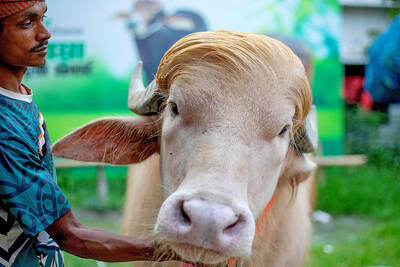
Crowds in Bangladesh are flocking to snap photographs with an unlikely social media star — an albino buffalo with flowing blond hair nicknamed “Donald Trump” that is due to be sacrificed within days. Owner Zia Uddin Mridha, 38, said his brother named the 700kg bull over its flowing helmet of hair resembling the signature look of the US president. “My younger brother picked this name because of the buffalo’s extraordinary hair,” he said at his farm in Narayanganj, just outside the capital, Dhaka. Mridha said that a constant stream of curious visitors — social media fans, onlookers and children — have come throughout
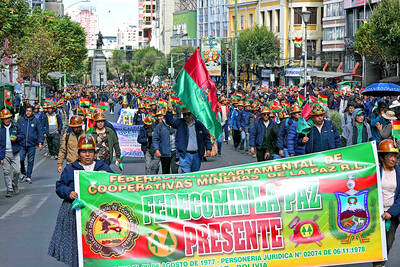
The Bolivian government on Friday struck a deal with protesting miners, but was still grappling with blockades and demonstrations by other workers across La Paz. Other groups are still blocking access roads into the city, which is also the seat of the government. Police on Thursday prevented the miners from entering the main square by using tear gas, while the demonstrators hurled stones and explosives with slingshots. Protests against the policies of Bolivian President Rodrigo Paz have convulsed the Andean nation since early this month, and roadblocks were choking routes into La Paz throughout Friday, the national road authority said. Miners demanded that Paz
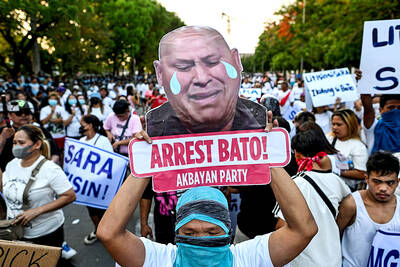
The Philippines said it has asked the country’s Supreme Court to allow it to arrest former Philippine president Rodrigo Duterte’s chief drug war enforcer to stand trial in an international tribunal. The International Criminal Court (ICC) last week unsealed an arrest warrant against Philippine Senator Ronald dela Rosa, accusing him along with Duterte and other “coperpetrators” of the “crime against humanity of murder.” Dela Rosa briefly sought refuge in the Philippine Senate last week while asking the Philippine Supreme Court to stop an ongoing attempt by government agents to arrest him. “By his own conduct, he has placed himself outside the protection of

The researchers in Ireland looked at their computer screen, marveling at a medieval book tracked down in a Roman library. They flipped through its digitized pages and found their sought-after treasure: the oldest surviving English poem. “We were extremely surprised. We were speechless. We couldn’t believe our eyes when we first saw that,” said Elisabetta Magnanti, a visiting research fellow at Trinity College Dublin’s school of English. The poem was also within the main body of Latin text, she said, calling it “extraordinary.” Composed in Old English by a Northumbrian agricultural worker in the 7th century, Caedmon’s Hymn appears within some copies of


 RSS
RSS