


US President George W. Bush on Monday declined to comment on reports of secret US prisons for terrorism suspects but defended US interrogation tactics, declaring: "We do not torture."
Amid reports that senior aides have been lobbying lawmakers to exempt the CIA from limits on aggressive questioning, Bush said he was "working with Congress" to "make it possible -- more possible -- to do our job."
"Our country is at war, and our government has the obligation to protect the American people," he said. "Anything we do to that end, in that effort, any activity we conduct, is within the law. We do not torture."
The Washington Post reported last week the CIA was holding al-Qaeda suspects in secret prisons in eight countries, including Thailand, Afghanistan and "several democracies in eastern Europe," after the Sept. 11, 2001, attacks.
Bush's comments came after he met here with Panamanian President Martin Torrijos, while in Washington the US Supreme Court said it would take up the legality of special military courts for terrorism suspects.
US officials, who insist they have been transparent in dealing with high-profile abuse cases like the Abu Ghraib prison scandal in Iraq, have refused to confirm or deny the existence of the secret prisons.
"There are things that go on that you just can't talk about, which are classified," deputy State Department spokesman Adam Ereli said on Monday. "And I'm not in a position to talk about those sorts of things."
"I don't know any country that wages a war completely out in the open, its belief and commitment to transparency notwithstanding," Ereli told the department's daily briefing.
The Post reported on Monday the emergence of rifts within the Bush administration over the handling of terrorist suspects, pitting hardline Vice President Dick Cheney against officials such as Secretary of State Condoleezza Rice. It said Rice argued that the issue was costing Washington the moral high ground and hurting US public diplomacy around the world. But Ereli sought to play down the impression of a divided Cabinet.
"Those quoted in the article do not speak for the secretary of state, and more importantly, they do not reflect her views," he said. The spokesman would not elaborate.
The White House has been locked in a legislative battle with Republican Senator John McCain, who plans to seek the presidency in 2008 and said on Sunday that he would keep fighting for his proposal to ban torture.
The senator's amendment, which was inspired by Abu Ghraib and other damaging episodes, would "prohibit cruel, inhuman and degrading treatment of persons in the detention of the US government."
The US Senate last week voted 90-9 to attach the measure to a defense spending bill. But the House of Representatives version of the bill lacks the provision, and Bush has threatened to veto the legislation.
Cheney has led a lobbying effort against the measure, and the White House has repeatedly said the legislation is unnecessary because the US abides by international rules, like the Geneva Convention, that prohibit torture.
McCain said the measure was critical to repair the US image abroad in the wake of detainee abuse scandals in Iraq and elsewhere and an explicit ban would help US soldiers on the front lines.
"Our image in the world is suffering very badly, and one of the reasons for it is the perception that we abuse people that we take captive," McCain told Fox News television.
UN Special Rapporteur on Torture Manfred Nowak has urged the EU to investigate the Washington Post report on secret CIA prisons.
US-based independent watchdog Human Rights Watch (HRW) said it was "practically convinced" that such detention centers existed, at least in Poland and Romania.

‘IN A DIFFERENT PLACE’: The envoy first visited Shanghai, where he attended a Chinese basketball playoff match, and is to meet top officials in Beijing tomorrow US Secretary of State Antony Blinken yesterday arrived in China on his second visit in a year as the US ramps up pressure on its rival over its support for Russia while also seeking to manage tensions with Beijing. The US diplomat tomorrow is to meet China’s top brass in Beijing, where he is also expected to plead for restraint as Taiwan inaugurates president-elect William Lai (賴清德), and to raise US concerns on Chinese trade practices. However, Blinken is also seeking to stabilize ties, with tensions between the world’s two largest economies easing since his previous visit in June last year. At the

UNSETTLING IMAGES: The scene took place in front of TV crews covering the Trump trial, with a CNN anchor calling it an ‘emotional and unbelievably disturbing moment’ A man who doused himself in an accelerant and set himself on fire outside the courthouse where former US president Donald Trump is on trial has died, police said yesterday. The New York City Police Department (NYPD) said the man was declared dead by staff at an area hospital. The man was in Collect Pond Park at about 1:30pm on Friday when he took out pamphlets espousing conspiracy theories, tossed them around, then doused himself in an accelerant and set himself on fire, officials and witnesses said. A large number of police officers were nearby when it happened. Some officers and bystanders rushed

Beijing is continuing to commit genocide and crimes against humanity against Uyghurs and other Muslim minorities in its western Xinjiang province, U.S. Secretary of State Antony Blinken said in a report published on Monday, ahead of his planned visit to China this week. The State Department’s annual human rights report, which documents abuses recorded all over the world during the previous calendar year, repeated language from previous years on the treatment of Muslims in Xinjiang, but the publication raises the issue ahead of delicate talks, including on the war in Ukraine and global trade, between the top U.S. diplomat and Chinese
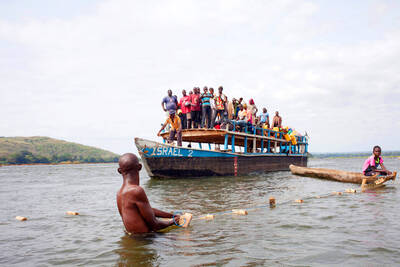
RIVER TRAGEDY: Local fishers and residents helped rescue people after the vessel capsized, while motorbike taxis evacuated some of the injured At least 58 people going to a funeral died after their overloaded river boat capsized in the Central African Republic’s (CAR) capital, Bangui, the head of civil protection said on Saturday. “We were able to extract 58 lifeless bodies,” Thomas Djimasse told Radio Guira. “We don’t know the total number of people who are underwater. According to witnesses and videos on social media, the wooden boat was carrying more than 300 people — some standing and others perched on wooden structures — when it sank on the Mpoko River on Friday. The vessel was heading to the funeral of a village chief in


 RSS
RSS