


British Prime Minister Tony Blair was under pressure to reassert his authority yesterday after he suffered one of the worst days in his eight years in office.
Nearly six months after comfortably winning a third successive election, Blair faced a barrage of front pages saying his authority had slumped during his "day from hell."
In a double blow on Wednesday, Blair endured a revolt in parliament over his proposed anti-terrorism plans and saw his key ally David Blunkett resign from government.
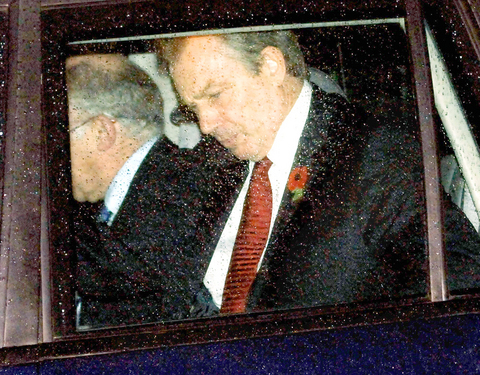
PHOTO: AP
UK Home Secretary Charles Clarke on Wednesday night caved in to huge opposition to his plans to hold terrorist suspects without charge for 90 days by promising all-party talks next week on a substantially reduced period of detention.
The offer came as the anti-terror legislation threatened to founder in its committee stage, with ministers seeing their majority cut to one in a vote on another clause -- the government's closest shave since Blair first formed a government in 1997.
Opposition members of parliament (MPs) and many Labour backbenchers were predicting that parts of the bill were "untenable" and "in tatters" as the House of Commons sent a signal to the House of Lords that two contentious measures -- creating a wide ranging offence of encouraging or glorifying terrorism and holding people without charge for 90 days -- were unacceptable to many rebels.
The Opposition Conservative home affairs spokesman David Davis and his Liberal Democrat counterpart Mark Oaten told the UK Channel 4 TV News that any period longer than 28 days would be "a non-starter."
"All prime ministers run out of credit in the end," the usually pro-Labour Guardian said in an editorial. "This one is in trouble."
Blair is "facing his own battle for political survival", the tabloid Daily Mail said on its front page, while the Times said he was "struggling to retain his political authority."
The Independent offered some rare support, saying Blair, once nicknamed "Teflon Tony" because no dirt ever stuck, remained in control.
Political commentator Andrew Rawnsley said the prime minister must move quickly to "stamp his authority now pretty hard on this government."
Blair's close ally and friend, Work and Pensions Secretary David Blunkett, resigned for the second time in less than a year over accusations he violated a ministerial code of conduct.
Hours later, Blair was forced to back down on his proposed terrorism laws to avoid a first major defeat in parliament during eight years in power.
In one vote on the terrorist bill on Wednesday, Blair's majority was cut to one -- its lowest ever and perilously close to his first defeat in the elected chamber.
More than 30 Labour members of parliament rebelled against Blair over proposals to create a new offence of indirect incitement or glorification of terrorism.
Opposition parties attempted to brand Blair a "lame duck" leader who will struggle to wield power as his time in office nears an end. Blair said last year that he would not seek a fourth term.
"We have seen the slow seepage of his authority turn into a hemorrhage," Michael Howard, leader of the opposition Conservatives, told a packed parliament after Blunkett quit.

‘IN A DIFFERENT PLACE’: The envoy first visited Shanghai, where he attended a Chinese basketball playoff match, and is to meet top officials in Beijing tomorrow US Secretary of State Antony Blinken yesterday arrived in China on his second visit in a year as the US ramps up pressure on its rival over its support for Russia while also seeking to manage tensions with Beijing. The US diplomat tomorrow is to meet China’s top brass in Beijing, where he is also expected to plead for restraint as Taiwan inaugurates president-elect William Lai (賴清德), and to raise US concerns on Chinese trade practices. However, Blinken is also seeking to stabilize ties, with tensions between the world’s two largest economies easing since his previous visit in June last year. At the
Nearly half of China’s major cities are suffering “moderate to severe” levels of subsidence, putting millions of people at risk of flooding, especially as sea levels rise, according to a study of nationwide satellite data released yesterday. The authors of the paper, published by the journal Science, found that 45 percent of China’s urban land was sinking faster than 3mm per year, with 16 percent at more than 10mm per year, driven not only by declining water tables, but also the sheer weight of the built environment. With China’s urban population already in excess of 900 million people, “even a small portion

UNSETTLING IMAGES: The scene took place in front of TV crews covering the Trump trial, with a CNN anchor calling it an ‘emotional and unbelievably disturbing moment’ A man who doused himself in an accelerant and set himself on fire outside the courthouse where former US president Donald Trump is on trial has died, police said yesterday. The New York City Police Department (NYPD) said the man was declared dead by staff at an area hospital. The man was in Collect Pond Park at about 1:30pm on Friday when he took out pamphlets espousing conspiracy theories, tossed them around, then doused himself in an accelerant and set himself on fire, officials and witnesses said. A large number of police officers were nearby when it happened. Some officers and bystanders rushed

Beijing is continuing to commit genocide and crimes against humanity against Uyghurs and other Muslim minorities in its western Xinjiang province, U.S. Secretary of State Antony Blinken said in a report published on Monday, ahead of his planned visit to China this week. The State Department’s annual human rights report, which documents abuses recorded all over the world during the previous calendar year, repeated language from previous years on the treatment of Muslims in Xinjiang, but the publication raises the issue ahead of delicate talks, including on the war in Ukraine and global trade, between the top U.S. diplomat and Chinese


 RSS
RSS