


The US Congress has expressed concerns over civil liberty curbs in Hong Kong directly to Hong Kong Chief Executive Donald Tsang (
Media and immigration controls, disappointment over a constitutional reform plan and failure to make progress on universal suffrage were among the concerns raised by leaders of the US legislature during talks with Tsang, who is on a three day visit to Washington.
Republican Representative Henry Hyde, the chairman of the powerful committee on international relations of the House of Representatives, and ranking Democratic member Tom Lantos raised the issues in a "very candid but cordial" fashion, Hyde's spokesman Sam Stratman said.
"The concerns over civil liberties were on freedom of the press -- self-censorship and interference in press -- and denial of visas to pro-democracy activists, Beijing's lack of respect for the Basic Law, disappointment with the constitutional reform plan and failure to make progress on universal suffrage," Stratman said.
Congress sought "further progress in the development of democracy in Hong Kong," said Lynne Weil, spokeswoman for Lantos.
"The positive sign is the upcoming election of the chief executive," she said.
Tsang, named by Beijing this year, told reporters that he briefed Congress on the latest proposal submitted to the Hong Kong legislative council seeking elections next year of a chief executive and 2007 for the territory's legislature.
The plan also calls for doubling the size of the 800-member election committee that chooses the chief executive and is currently stacked with prominent citizens loyal to Beijing. It did not however spell out a timetable for giving the public the right to elect the territory's leader and lawmakers, and unconvinced opposition lawmakers have vowed to vote it down in the legislature. They are also organizing a large-scale protest on Dec. 4 for the public to denounce the reform proposals.
But Tsang on Wednesday defended the reform plans, saying they "represent a major advancement in our democratic arrangements in Hong Kong" and "these developments were welcome by our interlocutors, including Chairman Hyde."
Under the territory's post-colonial constitution, it must enact laws that will eventually create a fully representative electoral system. But China stymied a swift transition in a controversial ruling last year, insisting change must be gradual.
Tsang said the meetings with US lawmakers, senior officials and business leaders here were "very important and very useful to dispel unnecessary conceptions of Hong Kong among leading figures in the American administration, Congress and private sector."
He was scheduled to hold talks with Secretary of State Condoleezza Rice and Vice-President Dick Cheney yesterday.
His predecessors have met with the US president during their trips to Washington but Tsang did not consider it a "downgrade" for not being able to meet with US President George W. Bush.
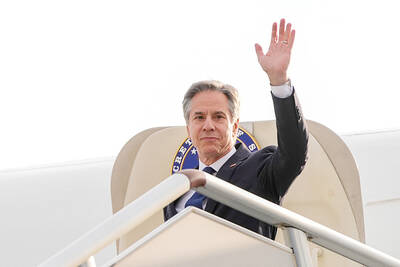
‘IN A DIFFERENT PLACE’: The envoy first visited Shanghai, where he attended a Chinese basketball playoff match, and is to meet top officials in Beijing tomorrow US Secretary of State Antony Blinken yesterday arrived in China on his second visit in a year as the US ramps up pressure on its rival over its support for Russia while also seeking to manage tensions with Beijing. The US diplomat tomorrow is to meet China’s top brass in Beijing, where he is also expected to plead for restraint as Taiwan inaugurates president-elect William Lai (賴清德), and to raise US concerns on Chinese trade practices. However, Blinken is also seeking to stabilize ties, with tensions between the world’s two largest economies easing since his previous visit in June last year. At the

UNSETTLING IMAGES: The scene took place in front of TV crews covering the Trump trial, with a CNN anchor calling it an ‘emotional and unbelievably disturbing moment’ A man who doused himself in an accelerant and set himself on fire outside the courthouse where former US president Donald Trump is on trial has died, police said yesterday. The New York City Police Department (NYPD) said the man was declared dead by staff at an area hospital. The man was in Collect Pond Park at about 1:30pm on Friday when he took out pamphlets espousing conspiracy theories, tossed them around, then doused himself in an accelerant and set himself on fire, officials and witnesses said. A large number of police officers were nearby when it happened. Some officers and bystanders rushed
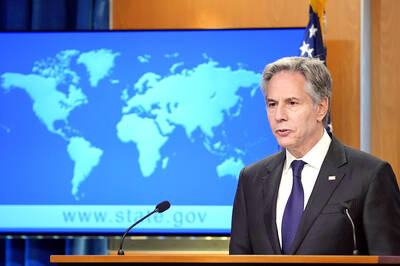
Beijing is continuing to commit genocide and crimes against humanity against Uyghurs and other Muslim minorities in its western Xinjiang province, U.S. Secretary of State Antony Blinken said in a report published on Monday, ahead of his planned visit to China this week. The State Department’s annual human rights report, which documents abuses recorded all over the world during the previous calendar year, repeated language from previous years on the treatment of Muslims in Xinjiang, but the publication raises the issue ahead of delicate talks, including on the war in Ukraine and global trade, between the top U.S. diplomat and Chinese

RIVER TRAGEDY: Local fishers and residents helped rescue people after the vessel capsized, while motorbike taxis evacuated some of the injured At least 58 people going to a funeral died after their overloaded river boat capsized in the Central African Republic’s (CAR) capital, Bangui, the head of civil protection said on Saturday. “We were able to extract 58 lifeless bodies,” Thomas Djimasse told Radio Guira. “We don’t know the total number of people who are underwater. According to witnesses and videos on social media, the wooden boat was carrying more than 300 people — some standing and others perched on wooden structures — when it sank on the Mpoko River on Friday. The vessel was heading to the funeral of a village chief in


 RSS
RSS