


Pakistan's army was flying geologists to an isolated northwestern valley yesterday to investigate reports of possible volcanic activity after the massive Oct. 8 earthquake that killed about 80,000 people, an official said.
The Pakistani geologists will survey the Alai Valley, and if they find evidence of a volcanic eruption the 150,000 people who live there will be evacuated, said army spokesman Major General Shaukat Sultan.
Army helicopters flew over the rugged region of North West Frontier Province on Monday and did not find any signs of an eruption, Sultan said.
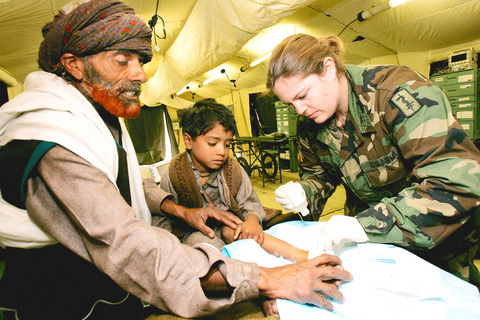
PHOTO: AP
An estimated 3.3 million people have been left homeless by the Oct. 8 quake, which has been followed by hundreds of aftershocks that have frightened survivors and periodically triggered landslides.
A huge international relief effort has been mounted, but fears remain for vulnerable communities in distant mountains, with the harsh Himalayan winter closing in.
Despite fresh appeals and warnings of a second wave of deaths, the UN said on Monday it has received less than 30 percent of the US$312 million it desperately needs to help the victims.
UN Secretary-General Kofi Annan invited ministers to attend a high-level donor conference in Geneva today to mobilize additional financial support.
Cloudy weather yesterday raised concern that rain could fall in the coming days. But Major Farooq Nasir, army spokesman in Muzaffarabad, the capital of Pakistan's portion of Kashmir, said helicopter relief flights were still operating.
Sultan said it was possible that people in the Alai Valley -- located at a height of about 1,800m and surrounded by mountains as high as 3,000m -- could be mistaking the noise of aftershocks or landslides for the sound of a volcano.
"It could be more prominent in the valley because it is very narrow and aftershocks trigger landslides in the mountains, which have already been cut by the earthquake. It kicks up dust due to which local people believe there could be some volcanic activity," he said.
An official from Pakistan's meteorological department, who requested anonymity because he wasn't authorized to speak to the media, said there was very little chance of volcanic activity as there was no recent history of eruptions in Pakistan.
Meanwhile, police in the quake-hit Mansehra district, north of Islamabad, have arrested 350 to 400 people over the past two weeks for taking relief supplies -- whether by stealing them outright or lining up to receive supplies more than once, police chief Yamin Khan said.
The arrests have been made in a number of damaged towns since relief started flowing in for quake victims, Khan said.
"We want to ensure that only those who need the aid get it," he said.
Many were later released on bail, another police official said on condition of anonymity. They could face up to three years in jail, he said.
Indian soldiers have set up a relief camp for Pakistani quake victims along the Line of Control dividing the rivals' areas of Kashmir, although the camp remains empty as India and Pakistan try to broker a deal to allow people to cross the militarized frontier.
Also yesterday, a US Army field hospital unit, with more than 130 staff, started treating patients in Muzaffarabad on a mission Washington hopes will help generate goodwill among Pakistanis.
Officials say it is the eighth mobile hospital to set up in the ruined city, and only two patients were waiting at its gate when it opened yesterday morning. The hospital's arrival was delayed by a shortage of aircraft, vehicle breakdowns and the winding roads of the lower Himalayas.
The first of the patients, Aribba Abbasi, a three-year-old girl, was suffering a broken thigh from when her home collapsed on her. The other, Faisal Hussain, an eight-year-old boy, had been caught in a collapsed school and had a bad gash on his ankle. Both had already received treatment but needed aftercare.
The official quake toll currently states that more than 53,000 are dead and 75,000 injured.

An American scientist convicted of lying to US authorities about payments from China while he was at Harvard University has rebuilt his research lab in Shenzhen, China, to pursue technology the Chinese government has identified as a national priority: embedding electronics into the human brain. Charles Lieber, 67, is among the world’s leading researchers in brain-computer interfaces. The technology has shown promise in treating conditions such as amyotrophic lateral sclerosis and restoring movement in paralyzed people. It also has potential military applications: Scientists at the Chinese People’s Liberation Army have investigated brain interfaces as a way to engineer super soldiers by boosting

Jailed media entrepreneur Jimmy Lai (黎智英) has been awarded Deutsche Welle’s (DW) freedom of speech award for his contribution to Hong Kong’s pro-democracy movement. The German public broadcaster on Thursday said Lai would be presented in absentia with the 12th iteration of the award on June 23 at the DW Global Media Forum in Bonn. Deutsche Welle director-general Barbara Massing praised the 78-year-old founder of the now-shuttered news outlet Apple Daily for standing “unwaveringly for press freedom in Hong Kong at great personal risk.” “With Apple Daily, he gave journalists a platform for free reporting and a voice to the democracy movement in

PHILIPPINE COMMITTEE: The head of the committee that made the decision said: ‘If there is nothing to hide, there is no reason to hide, there is no reason to obstruct’ A Philippine congressional committee on Wednesday ruled that there was “probable cause” to impeach Philippine Vice President Sara Duterte after hearing allegations of unexplained wealth, misuse of state funds and threats to have the president assassinated. The unanimous decision of the 53-member committee in the Philippine House of Representatives sends the two impeachment complaints to deliberations and voting by the entire lower chamber, which has more than 300 lawmakers. The complaints centered on Duterte’s alleged illegal use and mishandling of intelligence funds from the vice president’s office, and from her time as education secretary under Philippine President Ferdinand Marcos Jr. Duterte and the

As evening falls in Fiji’s capital, a steady stream of people approaches a makeshift clinic that is a first line of defense against one of the world’s fastest-growing HIV epidemics. In the South Pacific nation — a popular tourist destination of just under a million people — more than 2,000 new HIV cases were recorded last year, a 26 percent increase from 2024. The government has declared an HIV outbreak and described it as a national crisis. “It’s spreading like wildfire,” said Siteri Dinawai, 46, who came to be tested. The Moonlight Clinic, a converted minibus parked in a suburban cul-de-sac in Suva, is


 RSS
RSS