


China began the countdown yesterday for its second manned foray into space, as specially invited guests poured off trains in the city of Jiuquan near the launch site to witness the event.
Communist party officials and other VIPs filled the overnight train from Lanzhou, the nearest major industrial city, gladly accepting a bumpy nine-hour ride for an opportunity to watch history unfold.
"We didn't get a chance to watch the first manned launch two years ago, so this time we really wanted to go," said one of the passengers, a middle-aged woman.
"My husband works with a telecom company that's doing business with the launch center, so I secured an invite for me and my daughter."
Officials involved in the launch said that Shenzhou VI would blast off this morning, and the official Xinhua news agency confirmed last night that lift off would be this morning at 9 am.
Regarding earlier secrecy surrounding the launch time, a Jiuquan police officer, patrolling the street here in his black uniform said, "it's all because we don't know when the weather will be suitable for a launch."
Previous reports have suggested that cool temperatures could delay the launch, and weather forecasters have warned of unseasonably cold weather in northern China this week.
Xinhua said the two astronauts for the five-day mission had been selected and would undergo final physical examinations yesterday.
Previous reports said that Zhai Zhigang (
"Preparations for the launch are going well," an unnamed official on the space program told Xinhua.
Like its first manned space launch in October two years ago, which made China only the third nation after the US and the former Soviet Union to send a man into orbit, this one will take place from the Jiuquan Satellite Launch Center.
A community of 15,000 served by everything from an Olympic-size swimming pool to a fast-food joint, it is located on the edge of the Gobi desert, several hours' drive away from Jiuquan city.
It is only rarely open to visitors, and this week has been sealed off completely, with roadblocks in place and the military patrolling the area.
Space enthusiasts from all over China started arriving in groups as early as a week ago, all of them eager to get as close to Shenzhou VI as possible.
They might have had a better shot at getting a good look if they had stayed at home in front of their television sets.
China's state television has announced it plans a live transmission of the launch, reflecting confidence that it will go according to plan.
Foreign observers said China had good reason not to worry, as it was not taking any major risks with Shenzhou VI as compared with Shenzhou V.
"It's the same kind of spacecraft doing the same kind of thing, except that they must prove that their system can work for five days rather than just one day," said David Baker, a London-based space policy analyst with Jane's Defence Weekly.
"The last Shenzhou unmanned missions stayed up for up to five days, so they're not trying anything that their unmanned versions of Shenzhou have not done already."
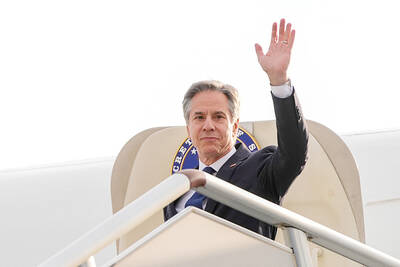
‘IN A DIFFERENT PLACE’: The envoy first visited Shanghai, where he attended a Chinese basketball playoff match, and is to meet top officials in Beijing tomorrow US Secretary of State Antony Blinken yesterday arrived in China on his second visit in a year as the US ramps up pressure on its rival over its support for Russia while also seeking to manage tensions with Beijing. The US diplomat tomorrow is to meet China’s top brass in Beijing, where he is also expected to plead for restraint as Taiwan inaugurates president-elect William Lai (賴清德), and to raise US concerns on Chinese trade practices. However, Blinken is also seeking to stabilize ties, with tensions between the world’s two largest economies easing since his previous visit in June last year. At the
Nearly half of China’s major cities are suffering “moderate to severe” levels of subsidence, putting millions of people at risk of flooding, especially as sea levels rise, according to a study of nationwide satellite data released yesterday. The authors of the paper, published by the journal Science, found that 45 percent of China’s urban land was sinking faster than 3mm per year, with 16 percent at more than 10mm per year, driven not only by declining water tables, but also the sheer weight of the built environment. With China’s urban population already in excess of 900 million people, “even a small portion

UNSETTLING IMAGES: The scene took place in front of TV crews covering the Trump trial, with a CNN anchor calling it an ‘emotional and unbelievably disturbing moment’ A man who doused himself in an accelerant and set himself on fire outside the courthouse where former US president Donald Trump is on trial has died, police said yesterday. The New York City Police Department (NYPD) said the man was declared dead by staff at an area hospital. The man was in Collect Pond Park at about 1:30pm on Friday when he took out pamphlets espousing conspiracy theories, tossed them around, then doused himself in an accelerant and set himself on fire, officials and witnesses said. A large number of police officers were nearby when it happened. Some officers and bystanders rushed

Beijing is continuing to commit genocide and crimes against humanity against Uyghurs and other Muslim minorities in its western Xinjiang province, U.S. Secretary of State Antony Blinken said in a report published on Monday, ahead of his planned visit to China this week. The State Department’s annual human rights report, which documents abuses recorded all over the world during the previous calendar year, repeated language from previous years on the treatment of Muslims in Xinjiang, but the publication raises the issue ahead of delicate talks, including on the war in Ukraine and global trade, between the top U.S. diplomat and Chinese


 RSS
RSS