


When a Mexican bishop told reporters recently that drug traffickers often donate to the Catholic Church, shock waves ran through this predominantly Catholic nation, not because the news was a surprise, but because admitting it was tantamount to confessing that nothing is sacred -- not even God -- when it comes to organized crime in Mexico.
Provoking the uproar were declarations by Bishop Ramon Godinez of the central state of Aguascalientes, who remarked earlier this month that donations from drug traffickers are not unusual, but that it was not the Church's responsibility to investigate. He argued that the money is "purified" once it passes through the parish doors.
"Just because the origin of the money is bad doesn't mean you have to burn it," Godinez said. "Instead, you have to transform it ... We live on this, on the offerings of the faithful."
Organized crime, especially drug trafficking, and the threat it poses to public safety, are among the issues Mexicans rank highest among their concerns. And it's not just the criminals they worry about. They also don't trust the public agencies responsible for tackling crime -- prosecutors, police, the judicial system and politicians -- all of which have been corrupted, or are perceived to have been corrupted, to some degree.
The church, on the other hand, is the one institution that is still held in high esteem.
"Of all the institutions in Mexico, the church is ranked No. 1 in terms of people's confidence," said Roderic Ai Camp, an expert on Mexican religion at Claremont-McKenna College in California. It is "the one institution they find morally superior and basically honest and serving the interests of the average Mexican."
That trust holds steady even though it is common knowledge among the people that "many towns and chapels in Mexico have been remodeled and restored thanks to the generous contributions of people who work in drug trafficking," Mexican religion expert Roberto Blancarte wrote in the Milenio newspaper.
Especially in poor, outlying rural areas, drug traffickers have become a species of "Robin Hood," Blancarte said.
"It's not official, but it's probably fairly accepted," Camp added. "But you don't want to legitimize it ... because it's such a contradiction to the church's whole philosophy. People are looking to the church for moral leadership."
Godinez's admission once again has drawn into the center of controversy one of Mexico's most prominent, revered -- and criticized -- institutions.
For more than 300 years after the Spanish conquest of 1521, the Catholic Church was at the heart of Mexican power socially, politically and economically. Although the mid-19th century Laws of the Reform put an end to that dominance, the country has remained -- at least nominally -- 90 percent Catholic in the more than 140 years since.
"There are many ... who want to scare us with the idea" that the Church once again could become an all-powerful presence, said Jaime Septien Crespo, editor of the Catholic Observador weekly newspaper, in the central state of Queretaro.
"There is an interest in discrediting this presence, so when a minister of the church says something clumsy, he becomes an easy target," he said.

‘IN A DIFFERENT PLACE’: The envoy first visited Shanghai, where he attended a Chinese basketball playoff match, and is to meet top officials in Beijing tomorrow US Secretary of State Antony Blinken yesterday arrived in China on his second visit in a year as the US ramps up pressure on its rival over its support for Russia while also seeking to manage tensions with Beijing. The US diplomat tomorrow is to meet China’s top brass in Beijing, where he is also expected to plead for restraint as Taiwan inaugurates president-elect William Lai (賴清德), and to raise US concerns on Chinese trade practices. However, Blinken is also seeking to stabilize ties, with tensions between the world’s two largest economies easing since his previous visit in June last year. At the

UNSETTLING IMAGES: The scene took place in front of TV crews covering the Trump trial, with a CNN anchor calling it an ‘emotional and unbelievably disturbing moment’ A man who doused himself in an accelerant and set himself on fire outside the courthouse where former US president Donald Trump is on trial has died, police said yesterday. The New York City Police Department (NYPD) said the man was declared dead by staff at an area hospital. The man was in Collect Pond Park at about 1:30pm on Friday when he took out pamphlets espousing conspiracy theories, tossed them around, then doused himself in an accelerant and set himself on fire, officials and witnesses said. A large number of police officers were nearby when it happened. Some officers and bystanders rushed

Beijing is continuing to commit genocide and crimes against humanity against Uyghurs and other Muslim minorities in its western Xinjiang province, U.S. Secretary of State Antony Blinken said in a report published on Monday, ahead of his planned visit to China this week. The State Department’s annual human rights report, which documents abuses recorded all over the world during the previous calendar year, repeated language from previous years on the treatment of Muslims in Xinjiang, but the publication raises the issue ahead of delicate talks, including on the war in Ukraine and global trade, between the top U.S. diplomat and Chinese
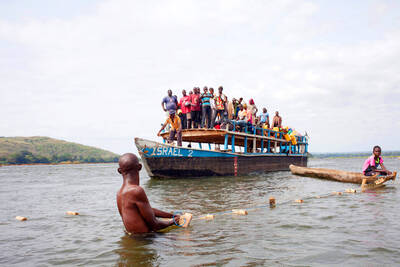
RIVER TRAGEDY: Local fishers and residents helped rescue people after the vessel capsized, while motorbike taxis evacuated some of the injured At least 58 people going to a funeral died after their overloaded river boat capsized in the Central African Republic’s (CAR) capital, Bangui, the head of civil protection said on Saturday. “We were able to extract 58 lifeless bodies,” Thomas Djimasse told Radio Guira. “We don’t know the total number of people who are underwater. According to witnesses and videos on social media, the wooden boat was carrying more than 300 people — some standing and others perched on wooden structures — when it sank on the Mpoko River on Friday. The vessel was heading to the funeral of a village chief in


 RSS
RSS