


A senior cardinal reaffirmed the Roman Catholic Church's celibacy rule for priests, which some reform groups have suggested should be relaxed as a way to attract more people to the priesthood.
Cardinal Angelo Scola, speaking at the opening of a meeting of the world's bishops on Monday, played down the shortage of priests -- which has left many churches without clergymen to celebrate Masses -- and said access to the Eucharist was a gift, not a right for Catholics.
Scola, the relator, or key moderator of the Synod of Bishops, also reaffirmed that divorced people who remarry without getting an annulment cannot receive Communion. But he said the synod would have to study the issue and hinted that certain aspects of it should be rethought.
The comments by the Venice patriarch came in a lengthy introductory speech, delivered in Latin, to the bishops on the first day of the meeting on the Eucharist. Some 250 bishops from 118 countries will discuss a host of issues surrounding the Catholic Mass and make recommendations to the pope.
Scola's comments drew immediate, if nuanced, criticism from two bishops who appeared with him at a news conference -- a hint of the debates that will likely ensue behind closed doors over the next three weeks.
Monsignor Luis Antonio Tagle of the Philippines said the synod had to "squarely" confront the priest shortage, recounting how on his first Sunday as an ordained priest he celebrated nine Masses -- and that that was the norm in his country.
"People long for the Eucharist and they believe that it is the Eucharistic gift that will make them fully the church," he said. "Our seminaries, thanks be to God, are fuller, but the Catholic population is increasing at a rate which is much higher and faster than the increase of the priests."
He said he didn't have an answer to the problem, but many church reform groups have called on the synod to discuss the celibacy rule for priests, saying the priesthood would grow if men were allowed to marry.
Scola, however, repeated what the church regards as the benefits of a celibate priesthood and said the synod should instead talk about better distributing the priests there are.
He said the church wasn't a "business" that had a quota of priests to fill, and preferred to speak about "communities waiting for priests" rather than a priest shortage.
He said the Eucharist was a "gift, not a right or a possession."
"Even if it provokes great suffering, the lack of the Eucharist doesn't confer to the faithful and the people of God any right to it," he said.

SPEAKING OUT: After Siranudh Scott’s allegations surfaced, celebrities and public figures took to social media to share their own experiences of sexual misconduct and abuse A high-profile alleged sexual abuse case within a wealthy Thai beer brewing family has prompted a wave of painful accounts from survivors of unconnected abuse in the conservative nation. Siranudh Scott, a member of the billionaire Thai family that founded the ubiquitous Singha beer brand, posted an emotional video this month accusing his elder brother Sunit of repeatedly abusing him when he was a teenager. Sunit, who is in his 30s, later denied the allegations in a video posted online, but Singha parent Boonrawd dismissed him from his executive role with the company on Tuesday last week. “I felt I needed to speak
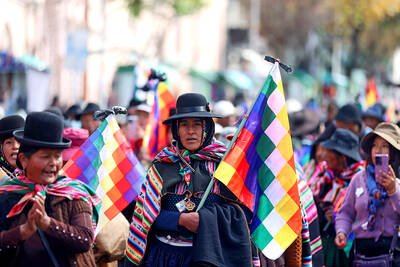
SEEKING ORDER: Rodrigo Paz said that ‘anyone who wants to destroy the nation will have to deal with this president and the full force of the constitution’ Bolivian President Rodrigo Paz on Wednesday said that the nation was at a “breaking point” after nearly a month of protests that have caused shortages of food, fuel and medicine. Paz, who took office six months ago amid the worst economic crisis there in four decades, is battling a groundswell of fury over his policies. The political capital, La Paz, has been besieged by low-income workers and members of the indigenous majority calling for his resignation. “The country needs order and is reaching breaking point,” the 58-year-old said at a public event in La Paz, renewing his appeal for dialogue. On Tuesday, the Bolivian

‘CROSSING THE LINE’: China’s embassy in Seoul criticized US Forces Korea Commander General Xavier Brunson, asking if his ‘hostile’ remarks were authorized by Washington South Korea and the US are in talks over recent public remarks by the commander of US Forces Korea, Seoul’s presidential office said yesterday, after the comments drew sharp criticism from China. In a recent podcast interview, US Forces Korea Commander General Xavier Brunson described South Korea as “the dagger in the heart of Asia” from China’s east coast, prompting the Chinese embassy in Seoul to say that he had “truly crossed the line.” The interview came amid growing speculation that Washington might seek to expand the role of US Forces Korea in countering the growing regional influence of China, a key

Forecasters in Europe yesterday warned of exceptional heat as record temperatures driven by a “heat dome” push temperatures well above seasonal norms across the continent. The surge follows a record-breaking Monday, with France logging its hottest day in the month of May on record, its weather agency said, and the UK also posting unprecedented highs. A so-called “heat dome” of warm air from northern Africa trapped under a high-pressure system over western Europe is behind the high temperatures not usually seen until high summer. Restrictions on outdoor work were imposed in parts of Italy, beaches in southwest France filled earlier than usual and


 RSS
RSS