


Iran's president has denied telling a newspaper that his government might curtail oil sales if Iran is referred to the UN Security Council for possible sanctions over its nuclear program.
President Mahmoud Ahmadinejad "never had an interview, either oral or written, with the Khaleej Times," the president's office said in a statement late Saturday.
Earlier in the day, the Dubai-based newspaper had reported Ahmadinejad as speaking about last month's resolution by the International Atomic Energy Agency, which warned Iran it would be referred to the UN Security Council unless it allayed fears about its nuclear program.
"If Iran's case is sent to the Security Council, we will respond by many ways, for example, by holding back on oil sales or limiting inspections of our nuclear facilities," Ahmadinejad said, according to the newspaper.
The president's office denied this, saying: "Such a claim is nothing more than a mere fabrication."
The Khaleej Times could not contacted about the denial because of the late hour on Saturday. But its Web site carried the interview without any mention of Ahmadinejad's rebuttal, which was published by the official Islamic Republic News Agency.
Iran pumps about 4 million barrels daily, making it the second-largest producer in the Organization of Petroleum Exporting Countries after Saudi Arabia.
If Iran were to curtail its exports by a substantial amount, it would raise the price of oil on the world market. But it would also reduce Iran's revenue.
Crude oil exports normally account for about 80 percent of Iran's hard currency income, and last month an oil official projected oil earnings this year at US$43 billion.
Iran has made other threats since the IAEA resolution. Officials have threatened to resume uranium enrichment and to block UN inspections of its nuclear facilities unless the UN nuclear agency stepped back from its resolution. Iran has also threatened to use trade to punish countries that voted for the resolution, and last week the parliament began debating a bill to force the government to scale back cooperation with the IAEA. The newspaper reported Ahmadinejad as saying that Iran's nuclear program was peaceful and it had to be so.
"Our religion prohibits us from having nuclear arms and our religious leader has prohibited it from the point of view of religious law. It's a closed road," he told the Khaleej Times. "I insist we don't need nuclear arms and our laws don't allow us to produce them. We are always acting in accordance with international law."
The president criticized the resolution and foreign countries, however, for trying to impose their will on Iran and said he was determined to fight for Iran's rights to a nuclear fuel supply. Iran says its nuclear program is for peaceful energy purposes. The US and some other countries suspect Iran of trying to build nuclear weapons.
"I said I'll do every thing in order to uphold our national interest," Ahmadinejad said of his campaign promises ahead of the June presidential election. "One of these things is that we will have access to the nuclear supply process. We don't want to be at war with the world, as you see they're trying to impose their will on our country. I have no worries about all that. We will have peace, prosperity and the nuclear supply cycle."
The IAEA resolution ordered Iran to ratify an additional protocol to the Nuclear Nonproliferation Treaty in its parliament, suspend all uranium enrichment activities, including uranium conversion, abandon the construction of a heavy water nuclear reactor and grant access to certain locations and documents.
The additional protocol requires any signatory country to report all its nuclear facilities to the IAEA and allow short-noticed intrusive inspections. Iran already allows this but parliament has not yet ratified the additional protocol.
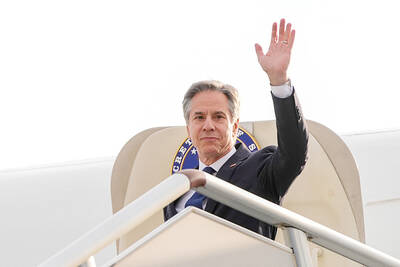
‘IN A DIFFERENT PLACE’: The envoy first visited Shanghai, where he attended a Chinese basketball playoff match, and is to meet top officials in Beijing tomorrow US Secretary of State Antony Blinken yesterday arrived in China on his second visit in a year as the US ramps up pressure on its rival over its support for Russia while also seeking to manage tensions with Beijing. The US diplomat tomorrow is to meet China’s top brass in Beijing, where he is also expected to plead for restraint as Taiwan inaugurates president-elect William Lai (賴清德), and to raise US concerns on Chinese trade practices. However, Blinken is also seeking to stabilize ties, with tensions between the world’s two largest economies easing since his previous visit in June last year. At the

UNSETTLING IMAGES: The scene took place in front of TV crews covering the Trump trial, with a CNN anchor calling it an ‘emotional and unbelievably disturbing moment’ A man who doused himself in an accelerant and set himself on fire outside the courthouse where former US president Donald Trump is on trial has died, police said yesterday. The New York City Police Department (NYPD) said the man was declared dead by staff at an area hospital. The man was in Collect Pond Park at about 1:30pm on Friday when he took out pamphlets espousing conspiracy theories, tossed them around, then doused himself in an accelerant and set himself on fire, officials and witnesses said. A large number of police officers were nearby when it happened. Some officers and bystanders rushed

Beijing is continuing to commit genocide and crimes against humanity against Uyghurs and other Muslim minorities in its western Xinjiang province, U.S. Secretary of State Antony Blinken said in a report published on Monday, ahead of his planned visit to China this week. The State Department’s annual human rights report, which documents abuses recorded all over the world during the previous calendar year, repeated language from previous years on the treatment of Muslims in Xinjiang, but the publication raises the issue ahead of delicate talks, including on the war in Ukraine and global trade, between the top U.S. diplomat and Chinese
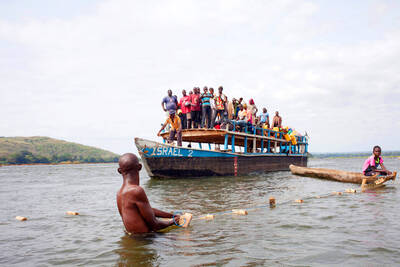
RIVER TRAGEDY: Local fishers and residents helped rescue people after the vessel capsized, while motorbike taxis evacuated some of the injured At least 58 people going to a funeral died after their overloaded river boat capsized in the Central African Republic’s (CAR) capital, Bangui, the head of civil protection said on Saturday. “We were able to extract 58 lifeless bodies,” Thomas Djimasse told Radio Guira. “We don’t know the total number of people who are underwater. According to witnesses and videos on social media, the wooden boat was carrying more than 300 people — some standing and others perched on wooden structures — when it sank on the Mpoko River on Friday. The vessel was heading to the funeral of a village chief in


 RSS
RSS