


John Roberts Jr became the US Supreme Court's youngest chief justice in two centuries by winning support from more than three-fourths of the Senate, even including half the 44 Democrats.
Roberts, at 50, becomes the 17th chief justice of the US to preside over a Supreme Court that seems as divided as the nation over abortion and other tumultuous social issues. The court's new term opens on Monday.
"The Senate has confirmed a man with an astute mind and kind heart," President George W. Bush said just before Roberts was sworn in by acting Chief Justice John Paul Stevens.
Roberts "will be prudent in exercising judicial power, firm in defending judicial independence and above all a faithful guardian of the Constitution," he said.
Bush is expected to make his second Supreme Court nomination within days, one that conservatives hope will move the court to the right. Replacing the late chief justice William Rehnquist with Roberts keeps the court's current balance, since both are conservatives like Bush, but replacing the moderate Justice Sandra Day O'Connor with a conservative could tilt it rightward.
Roberts called the Senate's 78-22 bipartisan vote for him "confirmation of what is for me a bedrock principle, that judging is different from politics."
All the Senate's 55 Republicans, independent James Jeffords of Vermont and 22 Democrats supported him.
He said he would try to "pass on to my children's generation a charter of self-government as strong and as vibrant as the one that chief justice Rehnquist passed on to us."
Rehnquist, for whom Roberts was a clerk in the early 1980s, died Sept. 3 at age 80. Roberts replaces him five years older than the youngest chief justice, John Marshall, who took over at age 45 when he was confirmed in 1801.
Roberts is the first new Supreme Court justice since 1994, and his age means he probably will influence US law for decades because of federal judges' lifetime tenure.
A crowd including seven of the eight sitting justices, Roberts' parents, Rosemary and John, children John and Josephine, Senate supporters and White House well-wishers stood and applauded as Roberts kissed his wife and shook Stevens' hand.
The audience also included Attorney General Alberto Gonzales and White House counsel Harriet Miers, both mentioned as candidates for O'Connor's seat.
Roberts took a separate judicial oath during a private White House ceremony attended by the other justices. A formal Supreme court ceremony was scheduled for Monday, before the opening of the term.
O'Connor, a moderate voice on the Supreme Court and one of only two women, is leaving after 24 years. Bush is the first president since Richard Nixon 34 years ago who has had simultaneous openings to fill on the high court.
The president originally named Roberts to succeed O'Connor in July. Rehnquist's death led to the switch to Roberts for chief justice on Sept. 6.
O'Connor remains on the court until the president selects a replacement and that person is confirmed by the Senate.
The only justice not at the White House was Antonin Scalia, who had a previous engagement.
Before becoming a federal appeals court judge, Roberts ranked among the nation's best appellate lawyers, arguing 39 cases, many in front of the same eight justices he now will lead as chief.
He won 25 of the cases.
Under Roberts, the court will tackle such issues as assisted suicide, campaign finance law and abortion this year, with questions about religion, same-sex marriage, the government's war on terror and human cloning looming in the future.
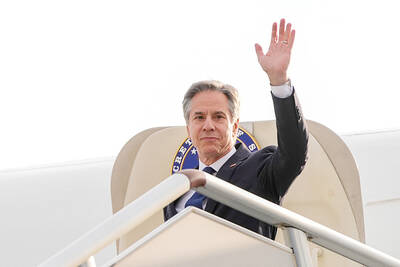
‘IN A DIFFERENT PLACE’: The envoy first visited Shanghai, where he attended a Chinese basketball playoff match, and is to meet top officials in Beijing tomorrow US Secretary of State Antony Blinken yesterday arrived in China on his second visit in a year as the US ramps up pressure on its rival over its support for Russia while also seeking to manage tensions with Beijing. The US diplomat tomorrow is to meet China’s top brass in Beijing, where he is also expected to plead for restraint as Taiwan inaugurates president-elect William Lai (賴清德), and to raise US concerns on Chinese trade practices. However, Blinken is also seeking to stabilize ties, with tensions between the world’s two largest economies easing since his previous visit in June last year. At the
Nearly half of China’s major cities are suffering “moderate to severe” levels of subsidence, putting millions of people at risk of flooding, especially as sea levels rise, according to a study of nationwide satellite data released yesterday. The authors of the paper, published by the journal Science, found that 45 percent of China’s urban land was sinking faster than 3mm per year, with 16 percent at more than 10mm per year, driven not only by declining water tables, but also the sheer weight of the built environment. With China’s urban population already in excess of 900 million people, “even a small portion

UNSETTLING IMAGES: The scene took place in front of TV crews covering the Trump trial, with a CNN anchor calling it an ‘emotional and unbelievably disturbing moment’ A man who doused himself in an accelerant and set himself on fire outside the courthouse where former US president Donald Trump is on trial has died, police said yesterday. The New York City Police Department (NYPD) said the man was declared dead by staff at an area hospital. The man was in Collect Pond Park at about 1:30pm on Friday when he took out pamphlets espousing conspiracy theories, tossed them around, then doused himself in an accelerant and set himself on fire, officials and witnesses said. A large number of police officers were nearby when it happened. Some officers and bystanders rushed
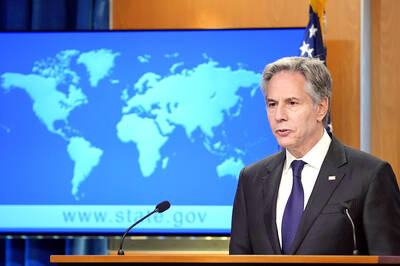
Beijing is continuing to commit genocide and crimes against humanity against Uyghurs and other Muslim minorities in its western Xinjiang province, U.S. Secretary of State Antony Blinken said in a report published on Monday, ahead of his planned visit to China this week. The State Department’s annual human rights report, which documents abuses recorded all over the world during the previous calendar year, repeated language from previous years on the treatment of Muslims in Xinjiang, but the publication raises the issue ahead of delicate talks, including on the war in Ukraine and global trade, between the top U.S. diplomat and Chinese


 RSS
RSS