


A Chinese human-rights activist said yesterday authorities have evicted her from her Beijing apartment as part of their efforts to stop her from helping peasants and other people who protest government actions.
Hou Wenzhuo, 36, said she was packing up her possessions following an order to vacate the second-story premises in the capital's Haidian district.
An officer who answered the telephone at the Haidian police station referred questions to the main Beijing city station, where calls were not answered.
Hou is the founder of the Empowerment and Rights Institute, which helps farmers and others with complaints against China's communist government.
She began the group early last year after studying human rights and refugee law at Harvard University Law School and Britain's Oxford University.
Her group is supported by the US-based National Endowment for Democracy.
Hou said she had first been informed that she would have to leave her modest apartment on Wednesday.
"The situation is very tense now," she said, pointing to a uniformed soldier standing in the street adjacent to her building.
"They told me this evening, absolutely this evening by 6 o'clock, if I don't get out by that time they're going to do everything to get me out," she said.
Hou said she had already been evicted from one apartment and that officials had closed the offices of her Beijing institute as part of their campaign to get her to stop work on her human-rights activities.
She said that she had been put under house arrest when UN High Commissioner for Human Rights Louise Arbour visited Beijing in late August.
Hou denied that the activities of her institute constitute a threat to China's government.
"I personally think all I did was moderate human-rights work," she said. "We help farmers, we help petitioners and ordinary laborers.
The type of work we do is just educating ordinary Chinese people about civil rights, about their human rights, and encourage them to participate in local elections."
Hou said the timing of her eviction appeared to be connected to today's National Day holiday, an occasion routinely accompanied by wide-ranging police sweeps aimed at cleansing China's capital of petitioners and other aggrieved citizens.
"I think there are people being watched more, being put under some sort of house arrest," she said.
The measures are part of the government's ongoing efforts to curb a growing number of organized protests, especially in its poverty-stricken countryside.
Demonstrators frequently complain about pollution, incompetent or corrupt local governments, the seizure of farmland for real estate development, and other problems.
Last month the Chinese government signed an agreement with the UN human-rights agency to collaborate on reforming China's legal system in preparation for adopting a key UN treaty on civil and political rights.
Nevertheless, many human-rights groups accuse China of suppressing independent religious groups, harassing labor and political activists and enforcing a birth-control policy that limits most urban couples to one child.
China says it has worked hard to ensure basic human rights by reforming its economy, which has improved the overall standard of living of its people.
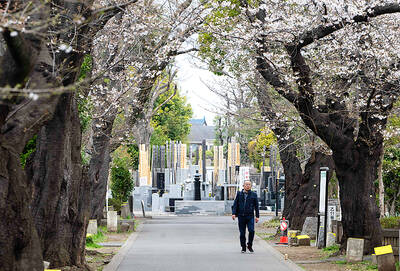
ROCKY RELATIONS: The figures on residents come as Chinese tourist numbers drop following Beijing’s warnings to avoid traveling to Japan The number of Chinese residents in Japan has continued to rise, even as ties between the two countries have become increasingly fractious, data released on Friday showed. As of the end of December last year, the number of Chinese residents had increased by 6.5 percent from the previous year to 930,428. Chinese people accounted for 22.6 percent of all foreign residents in Japan, making them by far the largest group, Japanese Ministry of Justice data showed. Beijing has criticized Tokyo in increasingly strident terms since Japanese Prime Minister Sanae Takaichi last year suggested that a military conflict around Taiwan could
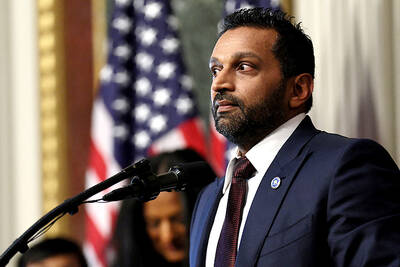
A pro-Iran hacking group claimed to breach FBI Director Kash Patel’s personal e-mail inbox and posted some of the contents online. The e-mails provided by the hacking group include travel details, correspondence with leasing agents in Washington and global entry, and loyalty account numbers. The e-mail address the hackers claim to have compromised has been previously tied to Patel’s personal details, and the leaked e-mails contain photos of Patel and others, in addition to correspondence with family members and colleagues. “The FBI is aware of malicious actors targeting Director Patel’s personal email information,” the agency said in a statement on
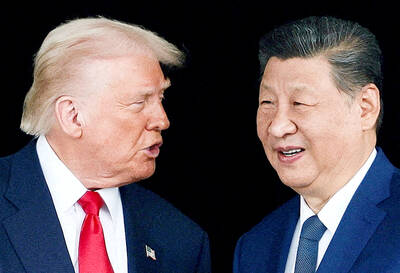
RIVALRY: ‘We know that these are merely symbolic investigations initiated by China, which is in fact the world’s most profligate disrupter of supply chains,’ a US official said China has started a pair of investigations into US trade practices, retaliating against similar probes by US President Donald Trump’s administration as the superpowers stake out positions before an expected presidential summit in May. The move, announced by the Chinese Ministry of Commerce on Friday, is a direct mirror of steps Trump took to revive his tariff agenda after the US Supreme Court last month struck down some of his duties. “China expresses its strong dissatisfaction and firm opposition to these actions,” a ministry spokesperson said in a statement, referring to the so-called Section 301 investigations initiated on March 11.

When a hiker fell from a 55m waterfall in wild New Zealand bush, rescuers were forced to evacuate the badly hurt woman without her dog, which could not be found. After strangers raised thousands of dollars for a search, border collie Molly was flown to safety by a helicopter pilot who was determined to reunite the pet and the owner. A week earlier, an emergency rescue helicopter found the woman with bruises and lacerations after a fall at a rocky spot at the waterfall on the South Island’s West Coast. She was airlifted on March 24, but they were forced to


 RSS
RSS