


Widening its five-day campaign against Palestinian militants, Israel for the first time fired artillery shells into the Gaza Strip yesterday and shut down 15 West Bank offices suspected of distributing money to families of suicide bombers from the Hamas and Islamic Jihad groups.
Israeli aircraft also fired missiles at several Gaza targets, knocking out power in Gaza City for most of the night, damaging several buildings and destroying an overpass, but there were no injuries. In the West Bank, Israel rounded up 24 suspected militants, bringing the number of people arrested since the weekend to more than 400.
In other developments, an adviser to Prime Minister Ariel Sharon and an Israeli Cabinet minister said yesterday that Israel could withdraw from some parts of the West Bank and annex others to its territory if peace efforts remain bogged down. The comments by adviser Eyal Arad and Cabinet Minister Tzahi Hanegbi on Israel Army Radio marked the first time two confidants of the prime minister talked in public about the idea of additional unilateral moves by Israel, after the Gaza pullout that was completed in the middle of this month. Sharon's office said it remained committed to a negotiated peace deal with the Palestinians.
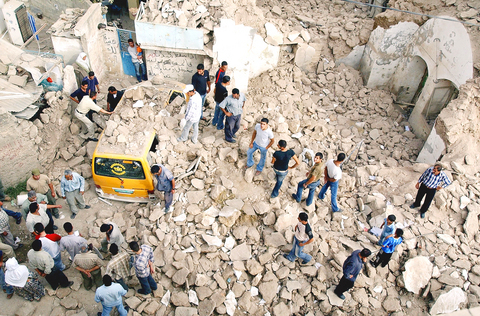
PHOTO: AP
The Israeli strikes were triggered by weekend rocket fire from Gaza at Israeli border towns. Since then, Hamas and Islamic Jihad have announced they would halt attacks, but Israel said it would press ahead with the campaign, including targeted killings of militant leaders. On Tuesday, Israeli Defense Minister Shaul Mofaz threatened Hamas leaders Mahmoud Zahar and Ismail Hanieh by name, saying they could be the next targets.
Israel says the strong reaction is necessary to show that new rules are in place following its withdrawal from Gaza, after a 38-year occupation, and that attacks from the area won't be tolerated.
"Terrorism must be rooted out," Vice Premier Shimon Peres told Israel Radio yesterday.
However, Israel also appears to be seizing an opportunity to deliver a major blow to Hamas, which had been largely off-limits after it agreed in February to abide by an informal truce. Israel has repeatedly demanded that Palestinian leader Mahmoud Abbas disarm Hamas, but Abbas has chosen to co-opt the militants instead.
Hamas charged that Israel is also trying to weaken the group politically before the Palestinian parliamentary elections in January. Among those rounded up in recent days were dozens of Hamas candidates for parliament and local councils. Hamas is expected to make a strong showing in the parliamentary vote and in a new round of local elections -- the third of four -- to be held in more than 100 towns and villages today.
In a new phase of Israel's offensive, troops closed down 15 offices, including charities linked to local mosques, across the West Bank yesterday, the military said. Israel said money for the families of suicide bombers and militants jailed by Israel was distributed through these offices.
The military activity came after various Palestinian factions, including Hamas and the ruling Fatah movement, renewed their commitment to a ceasefire, although they also said they reserved the right to retaliate for perceived Israeli truce violations. As the militants were meeting, a rocket landed in the southern Israeli town of Sderot, causing no damage or injuries, the army said. No one claimed responsibility for the attack.
Captain Yael Hartmann, a spokeswoman for the Israeli army, called the militants' pledges "meaningless" and said the open-ended military operation would continue.

VAGUE: The criteria of the amnesty remain unclear, but it would cover political violence from 1999 to today, and those convicted of murder or drug trafficking would not qualify Venezuelan Acting President Delcy Rodriguez on Friday announced an amnesty bill that could lead to the release of hundreds of prisoners, including opposition leaders, journalists and human rights activists detained for political reasons. The measure had long been sought by the US-backed opposition. It is the latest concession Rodriguez has made since taking the reins of the country on Jan. 3 after the brazen seizure of then-Venezuelan president Nicolas Maduro. Rodriguez told a gathering of justices, magistrates, ministers, military brass and other government leaders that the ruling party-controlled Venezuelan National Assembly would take up the bill with urgency. Rodriguez also announced the shutdown

Civil society leaders and members of a left-wing coalition yesterday filed impeachment complaints against Philippine Vice President Sara Duterte, restarting a process sidelined by the Supreme Court last year. Both cases accuse Duterte of misusing public funds during her term as education secretary, while one revives allegations that she threatened to assassinate former ally Philippine President Ferdinand Marcos Jr. The filings come on the same day that a committee in the House of Representatives was to begin hearings into impeachment complaints against Marcos, accused of corruption tied to a spiraling scandal over bogus flood control projects. Under the constitution, an impeachment by the
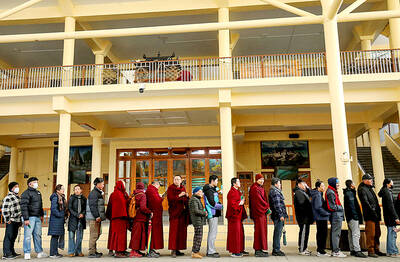
Exiled Tibetans began a unique global election yesterday for a government representing a homeland many have never seen, as part of a democratic exercise voters say carries great weight. From red-robed Buddhist monks in the snowy Himalayas, to political exiles in megacities across South Asia, to refugees in Australia, Europe and North America, voting takes place in 27 countries — but not China. “Elections ... show that the struggle for Tibet’s freedom and independence continues from generation to generation,” said candidate Gyaltsen Chokye, 33, who is based in the Indian hill-town of Dharamsala, headquarters of the government-in-exile, the Central Tibetan Administration (CTA). It

China executed 11 people linked to Myanmar criminal gangs, including “key members” of telecom scam operations, state media reported yesterday, as Beijing toughens its response to the sprawling, transnational industry. Fraud compounds where scammers lure Internet users into fake romantic relationships and cryptocurrency investments have flourished across Southeast Asia, including in Myanmar. Initially largely targeting Chinese speakers, the criminal groups behind the compounds have expanded operations into multiple languages to steal from victims around the world. Those conducting the scams are sometimes willing con artists, and other times trafficked foreign nationals forced to work. In the past few years, Beijing has stepped up cooperation


 RSS
RSS