


New Orleans will be rebuilt, despite its vulnerability to Mother Nature.
History, geography and especially economics make it inevitable that New Orleans will be rebuilt -- almost certainly with more substantial flood protection. The city is, always has been and probably always will be a vital US port.
House of Representatives Speaker Dennis Hastert may muse that it makes no sense to spend billions of dollars to rebuild a city that's 2m under sea level. Fifty-four percent of Americans may say that the flooded parts of the city should be moved to safety, according to an AP-Ipsos poll. Forget about it.
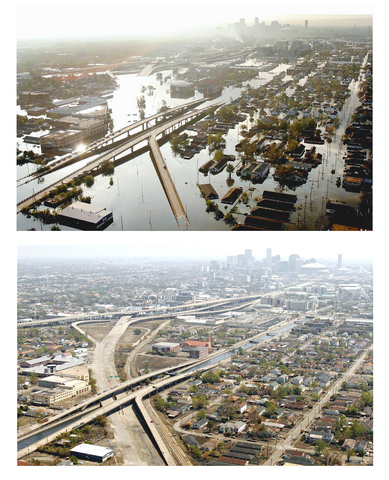
PHOTO: AP
"We cannot live without it," said Ari Kelman, a historian at the University of California, Davis, and the author of A River and its City: The Nature of Landscape in New Orleans.
The Port of South Louisiana is what makes it possible for farmers in Iowa to sell corn to customers in China. It gets steel to Midwestern automakers and coffee to wholesalers all over the country. And thanks to the unique history and culture that 300 years of maritime trade have spawned, the city of New Orleans now has a singular place in the American tourism business as well.
New Orleans lies at the outlet of a 24,100km river transportation network that stretches from the Rocky Mountains to the Alleghenies. That's why French settlers located it there in the first place -- enduring floods, disease and sweltering heat in exchange for economic and military control over the interior of North America.
"New Orleans is a surprising evidence of what men will endure, when cheered by the hopes of an ever-flowing tide of all-mighty dollars and cents," an English visitor declared in 1857.
A little more than a century later, geographer Peirce Lewis summed up New Orleans as "an inevitable city on an impossible site."
Every year, about 50 percent of the corn and one-third of the soybeans exported by the US float down the Mississippi River and its tributaries on barges. They move far more cheaply that way than they would by road or rail, said commodities trader J. Stephen Lucas, president of Jayhawker Consulting Co.
"You can ship corn out of Iowa on rail cars," Lucas said. "That costs more money for transportation, and that means a lower price for the farmer."
You can't sail a barge to China, so those river vessels have to stop at docks in and around New Orleans to have their cargo transferred to oceangoing ships.
Similarly, ships coming from all over the world have to stop in the New Orleans area to offload their products -- some onto barges, others onto rail cars or trucks. Altogether, the docks in and around New Orleans handle more than 100 million tons of cargo annually, making it the world's third-busiest port by volume.
The New Orleans area also plays a role in the energy industry, thanks to its proximity to offshore oil and natural gas fields in the Gulf of Mexico. Although most corporations use nearby Houston as a headquarters rather than New Orleans, they still rely on Port Fourchon, about 60 miles (100 kilometers) south of the city, to ferry equipment and workers out to the rigs. A significant fraction of the nation's oil imports come in through the region. And Louisiana refineries account for about 15 percent of the nation's gasoline refining capacity.
It wouldn't be possible to operate all this industrial infrastructure without a lot of people nearby. According to the Port of New Orleans, there are 60,000 people directly employed in maritime shipping in Louisiana, and 107,000 people whose jobs depend on the industry.
Those people, in turn, need groceries and clothing. They need banks and gas stations and appliance stores. Their children need schools to attend. They need New Orleans.
Some economists have predicted that many lawyers, accountants and other professionals who have been forced to retreat to Baton Rouge, 80km upriver, will stay there even after New Orleans is rebuilt.
But the French Quarter isn't going anywhere. Tourism is a major business in New Orleans, thanks to the city's rich history, unique culture and reputation for naughty good times. With the Quarter and other popular destinations relatively undamaged by the flooding of lower-lying parts of New Orleans, the city still has plenty of appeal.
"I guarantee you that it would cost many times more to abandon the city than to rebuild it," said Laurence Geller, president and CEO of Strategic Hotel Capital.
The company owns the Hyatt Regency New Orleans. The building suffered major damage during the hurricane, but it is well worth repairing, Geller said -- as is the rest of New Orleans.
"I really am an optimist for the future of this city," Geller said.
Tourism brings US$10 billion to New Orleans annually and accounts for about 15 percent of the city's jobs. Because those jobs tend to be relatively low-paying, they are held mostly by the poor minority residents of New Orleans who were disproportionately harmed by Hurricane Katrina.

‘IN A DIFFERENT PLACE’: The envoy first visited Shanghai, where he attended a Chinese basketball playoff match, and is to meet top officials in Beijing tomorrow US Secretary of State Antony Blinken yesterday arrived in China on his second visit in a year as the US ramps up pressure on its rival over its support for Russia while also seeking to manage tensions with Beijing. The US diplomat tomorrow is to meet China’s top brass in Beijing, where he is also expected to plead for restraint as Taiwan inaugurates president-elect William Lai (賴清德), and to raise US concerns on Chinese trade practices. However, Blinken is also seeking to stabilize ties, with tensions between the world’s two largest economies easing since his previous visit in June last year. At the
Nearly half of China’s major cities are suffering “moderate to severe” levels of subsidence, putting millions of people at risk of flooding, especially as sea levels rise, according to a study of nationwide satellite data released yesterday. The authors of the paper, published by the journal Science, found that 45 percent of China’s urban land was sinking faster than 3mm per year, with 16 percent at more than 10mm per year, driven not only by declining water tables, but also the sheer weight of the built environment. With China’s urban population already in excess of 900 million people, “even a small portion

UNSETTLING IMAGES: The scene took place in front of TV crews covering the Trump trial, with a CNN anchor calling it an ‘emotional and unbelievably disturbing moment’ A man who doused himself in an accelerant and set himself on fire outside the courthouse where former US president Donald Trump is on trial has died, police said yesterday. The New York City Police Department (NYPD) said the man was declared dead by staff at an area hospital. The man was in Collect Pond Park at about 1:30pm on Friday when he took out pamphlets espousing conspiracy theories, tossed them around, then doused himself in an accelerant and set himself on fire, officials and witnesses said. A large number of police officers were nearby when it happened. Some officers and bystanders rushed

Beijing is continuing to commit genocide and crimes against humanity against Uyghurs and other Muslim minorities in its western Xinjiang province, U.S. Secretary of State Antony Blinken said in a report published on Monday, ahead of his planned visit to China this week. The State Department’s annual human rights report, which documents abuses recorded all over the world during the previous calendar year, repeated language from previous years on the treatment of Muslims in Xinjiang, but the publication raises the issue ahead of delicate talks, including on the war in Ukraine and global trade, between the top U.S. diplomat and Chinese


 RSS
RSS