


A violin that many consider to be second in quality and in preservation only to the celebrated "Messiah" Stradivarius was settling into its new home at London's Royal Academy of Music on Saturday -- and, unlike the Messiah, was actually being played for the first time for many years.
"I'm waking this up in public," said the violinist, Peter Sheppard Skaerved, as he put the "Viotti" Stradivarius through its paces, with frequent stops to retune a new set of strings.
Violins need to be kept "played in" if they are to retain their maximum resonance and sound their best and, as the Viotti has remained largely unplayed during the past 80 years, its full mellowness and warmth will take some coaxing out over time. But the instrument's enormous potential, the radiance and sheer heft of its tone, was immediately apparent, and Skaerved was clearly enjoying himself.
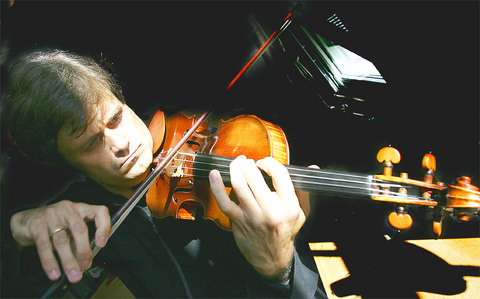
PHOTO: AFP
About 650 of Antonio Stradivari's instruments survive and, although countless copies of them have been made, the precise secret of their magic remains elusive. What is certain is that, given the chance, almost every violinist wants to play one.
The Viotti, made by Stradivari in 1709 and named after its most famous owner -- the Italian violinist Giovanni Battista Viotti (1755-1824) -- was offered to Britain in 2002 in lieu of inheritance tax by the son of its previous owner, John Bruce. However, its market value of about ?3.5 million considerably exceeded the amount of tax owed -- leaving the Royal Academy of Music to spearhead a spirited campaign to save it for the nation by raising a cool ?2.1 million.
"That's more money than has ever been raised by a public institution to buy a musical instrument," said Curtis Price, the academy's principal. "And, even then, we got it at a discount."
Indeed, the instrument has been renamed the "Viotti ex Bruce" in acknowledgement of the generosity of its donors, who could potentially have sold it for millions more at an open auction -- probably to a private collector in Japan or the US.
The first of the donors to come forward was the National Art Collections Fund, an independent charity that put ?150,000 towards what was, for its officials, an unusual acquisition.
"We've helped with quite a few musical instruments over the years," said Mary Yule, the fund's head of grants. "But, as far as I know, never a playing violin. But it's a beautiful work of craftsmanship, and with its historical interest as well, the question of whether we should support it really wasn't an issue."
Further help came from the National Heritage Memorial Fund and, after the violin was featured being played by Clio Gould on BBC TV, hundreds of individual donors.
The instrument was brought to London in 1792 by Viotti, whose playing alerted British audiences to the talents of Stradivari as well as himself. Viotti, who lived in London for many years, was an innovative player and an influential teacher, who has had an enormous influence on modern playing techniques.
Following his death, his violin has had only three other owners. The Bruce family bought it in 1928 with the intention that it should remain in the UK.
It is now set to become the jewel in the crown of the academy's renowned York Gate Collection, where it will join more than 200 other stringed instruments.
Skaerved, a professional violinist, academy research fellow and authority on Viotti, was able to give it an informal debut at its new home with snatches of music by Bach, Beethoven and Viotti himself.
"What has to be stressed about it [the violin] is that it was the choice of the defining player of the early 19th century. We are all his children," Skaerved said.

‘IN A DIFFERENT PLACE’: The envoy first visited Shanghai, where he attended a Chinese basketball playoff match, and is to meet top officials in Beijing tomorrow US Secretary of State Antony Blinken yesterday arrived in China on his second visit in a year as the US ramps up pressure on its rival over its support for Russia while also seeking to manage tensions with Beijing. The US diplomat tomorrow is to meet China’s top brass in Beijing, where he is also expected to plead for restraint as Taiwan inaugurates president-elect William Lai (賴清德), and to raise US concerns on Chinese trade practices. However, Blinken is also seeking to stabilize ties, with tensions between the world’s two largest economies easing since his previous visit in June last year. At the
Nearly half of China’s major cities are suffering “moderate to severe” levels of subsidence, putting millions of people at risk of flooding, especially as sea levels rise, according to a study of nationwide satellite data released yesterday. The authors of the paper, published by the journal Science, found that 45 percent of China’s urban land was sinking faster than 3mm per year, with 16 percent at more than 10mm per year, driven not only by declining water tables, but also the sheer weight of the built environment. With China’s urban population already in excess of 900 million people, “even a small portion

UNSETTLING IMAGES: The scene took place in front of TV crews covering the Trump trial, with a CNN anchor calling it an ‘emotional and unbelievably disturbing moment’ A man who doused himself in an accelerant and set himself on fire outside the courthouse where former US president Donald Trump is on trial has died, police said yesterday. The New York City Police Department (NYPD) said the man was declared dead by staff at an area hospital. The man was in Collect Pond Park at about 1:30pm on Friday when he took out pamphlets espousing conspiracy theories, tossed them around, then doused himself in an accelerant and set himself on fire, officials and witnesses said. A large number of police officers were nearby when it happened. Some officers and bystanders rushed

Beijing is continuing to commit genocide and crimes against humanity against Uyghurs and other Muslim minorities in its western Xinjiang province, U.S. Secretary of State Antony Blinken said in a report published on Monday, ahead of his planned visit to China this week. The State Department’s annual human rights report, which documents abuses recorded all over the world during the previous calendar year, repeated language from previous years on the treatment of Muslims in Xinjiang, but the publication raises the issue ahead of delicate talks, including on the war in Ukraine and global trade, between the top U.S. diplomat and Chinese


 RSS
RSS