


As the choking haze clears from Indonesia's forest fires, the government and some environmental groups are turning up the heat on palm-oil and paper companies they blame for starting many of the blazes.
The Worldwide Fund for Nature (WWF) says nearly half of the 5,420 hot spots identified in Sumatra island's Riau Province between July 18 and Aug. 16 were in timber concessions and palm-oil plantations. The rest were on communal plantations, it found in a study released this week.
It has singled out at least two dozen companies, including some linked to Asia Pulp and Paper Co (APP) -- the world's largest pulp producer -- and Asia Pacific Resources International (APRIL), both based in Singapore.
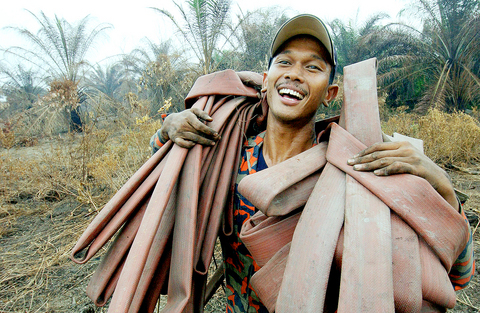
PHOTO: AFP
The two deny the charges, pointing fingers at villagers living in and around their property. APP notes that 13 palm-oil farmers have been arrested in the past month for lighting fires on land managed by one of its suppliers, Arara Abadi.
"APP has invested many hundreds of millions of dollars developing sustainable plantation forests in Riau," the company said in a statement. "It is simply not logical for APP or its fiber suppliers to put this investment at risk by intentionally burning forests."
The debate over who is to blame has played out year after year in Indonesia since 1997, when forest fires destroyed 10 million hectares of land, blanketing Southeast Asia in white haze and sickening millions of people.
The government's response until now has been to round up a few farmers and wait for the haze to clear.
Companies that manage hundreds of thousands of hectares of forest and plantations have largely escaped responsibility, despite allegations of illegally setting fires, logging in protected forests and sometimes displacing villages in their concessions.
Fitrian Ardiansyah, WWF's coordinator of forest restoration and threat mitigation, said the foundation has repeatedly tried to bring the companies to court. And while the government has also threatened to take action, so far only one firm has been fined.
"I don't think local authorities have the capacity, the willingness or even the technology to investigate these cases," Ardiansyah said.
Criticized by its neighbors for not tackling the problem head-on, the government this month threatened to bring 10 companies -- eight Malaysian and two Indonesian -- to court, and to scour satellite data that points to hot spots in areas operated by lumber, palm-oil and rubber companies.
"If fires are found in concession of companies, of course we will prosecute them," Environment Minister Rachmat Witoelar said. "We are very serious about this. We have to do that for our people and our neighbors who have been subjected to the haze."
Proving wrongdoing, however, could be difficult.
Open burning has for decades been an accepted way of clearing debris in most Sumatran communities. Complicating matters further, scores of villages and small farms often fall within the boundaries of company plantations and logging concessions, making it difficult to prove responsibility.
"In a context where everyone is burning and the whole system operates based on burning, you're not going to change the system by fining a couple of people," said David Kaimowitz, director-general of the conservation group Center for International Forestry Research in Indonesia.
Pulp companies like APP and APRIL to some degree exemplify the dilemma facing authorities. They insist they have a policy banning open burning on their land, but acknowledge that fires -- either illegal or accidental -- have been set in recent weeks within their concessions.
"We don't start fires. We actively prevent and extinguish fires," said Mark Werren, director of fiber services for APRIL, adding that his company has a 300-member rapid response team that fights fires on its 250,000 hectares of acacia and eucalyptus plantations with a helicopter, air tractor and water pumps.
"Fires are usually in areas surrounding the plantations -- or accidents in the plantations due to cooking or, say, cigarettes," he said.
"In the concessions we operate in, we don't have total control over those areas. There are other people living in the concessions, communities in the concessions and farming in the concessions," he said.
Given the difficulty of prosecuting cases, Kaimowitz and others say authorities would be better off banning development in soggy peat lands -- which produce the most smoke and are about the only undeveloped areas left in many parts of Sumatra.
He said the government should also demand companies improve their fire-management plans and offer incentives to villagers, who have lit fires in peat land to plant crops or start small palm-oil plantations.
"The fire problems are heavily linked to the timber and palm-oil plantations coming into these peat land areas," he said. "What you need to do is keep people out of certain peat land areas."

‘IN A DIFFERENT PLACE’: The envoy first visited Shanghai, where he attended a Chinese basketball playoff match, and is to meet top officials in Beijing tomorrow US Secretary of State Antony Blinken yesterday arrived in China on his second visit in a year as the US ramps up pressure on its rival over its support for Russia while also seeking to manage tensions with Beijing. The US diplomat tomorrow is to meet China’s top brass in Beijing, where he is also expected to plead for restraint as Taiwan inaugurates president-elect William Lai (賴清德), and to raise US concerns on Chinese trade practices. However, Blinken is also seeking to stabilize ties, with tensions between the world’s two largest economies easing since his previous visit in June last year. At the

UNSETTLING IMAGES: The scene took place in front of TV crews covering the Trump trial, with a CNN anchor calling it an ‘emotional and unbelievably disturbing moment’ A man who doused himself in an accelerant and set himself on fire outside the courthouse where former US president Donald Trump is on trial has died, police said yesterday. The New York City Police Department (NYPD) said the man was declared dead by staff at an area hospital. The man was in Collect Pond Park at about 1:30pm on Friday when he took out pamphlets espousing conspiracy theories, tossed them around, then doused himself in an accelerant and set himself on fire, officials and witnesses said. A large number of police officers were nearby when it happened. Some officers and bystanders rushed

Beijing is continuing to commit genocide and crimes against humanity against Uyghurs and other Muslim minorities in its western Xinjiang province, U.S. Secretary of State Antony Blinken said in a report published on Monday, ahead of his planned visit to China this week. The State Department’s annual human rights report, which documents abuses recorded all over the world during the previous calendar year, repeated language from previous years on the treatment of Muslims in Xinjiang, but the publication raises the issue ahead of delicate talks, including on the war in Ukraine and global trade, between the top U.S. diplomat and Chinese

RIVER TRAGEDY: Local fishers and residents helped rescue people after the vessel capsized, while motorbike taxis evacuated some of the injured At least 58 people going to a funeral died after their overloaded river boat capsized in the Central African Republic’s (CAR) capital, Bangui, the head of civil protection said on Saturday. “We were able to extract 58 lifeless bodies,” Thomas Djimasse told Radio Guira. “We don’t know the total number of people who are underwater. According to witnesses and videos on social media, the wooden boat was carrying more than 300 people — some standing and others perched on wooden structures — when it sank on the Mpoko River on Friday. The vessel was heading to the funeral of a village chief in


 RSS
RSS