


Scientists at Harvard say they have developed a technique that offers a long-range possibility for producing therapeutic stem cells without a need to harvest them from discarded human embryos.
The technique, which involves fusing two cells together, sheds light on how an adult cell like a skin cell can be reprogrammed back to its embryonic state. Scientists hope that cells in this state can be developed into the tissue needed for repairing a damaged brain or heart or other ailing organ.
The technique is described in an article by Kevin Eggan, Chad Cowan and other Harvard biologists, to appear Friday in Science. The journal released the paper early because its results had been described at a scientific conference. They were reported Monday in the Washington Post.
Any recipe that avoided the use of embryos might be welcomed by opponents of stem cell research. But the Harvard article may have little political impact, since it could be many years, if ever, before the technique becomes applicable to humans.
The idea of such regenerative medicine is to generate embryonic cells from a patient and develop them into the specialized cells that can replace those lost to disease. The only practical method at present, to judge from experiments with mice, is to take the nucleus of a patient's skin cell and insert it into an unfertilized human egg whose own nucleus has been removed; unknown factors in the main body, or cytoplasm, of the egg make the chromosomes of the introduced nucleus revert to an embryonic state. This reprogramming is apparently executed by switching off banks of genes used by the specialized adult cell, and switching on other genes that restore the cell to its full youthful potential.
Scientists have long tried to identify these mysterious reprogramming factors, because once known they could be injected directly into one of the patient's skin cells to make it embryonic, without the difficulties of nuclear transfer into human eggs.
In the Harvard study, the researchers have fused an embryonic stem cell with a human adult cell, and shown that the stem cell, like the unfertilized egg, can reprogram the adult cell's chromosomes. They hope the combined cell will provide another system in which to hunt for the elusive reprogramming factors, which could be synthesized and used to redirect a patient's cells.
So complete is the embryonic cell's takeover that the fused cell behaves just like one. This raises a second possible therapeutic approach: that of using the fused cells themselves to make replacement tissues. Such an approach would require continuing the use of stem cells from embryos, though existing lines of them might be sufficient for the task.
In this approach, the fused cells, being half-foreign to the patient, would be rejected, and in any case the combined cell, with twice the proper number of chromosomes, could probably not survive. Still, the approach could be effective if the embryonic stem cell's chromosomes could somehow be removed from the combined cell just after they had executed their reprogramming maneuver.

‘IN A DIFFERENT PLACE’: The envoy first visited Shanghai, where he attended a Chinese basketball playoff match, and is to meet top officials in Beijing tomorrow US Secretary of State Antony Blinken yesterday arrived in China on his second visit in a year as the US ramps up pressure on its rival over its support for Russia while also seeking to manage tensions with Beijing. The US diplomat tomorrow is to meet China’s top brass in Beijing, where he is also expected to plead for restraint as Taiwan inaugurates president-elect William Lai (賴清德), and to raise US concerns on Chinese trade practices. However, Blinken is also seeking to stabilize ties, with tensions between the world’s two largest economies easing since his previous visit in June last year. At the

UNSETTLING IMAGES: The scene took place in front of TV crews covering the Trump trial, with a CNN anchor calling it an ‘emotional and unbelievably disturbing moment’ A man who doused himself in an accelerant and set himself on fire outside the courthouse where former US president Donald Trump is on trial has died, police said yesterday. The New York City Police Department (NYPD) said the man was declared dead by staff at an area hospital. The man was in Collect Pond Park at about 1:30pm on Friday when he took out pamphlets espousing conspiracy theories, tossed them around, then doused himself in an accelerant and set himself on fire, officials and witnesses said. A large number of police officers were nearby when it happened. Some officers and bystanders rushed
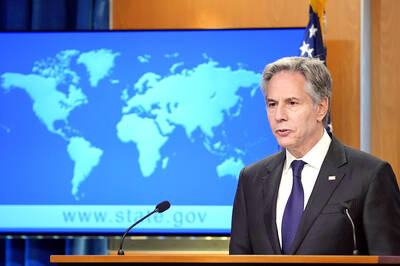
Beijing is continuing to commit genocide and crimes against humanity against Uyghurs and other Muslim minorities in its western Xinjiang province, U.S. Secretary of State Antony Blinken said in a report published on Monday, ahead of his planned visit to China this week. The State Department’s annual human rights report, which documents abuses recorded all over the world during the previous calendar year, repeated language from previous years on the treatment of Muslims in Xinjiang, but the publication raises the issue ahead of delicate talks, including on the war in Ukraine and global trade, between the top U.S. diplomat and Chinese

RIVER TRAGEDY: Local fishers and residents helped rescue people after the vessel capsized, while motorbike taxis evacuated some of the injured At least 58 people going to a funeral died after their overloaded river boat capsized in the Central African Republic’s (CAR) capital, Bangui, the head of civil protection said on Saturday. “We were able to extract 58 lifeless bodies,” Thomas Djimasse told Radio Guira. “We don’t know the total number of people who are underwater. According to witnesses and videos on social media, the wooden boat was carrying more than 300 people — some standing and others perched on wooden structures — when it sank on the Mpoko River on Friday. The vessel was heading to the funeral of a village chief in


 RSS
RSS