


The Australian government and moderate Muslim leaders pledged yesterday to join forces in the fight against terrorism and to blend Australian values with Islamic teachings at mosques and schools.
But critics said the exclusion of radical Muslims from the landmark summit at Parliament House risked further marginalizing young Muslims among Australia's 350,000 Islamic community.
Although Australia has never been hit by a major terror attack there are fears that Prime Minister John Howard's close links to the US and decision to send troops to Afghanistan and Iraq have raised the country's profile as a target for Islamic anger.
Hassim Doureihi, the Sydney spokesman for the radical Hizb ut-Tahrir Islamic group that was recently banned in Britain, said the government should accept that its foreign policy on Iraq and Afghanistan was to blame for anger among Muslims.
"It's disappointing to see that the prime minister continues to fail to acknowledge any responsibility for a condition which he gave rise to and which Western governments continue to give rise to," said Doureihi, who was not invited to the summit.
"We reject any attempt to place the collective burden upon the Muslim community and not upon the government itself," he said.
Canberra recently increased its troop numbers in Iraq and plans to send 190 elite combat troops to Afghanistan next month to fight al-Qaeda and Taliban insurgents.
Howard hand-picked the 14 leaders invited to the summit to discuss how to stamp out extremism and keep the country safe from terror attacks in the aftermath of the London bombings killed 52 rail and bus commuters on July 7.
The government pledged to help provide better trained imams in a country that has no accredited Muslim theology school and where English-speaking Islamic clerics are rare.
"We do believe that more can be done to bring an Australian perspective," Howard told reporters without elaborating on the government's involvement.
The government and religious leaders have also agreed to cooperate on ensuring that children in Islamic schools were not being taught extremist religious views.
The summit agreed on a statement of principles that declared that "an overriding loyalty to Australia and a commitment to its traditions, values and institutions is the common bond that unites us all."
"Members of the Muslim faith and in particular its leaders have a responsibility to challenge and counteract those who seek to encourage the use of violence and terrorism in the name of Islam," the statement released after the meeting said.
"The government must support and encourage Islamic leaders to challenge and eradicate extrem-ism," it said.
The summit came after Howard accused Australian Muslim leaders of failing to do enough to prevent radical preachers from influencing young Muslims.
A leading delegate Ameer Ali, president of the Australian Federation of Islamic Councils, said the Muslim community would provide the government with practical suggestions about training of imams, ensure tolerance is preached in schools and tell Canberra about problems facing young Muslims.
"This is not the end ... it's the beginning of a long process," Ali said.
He said the government's decision to send Australian troops to Iraq and Afghanistan had sparked debate and anger in the community.
But Ali, a supporter of the government's role in the war on terror, added: "We're not here to change the foreign policy of this country."
Howard said the criticisms of his foreign policy showed the delegates reflected broader public opinion, which also is divided on whether Australian troops should remain in Iraq. He also said there was no discussion yesterday about the possibility of deporting preachers who aim to incite terrorism.
Kuranda Seyit, director of the advocacy group, the Forum on Australia's Islamic Relations, said shunning radicals was a mistake.
"What we are facing is a new generation of disenfranchised youth ripe for indoctrination by radical Islamic leaders," Seyit told the Sydney Morning Herald newspaper. "We need to take action and work with these groups, not to further alienate them."
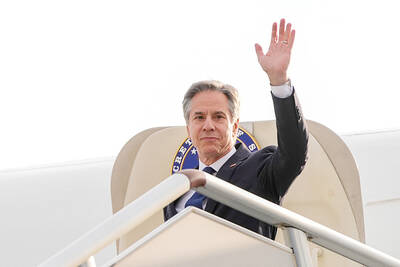
‘IN A DIFFERENT PLACE’: The envoy first visited Shanghai, where he attended a Chinese basketball playoff match, and is to meet top officials in Beijing tomorrow US Secretary of State Antony Blinken yesterday arrived in China on his second visit in a year as the US ramps up pressure on its rival over its support for Russia while also seeking to manage tensions with Beijing. The US diplomat tomorrow is to meet China’s top brass in Beijing, where he is also expected to plead for restraint as Taiwan inaugurates president-elect William Lai (賴清德), and to raise US concerns on Chinese trade practices. However, Blinken is also seeking to stabilize ties, with tensions between the world’s two largest economies easing since his previous visit in June last year. At the
Nearly half of China’s major cities are suffering “moderate to severe” levels of subsidence, putting millions of people at risk of flooding, especially as sea levels rise, according to a study of nationwide satellite data released yesterday. The authors of the paper, published by the journal Science, found that 45 percent of China’s urban land was sinking faster than 3mm per year, with 16 percent at more than 10mm per year, driven not only by declining water tables, but also the sheer weight of the built environment. With China’s urban population already in excess of 900 million people, “even a small portion

UNSETTLING IMAGES: The scene took place in front of TV crews covering the Trump trial, with a CNN anchor calling it an ‘emotional and unbelievably disturbing moment’ A man who doused himself in an accelerant and set himself on fire outside the courthouse where former US president Donald Trump is on trial has died, police said yesterday. The New York City Police Department (NYPD) said the man was declared dead by staff at an area hospital. The man was in Collect Pond Park at about 1:30pm on Friday when he took out pamphlets espousing conspiracy theories, tossed them around, then doused himself in an accelerant and set himself on fire, officials and witnesses said. A large number of police officers were nearby when it happened. Some officers and bystanders rushed

Beijing is continuing to commit genocide and crimes against humanity against Uyghurs and other Muslim minorities in its western Xinjiang province, U.S. Secretary of State Antony Blinken said in a report published on Monday, ahead of his planned visit to China this week. The State Department’s annual human rights report, which documents abuses recorded all over the world during the previous calendar year, repeated language from previous years on the treatment of Muslims in Xinjiang, but the publication raises the issue ahead of delicate talks, including on the war in Ukraine and global trade, between the top U.S. diplomat and Chinese


 RSS
RSS