


Leaders of the main Chinese party in Malaysia's ruling coalition faced a tough re-election Saturday amid complaints they have failed to stand up for the community at a time when ethnic Malays are seeking to boost their decades-old privileges.
Many Chinese are worried that some leaders of the Malay party that leads the coalition have recently called to strengthen a 35-year-old affirmative action program for Malays, said Tang Ah Chai, chief executive of the Selangor Chinese Assembly Hall.
The results of the internal polls in the Malaysian Chinese Association political party will also determine the composition of the government after a Cabinet reshuffle expected in October.
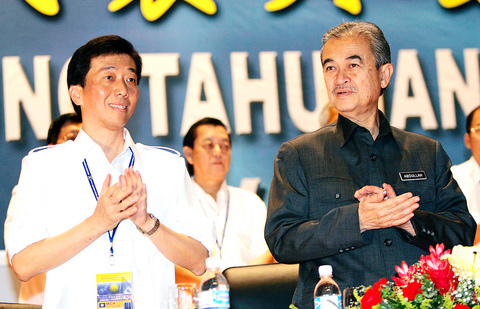
PHOTO: AP
The top four officer bearers of MCA get Cabinet posts as part of a power-sharing arrangement with Prime Minister Abdullah Ahmad Badawi's United Malays National Organization, or UMNO.
"There is a general feeling among the Chinese that the MCA should ... be more outspoken in voicing our feelings on national issues," said Cheng Lai Hock of the Federation of Chinese Associations, an umbrella of 8,000 community groups.
The 1.3 million-member MCA is the second largest party in the National Front coalition, dominated by the UMNO.
Malays have enjoyed a host of special privileges in business, education, government jobs and other fields for several decades as part of an effort to improve their economic lot.
During UMNO's annual meeting last month, top leaders including Education Minister Hishamuddin Hussein Onn and UMNO youth wing's deputy leader, Khairy Jamaluddin, called for increasing the privileges.
Tang noted that MCA President Ong Ka Ting has been guarded in his response to the racially sensitive issue and promised to raise this only in closed-door talks with Hishamuddin.
"There is dissatisfaction and unhappiness in the Chinese community that the MCA and its leaders like Ong do not have the courage and confidence to stand up to UMNO," he said.
Although UMNO has a stranglehold over political power in Malaysia, it has preferred to govern in a coalition with parties representing minority Chinese and Indians in the interest of racial harmony. Malays form 60 percent of the country's 26 million people, while Chinese are 25 percent and Indians 8 percent.
The elections are a big test for Ong, 48, who is also housing and local government minister. He is being challenged by the outspoken former health minister Chua Jui Meng, 62, for the top post.
Chua recently held a televised public debate over affirmative action with Khairy, who is also the premier's son-in-law, and has warned that a move to increase the scope of the privileges could arouse fear and insecurity among other ethnic groups.
Analysts say even if Chua wins, he will have to step carefully around the affirmative action policy to prevent antagonizing UMNO leaders and Malays.
"The elections are unlikely to cause any policy changes because the MCA (has) been part of the National Front for a long time," said political analyst James Wong.
Race relations are a sensitive issue, although ethnic enmity is rare in this Southeast Asian nation that has not seen communal violence since the 1969 riots largely between Malays and Chinese when hundreds were killed.

‘IN A DIFFERENT PLACE’: The envoy first visited Shanghai, where he attended a Chinese basketball playoff match, and is to meet top officials in Beijing tomorrow US Secretary of State Antony Blinken yesterday arrived in China on his second visit in a year as the US ramps up pressure on its rival over its support for Russia while also seeking to manage tensions with Beijing. The US diplomat tomorrow is to meet China’s top brass in Beijing, where he is also expected to plead for restraint as Taiwan inaugurates president-elect William Lai (賴清德), and to raise US concerns on Chinese trade practices. However, Blinken is also seeking to stabilize ties, with tensions between the world’s two largest economies easing since his previous visit in June last year. At the
Nearly half of China’s major cities are suffering “moderate to severe” levels of subsidence, putting millions of people at risk of flooding, especially as sea levels rise, according to a study of nationwide satellite data released yesterday. The authors of the paper, published by the journal Science, found that 45 percent of China’s urban land was sinking faster than 3mm per year, with 16 percent at more than 10mm per year, driven not only by declining water tables, but also the sheer weight of the built environment. With China’s urban population already in excess of 900 million people, “even a small portion

UNSETTLING IMAGES: The scene took place in front of TV crews covering the Trump trial, with a CNN anchor calling it an ‘emotional and unbelievably disturbing moment’ A man who doused himself in an accelerant and set himself on fire outside the courthouse where former US president Donald Trump is on trial has died, police said yesterday. The New York City Police Department (NYPD) said the man was declared dead by staff at an area hospital. The man was in Collect Pond Park at about 1:30pm on Friday when he took out pamphlets espousing conspiracy theories, tossed them around, then doused himself in an accelerant and set himself on fire, officials and witnesses said. A large number of police officers were nearby when it happened. Some officers and bystanders rushed

Beijing is continuing to commit genocide and crimes against humanity against Uyghurs and other Muslim minorities in its western Xinjiang province, U.S. Secretary of State Antony Blinken said in a report published on Monday, ahead of his planned visit to China this week. The State Department’s annual human rights report, which documents abuses recorded all over the world during the previous calendar year, repeated language from previous years on the treatment of Muslims in Xinjiang, but the publication raises the issue ahead of delicate talks, including on the war in Ukraine and global trade, between the top U.S. diplomat and Chinese


 RSS
RSS