


A Chinese man who spoke to foreign reporters about severe radiation poisoning affecting people living near a uranium mine has been detained and accused of crimes related to state secrets, a rights group said yesterday.
Sun Xiaodi, a former employee of the Gansu No. 792 Uranium Mine in northwestern China, met journalists on April 28 while he was in Beijing to petition authorities about what he said was serious pollution from the mine.
He said residents near and downstream of the plant suffered a high incidence of cancerous tumors, leukemia, birth defects, miscarriages and other afflictions.
A day after the meeting, Sun was bundled into an unmarked car near Beijing's southern railway station and has not been heard from since, Human Rights in China (HRIC) said, citing numerous witnesses.
It said that later the same day several plainclothes police officers searched the Beijing home of a friend of Sun, whom they then took to a State Security Bureau office.
They reportedly told the friend that Sun was a "wanted criminal" and that he had committed a "very serious crime related to state secrets."
Police produced Suns cellphone, wallet, telephone diary and other personal belongings, the rights group said.
Sun's daughter, Sun Haiyan, has inquired into her fathers whereabouts many times but has repeatedly been told by Beijing authorities that they know nothing, HRIC said.
The Beijing Public Security Bureau refused to comment yesterday and the State Security Bureau could not be reached.
The No. 792 Uranium Mine in Diebu County, Gansu Province, was established under the State Nuclear Industry Department as one of China's most important sources of uranium.
But it was "closed as a matter of policy" in 2002 on the basis of mine-exhaustion.
After the closure, mine employees accused mining and Nuclear Industry Department officials of plundering employee and state assets and damaging the environment, but their complaints were ignored by the authorities, HRIC said.
Local medical workers report that nearly half of all deaths in the area are from some form of cancer, but patients case histories are routinely altered because of "state secrets" concerns, HRIC said.
Sun began reporting the health concerns to the Nuclear Industry Department in 1988. But instead of an official response, he was fired and his family was put under surveillance, the group said.
"HRIC condemns the unlawful abduction and secret detention of Sun Xiaodi, which violate both his Chinese constitutional rights and his human rights," the group said in a statement.
"HRIC calls on the Chinese authorities to immediately release Sun Xiaodi from custody, and as a matter of urgency to address the dangerous environmental contamination and severe health hazards to humans and animals near the No. 792 Uranium Mine," the group said.

With the midday sun blazing, an experimental orange and white F-16 fighter jet launched with a familiar roar that is a hallmark of US airpower, but the aerial combat that followed was unlike any other: This F-16 was controlled by artificial intelligence (AI), not a human pilot, and riding in the front seat was US Secretary of the Air Force Frank Kendall. AI marks one of the biggest advances in military aviation since the introduction of stealth in the early 1990s, and the US Air Force has aggressively leaned in. Even though the technology is not fully developed, the service is planning
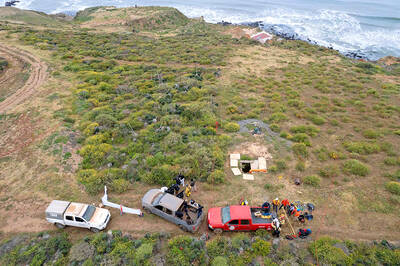
INTERNATIONAL PROBE: Australian and US authorities were helping coordinate the investigation of the case, which follows the 2015 murder of Australian surfers in Mexico Three bodies were found in Mexico’s Baja California state, the FBI said on Friday, days after two Australians and an American went missing during a surfing trip in an area hit by cartel violence. Authorities used a pulley system to hoist what appeared to be lifeless bodies covered in mud from a shaft on a cliff high above the Pacific. “We confirm there were three individuals found deceased in Santo Tomas, Baja California,” a statement from the FBI’s office in San Diego, California, said without providing the identities of the victims. Australian brothers Jake and Callum Robinson and their American friend Jack Carter
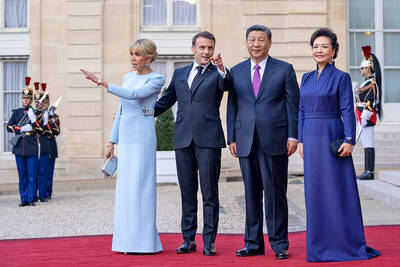
CUSTOMS DUTIES: France’s cognac industry was closely watching the talks, fearing that an anti-dumping investigation opened by China is retaliation for trade tensions French President Emmanuel Macron yesterday hosted Chinese President Xi Jinping (習近平) at one of his beloved childhood haunts in the Pyrenees, seeking to press a message to Beijing not to support Russia’s war against Ukraine and to accept fairer trade. The first day of Xi’s state visit to France, his first to Europe since 2019, saw respectful, but sometimes robust exchanges between the two men during a succession of talks on Monday. Macron, joined initially by EU Commission President Ursula von der Leyen, urged Xi not to allow the export of any technology that could be used by Russia in its invasion

UNDER INVESTIGATION: Members of the local Muslim community had raised concerns with the police about the boy, who officials said might have been radicalized online A 16-year-old boy armed with a knife was shot dead by police after he stabbed a man in the Australian west coast city of Perth, officials said yesterday. The incident occurred in the parking lot of a hardware store in suburban Willetton on Saturday night. The teen attacked the man and then rushed at police officers before he was shot, Western Australian Premier Roger Cook told reporters. “There are indications he had been radicalized online,” Cook told a news conference, adding that it appeared he acted alone. A man in his 30s was found at the scene with a stab wound to his back.


 RSS
RSS