


Afghanistan's parliamentary election campaign opened officially on Wednesday with political rallies in Kabul, but the day was marred by an explosion in Kandahar that killed one policeman and wounded 14 others. Officials had already been expressing concern that violence, mostly by insurgents, might disrupt the campaigning for the national and regional elections on Sept. 18.
The explosion was caused by a remote-controlled bomb that was hidden in a vegetable cart and hit a bus filled with police officers driving into the center of Kandahar, in the south, from a training school, said Colonel Abdul Malik Wahidi, the Kandahar police chief. He blamed fighters loyal to Afghanistan's former Taliban rulers.
Nearly 6,000 candidates are running for parliamentary and provincial council seats, which will create a lower and upper house of a new National Assembly and give Afghanistan the first truly representative legislature in its turbulent history.
Campaign posters are already plastered over walls and lampposts around Kabul, the capital, and, with the start of the official campaign, candidates will hit the airwaves, each receiving a free two-minute slot on local television stations, and a five-minute slot on radio.
A US$149 million international effort is under way to prepare for the elections and to make them a "Rolls-Royce operation," said Joanna Nathan, of the Crisis Group, a Brussels-based research and advocacy group. Hundreds of international election workers and aid organizations are educating candidates and voters about the process and organizing the election.
Ballots, boxes and other election materials have already been sent by donkey to the two most remote provinces.
More than 30,000 foreign troops are in Afghanistan, 20,000 with the mainly American coalition and 11,000 NATO-led peacekeepers, as well as thousands of Afghan soldiers and police officers.
The establishment of a National Assembly, after Afghanistan adopted a new constitution and had its first democratic presidential elections last October, would complete the political transition set out under the UN-sponsored Bonn Accords for Afghanistan in 2001, after US troops forced out the Taliban government and al-Qaeda, its allies.
A directly elected parliament would fill a political void that has increasingly been felt as President Hamid Karzai has ruled by decree for more than three years. It should also ease some of the political tension that built up after the presidential elections, when Karzai's opponents accused officials of fraud.
Karzai has repeatedly said that he hopes parliament will work with him and be a check on the government.
The National Assembly will be made up of a directly elected lower house, the House of the People, with 249 seats, and an indirectly elected and appointed upper house, the House of Elders. Voters will cast two ballots, to elect representatives from each of Afghanistan's 34 provinces for the lower house, and for provincial councils. The upper house will be made up of leaders of provincial councils, district councils and presidential appointees. Until district council elections are held next year, the upper house will work with 51 representatives, half its full size.
Women are guaranteed at least 68 seats -- 27 percent -- in the lower house, and one-sixth of the upper house.
Strong opposition
Among its duties, parliament will confirm ministerial appointments, and other senior posts, including the leaders of the Supreme Court and Central Bank and the attorney general. The ability to call government ministers to account for their actions could give the parliament substantial power, some candidates have said.
Some candidates have already objected to Karzai's policies. Muhammad Yunus Qanooni, who was second in the presidential race, has formed a political bloc and said he wants to change the 2004 constitution to replace a presidential system of government with a parliamentary one. Other candidates have voiced strong opposition to the long-term presence of foreign troops in Afghanistan, and have criticized the work of international aid organizations.
Many big names from the last two decades of turbulent politics have registered as candidates or lead parties that are fielding candidates. A vetting procedure aimed at keeping out militia leaders eliminated only 11 low-level commanders. Former commanders and political leaders from the jihadi parties, religiously conservative parties that opposed communism, are expected to win many seats. Other former communists with checkered pasts and a handful of former Taliban officials are taking part.
The large number of candidates and an unusual electoral system, known as the Single Nontransferable Vote, which is more likely to allow fringe candidates to win seats, makes it far from clear what kind of parliament will be elected, Nathan said. "The voting system will be a lottery," she said.
Troops increased
In related news, Australia said yesterday it would increase the number of soldiers it is sending to war-torn Afghanistan to help prepare the country for elections next month.
Defense Minister Robert Hill announced during a visit to Canberra by Afghanistan's Foreign Minister Abdullah Abdullah that Australia's commitment of elite Special Air Service (SAS) troops would increase from 150 to 190.
The soldiers will arrive in early September in time for national parliamentary elections and will remain in the country for a year.
In late 2001 Australia deployed SAS soldiers to Afghanistan to help oust the fundamentalist Taliban regime which was harbouring al-Qaeda leader Osama bin Laden.
Following a request from Afghanistan, Australia recently agreed to send some 150 elite soldiers to the country to help improve security before the September 18 elections.
Australia has provided some 110 million dollars (US$83.33 million) in reconstruction funding since the end of 2001 and was considering sending a second batch of soldiers to assist with reconstruction early in 2006, Australian Foreign Minister Alexander Downer said.
Australia was also considering establishing an embassy in Afghanistan, he said.
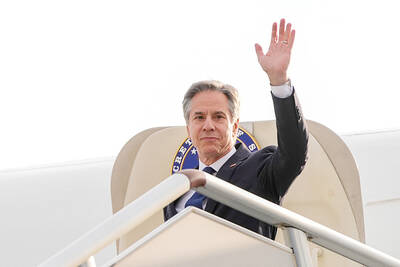
‘IN A DIFFERENT PLACE’: The envoy first visited Shanghai, where he attended a Chinese basketball playoff match, and is to meet top officials in Beijing tomorrow US Secretary of State Antony Blinken yesterday arrived in China on his second visit in a year as the US ramps up pressure on its rival over its support for Russia while also seeking to manage tensions with Beijing. The US diplomat tomorrow is to meet China’s top brass in Beijing, where he is also expected to plead for restraint as Taiwan inaugurates president-elect William Lai (賴清德), and to raise US concerns on Chinese trade practices. However, Blinken is also seeking to stabilize ties, with tensions between the world’s two largest economies easing since his previous visit in June last year. At the

UNSETTLING IMAGES: The scene took place in front of TV crews covering the Trump trial, with a CNN anchor calling it an ‘emotional and unbelievably disturbing moment’ A man who doused himself in an accelerant and set himself on fire outside the courthouse where former US president Donald Trump is on trial has died, police said yesterday. The New York City Police Department (NYPD) said the man was declared dead by staff at an area hospital. The man was in Collect Pond Park at about 1:30pm on Friday when he took out pamphlets espousing conspiracy theories, tossed them around, then doused himself in an accelerant and set himself on fire, officials and witnesses said. A large number of police officers were nearby when it happened. Some officers and bystanders rushed

Beijing is continuing to commit genocide and crimes against humanity against Uyghurs and other Muslim minorities in its western Xinjiang province, U.S. Secretary of State Antony Blinken said in a report published on Monday, ahead of his planned visit to China this week. The State Department’s annual human rights report, which documents abuses recorded all over the world during the previous calendar year, repeated language from previous years on the treatment of Muslims in Xinjiang, but the publication raises the issue ahead of delicate talks, including on the war in Ukraine and global trade, between the top U.S. diplomat and Chinese
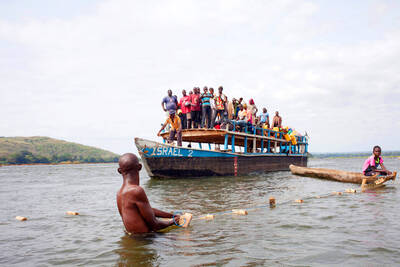
RIVER TRAGEDY: Local fishers and residents helped rescue people after the vessel capsized, while motorbike taxis evacuated some of the injured At least 58 people going to a funeral died after their overloaded river boat capsized in the Central African Republic’s (CAR) capital, Bangui, the head of civil protection said on Saturday. “We were able to extract 58 lifeless bodies,” Thomas Djimasse told Radio Guira. “We don’t know the total number of people who are underwater. According to witnesses and videos on social media, the wooden boat was carrying more than 300 people — some standing and others perched on wooden structures — when it sank on the Mpoko River on Friday. The vessel was heading to the funeral of a village chief in


 RSS
RSS