


A day after a historic peace deal was signed with rebels in Aceh province, Indonesian President Susilo Bambang Yudhoyono shifted his focus yesterday to the country's other simmering independence battle in resource-rich Papua.
In his first major address to parliament since becoming president last October, Yudhoyono ruled out independence for Papua -- instead offering increased autonomy -- and warned against any "foreign interference" in settling the matter.
"The government wishes to solve the issue in Papua in a peaceful, just and dignified manner by emphasizing dialogue and a persuasive approach," he said. "The policy for the settlement of the issue in Papua is ... special autonomy, as a just, comprehensive and dignified solution."
Indonesia took over Papua from Dutch colonial rule in 1963. Its sovereignty over the region was formalized in 1969 through a stage-managed vote by about 1,000 community leaders that critics dismissed as a sham.
A small, poorly armed separatist movement has battled Jakarta's rule ever since. About 100,000 Papuans -- one-sixth of the population -- have died in military operations.
Some hope for resolving the Papua dispute rests with a 2001 Indonesian law meant to give the province "special autonomy" in running its government and managing its abundant oil, gold, copper and timber resources.
A few hundred protesters demonstrated yesterday against Papuan independence outside the US consulate in Surabay. Meanwhile in Papua, Yudhoyono's comments were criticized by pro-independence supporters as "disappointing" but were welcomed by more moderate leaders.
"We appreciate the president's offer to solve the issue in Papua in a peaceful and dignified manner by emphasizing dialogue and a persuasive approach," said Leo Imbiri, general secretary of the Papua Tribal Council. "We hope this isn't an old song that is always repeated by the government without any real implementation."
The issue of Papua's future has taken on increased importance following Monday's signing of a peace agreement between the government and separatist rebels in Aceh. The government and the Free Aceh Movement (GAM) signed a peace accord in Helsinki on Monday after six months of negotiations, paving the way for an end to almost three decades of bloodshed.
Both sides agreed to end hostilities immediately in the province of 4.1 million people at the northern end of Sumatra island. The agreement contains provisions for an amnesty for separatist rebels, the creation of political parties allowing ex-guerrillas to run for office in the province and a withdrawal of non-local security forces by the end of the year.
The agreement also provides amnesty for GAM members and gives the province limited self-government and control over 70 percent of the revenue from its mineral wealth, including oil and natural gas.
An amnesty is due to be granted to GAM members and political prisoners within two weeks, and a human rights court and a truth and reconciliation commission will be established. GAM agreed to decommission its arms and demobilize its 3,000 fighters under the accord, which will be monitored by 200 unarmed foreigners.

‘IN A DIFFERENT PLACE’: The envoy first visited Shanghai, where he attended a Chinese basketball playoff match, and is to meet top officials in Beijing tomorrow US Secretary of State Antony Blinken yesterday arrived in China on his second visit in a year as the US ramps up pressure on its rival over its support for Russia while also seeking to manage tensions with Beijing. The US diplomat tomorrow is to meet China’s top brass in Beijing, where he is also expected to plead for restraint as Taiwan inaugurates president-elect William Lai (賴清德), and to raise US concerns on Chinese trade practices. However, Blinken is also seeking to stabilize ties, with tensions between the world’s two largest economies easing since his previous visit in June last year. At the

UNSETTLING IMAGES: The scene took place in front of TV crews covering the Trump trial, with a CNN anchor calling it an ‘emotional and unbelievably disturbing moment’ A man who doused himself in an accelerant and set himself on fire outside the courthouse where former US president Donald Trump is on trial has died, police said yesterday. The New York City Police Department (NYPD) said the man was declared dead by staff at an area hospital. The man was in Collect Pond Park at about 1:30pm on Friday when he took out pamphlets espousing conspiracy theories, tossed them around, then doused himself in an accelerant and set himself on fire, officials and witnesses said. A large number of police officers were nearby when it happened. Some officers and bystanders rushed

Beijing is continuing to commit genocide and crimes against humanity against Uyghurs and other Muslim minorities in its western Xinjiang province, U.S. Secretary of State Antony Blinken said in a report published on Monday, ahead of his planned visit to China this week. The State Department’s annual human rights report, which documents abuses recorded all over the world during the previous calendar year, repeated language from previous years on the treatment of Muslims in Xinjiang, but the publication raises the issue ahead of delicate talks, including on the war in Ukraine and global trade, between the top U.S. diplomat and Chinese
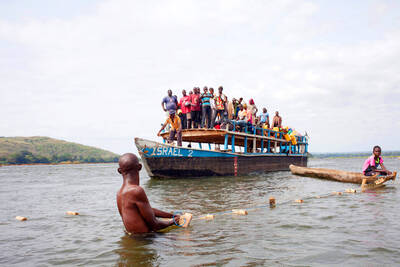
RIVER TRAGEDY: Local fishers and residents helped rescue people after the vessel capsized, while motorbike taxis evacuated some of the injured At least 58 people going to a funeral died after their overloaded river boat capsized in the Central African Republic’s (CAR) capital, Bangui, the head of civil protection said on Saturday. “We were able to extract 58 lifeless bodies,” Thomas Djimasse told Radio Guira. “We don’t know the total number of people who are underwater. According to witnesses and videos on social media, the wooden boat was carrying more than 300 people — some standing and others perched on wooden structures — when it sank on the Mpoko River on Friday. The vessel was heading to the funeral of a village chief in


 RSS
RSS