


With some fanfare in the weeks since the London bombings, the British authorities have quickly detained the main surviving suspects and, just as rapidly, embarked on a high-profile campaign to expel prominent foreign-born Islamic figures as part of promised measures against extremism.
But the investigation into the lethal July 7 attacks and the failed July 21 attacks seems to have undergone some less-publicized changes that have left important questions -- in public at least -- unanswered. Some leads, once hotly pursued, have fizzled out. Others have proved to be blind alleys.
Investigators now doubt their early estimation that the two groups of attackers had an organizational link to al-Qaeda, a senior British police official said, though the attackers might have taken their inspiration from it.
Nor have investigators identified any outside mastermind, or any evidence of an operational link between the groups of attackers.
Initially, Ian Blair, commissioner of London's Metropolitan Police, said the July 21 attacks had some "resonance" with the earlier bombing: Both attacks made targets of three subway trains and a bus; both involved young Muslim men with bulky bags or backpacks laden with homemade explosives capable, in his words, of wreaking "carnage."
Since then, comparisons of the two sets of attackers have become more nuanced. The groups differed in makeup. Three of the four July 7 bombers, who died with their 52 victims in subways and on a double-decker bus in London, were concentrated near Leeds in the north and were of Pakistani descent. The July 21 group, whose four bombs failed to go off in the London transit system, came from disparate areas, north, south and west of the city, and several of them were of African descent, from Somalia, Ethiopia and Eritrea.
One of the suspects in the July 21 attacks, Hussain Osman, who is also known as Hamdi Issac and who fled to Italy, is an Ethiopian-born father of three who told investigators in Rome that their attacks were "copycat" attacks designed to frighten, but not kill, Britons, according to his court-appointed lawyer, Antoinette Sonnessa.
Still, investigators have not ruled out the possibility that the groups were linked, said diplomats in London, as well as European and US law enforcement officials.
Philosophically, both groups seemed driven by a reverence for Osama bin Laden.
Two weeks ago, the investigators thought they had identified a third cell, of six or seven men, that was preparing for another attack. But in recent interviews, two senior diplomats in London who are kept informed of the investigation and an American official said investigators had concluded that the intelligence was faulty.
The investigation is entering a more difficult, grinding phase. Three of the four main suspects in the July 21 attack have been charged, which means that their interrogations have effectively ended, and that the police are legally severely limited in what they can say publicly about the case.
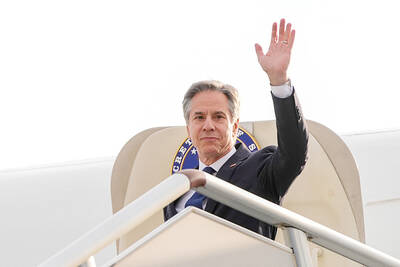
‘IN A DIFFERENT PLACE’: The envoy first visited Shanghai, where he attended a Chinese basketball playoff match, and is to meet top officials in Beijing tomorrow US Secretary of State Antony Blinken yesterday arrived in China on his second visit in a year as the US ramps up pressure on its rival over its support for Russia while also seeking to manage tensions with Beijing. The US diplomat tomorrow is to meet China’s top brass in Beijing, where he is also expected to plead for restraint as Taiwan inaugurates president-elect William Lai (賴清德), and to raise US concerns on Chinese trade practices. However, Blinken is also seeking to stabilize ties, with tensions between the world’s two largest economies easing since his previous visit in June last year. At the

UNSETTLING IMAGES: The scene took place in front of TV crews covering the Trump trial, with a CNN anchor calling it an ‘emotional and unbelievably disturbing moment’ A man who doused himself in an accelerant and set himself on fire outside the courthouse where former US president Donald Trump is on trial has died, police said yesterday. The New York City Police Department (NYPD) said the man was declared dead by staff at an area hospital. The man was in Collect Pond Park at about 1:30pm on Friday when he took out pamphlets espousing conspiracy theories, tossed them around, then doused himself in an accelerant and set himself on fire, officials and witnesses said. A large number of police officers were nearby when it happened. Some officers and bystanders rushed
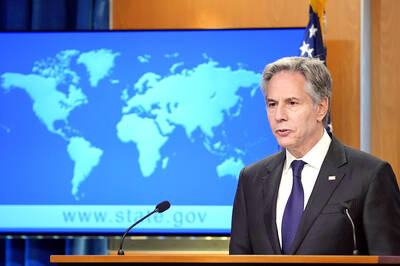
Beijing is continuing to commit genocide and crimes against humanity against Uyghurs and other Muslim minorities in its western Xinjiang province, U.S. Secretary of State Antony Blinken said in a report published on Monday, ahead of his planned visit to China this week. The State Department’s annual human rights report, which documents abuses recorded all over the world during the previous calendar year, repeated language from previous years on the treatment of Muslims in Xinjiang, but the publication raises the issue ahead of delicate talks, including on the war in Ukraine and global trade, between the top U.S. diplomat and Chinese
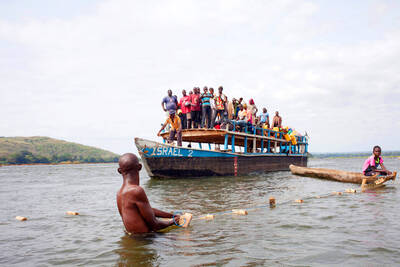
RIVER TRAGEDY: Local fishers and residents helped rescue people after the vessel capsized, while motorbike taxis evacuated some of the injured At least 58 people going to a funeral died after their overloaded river boat capsized in the Central African Republic’s (CAR) capital, Bangui, the head of civil protection said on Saturday. “We were able to extract 58 lifeless bodies,” Thomas Djimasse told Radio Guira. “We don’t know the total number of people who are underwater. According to witnesses and videos on social media, the wooden boat was carrying more than 300 people — some standing and others perched on wooden structures — when it sank on the Mpoko River on Friday. The vessel was heading to the funeral of a village chief in


 RSS
RSS