


Many death row inmates proclaim their innocence, but Roy "Hog" Roberts, a big man, loud and profane, was adamant. He was so convinced of his innocence that in the waning days before his 1999 execution for the murder of a prison guard, he demanded a polygraph test. Attorney Bruce Livingston looked at the results and walked into Roberts' small gray cell at Missouri's Potosi Correctional Center and told him the news: He passed. The test indicated Roberts was telling the truth when he said he did not hold down guard Tom Jackson while the other inmates stabbed him.
Tears rolled down the big man's cheeks. His voice grew unusually quiet. "When do I get out of here?" he asked.
Livingston remembers the heartbreak of explaining the polygraph was of no value unless it swayed the governor. It didn't. A few days later, Roberts was put to death.
Roberts' case is back in the spotlight amid heightened scrutiny of the death penalty in Missouri -- and a new investigation in a separate case into whether the state executed an innocent man.
In 2000, the anti-death penalty group Equal Justice USA released a national report citing 16 potential cases of wrongful executions. Both Missouri cases are among them.
"I think if I had to list all 16 I would put him [Roberts] first," said Claudia Whitman, who wrote the report. "There was really nothing there to convict him."
Death penalty opponents are discussing the Roberts case now that prosecutors are trying to determine if Larry Griffin, executed in 1995 for a drive-by killing in another case, was innocent. So far, no one has asked the state to re-open the Roberts case. Whitman said it simply was not exhaustive enough to merit asking for a re-examination.
Griffin was the immediate suspect in the drive-by killing of 19-year-old drug dealer Quintin Moss, who was shot 13 times. Revenge was the suspected motive in the 1980 slaying: Weeks earlier, Moss was believed to have killed Griffin's older brother. The only eyewitness testimony at Griffin's trial came from Robert Fitzgerald, a career criminal from Boston who was in St. Louis under the Federal Witness Protection Program.
Michigan Law School professor Sam Gross, who spent a year investigating the case, said in his report that Fitzgerald "developed a reputation as a snitch who couldn't produce convictions because Boston juries wouldn't believe him." Fitzgerald died last year.
Gross cited two other factors that shed doubt on Griffin's guilt: The first police officer at the scene now says the story told by Fitzgerald was false. And a second shooting victim, who did not testify at trial, now says Fitzgerald was not present at the shooting.
Gordon Ankney, who prosecuted the case, believed Fitzgerald's testimony. He also noted that an off-duty officer saw Griffin get in the 1968 Chevy Impala used in the shooting the day of the murder.
Still, Gross' report offered enough new information that even members of the Moss family asked to reopen the case.
Missouri has executed 64 men since the death penalty was reinstated in 1989. By the mid-1990s, executions had become so common they drew few protesters.
But the Roberts case came at a time of renewed interest. During a 1999 visit to St. Louis, Pope John Paul II asked Governor Mel Carnahan to spare the life of convicted killer Darrell Mease, who was days away from execution. Carnahan, a Baptist Democrat, commuted the sentence to life in prison, citing "the extraordinary circumstances of the pope's request."
Roberts' execution was set a few weeks later. Livingston suggested the decision to execute him was partly political, noting the governor was preparing to run for the Senate in 2000.
"Carnahan was still taking serious flack for the Mease case," Livingston said. "It was Roy's bad luck to be next up."
Friends of Roberts say bad timing was part of his life. He was once convicted of a restaurant robbery to which another man later confessed.
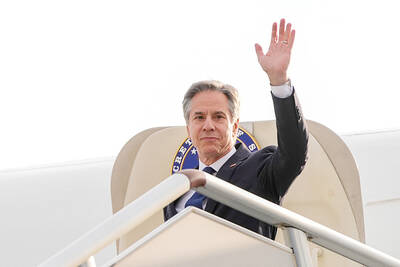
‘IN A DIFFERENT PLACE’: The envoy first visited Shanghai, where he attended a Chinese basketball playoff match, and is to meet top officials in Beijing tomorrow US Secretary of State Antony Blinken yesterday arrived in China on his second visit in a year as the US ramps up pressure on its rival over its support for Russia while also seeking to manage tensions with Beijing. The US diplomat tomorrow is to meet China’s top brass in Beijing, where he is also expected to plead for restraint as Taiwan inaugurates president-elect William Lai (賴清德), and to raise US concerns on Chinese trade practices. However, Blinken is also seeking to stabilize ties, with tensions between the world’s two largest economies easing since his previous visit in June last year. At the
Nearly half of China’s major cities are suffering “moderate to severe” levels of subsidence, putting millions of people at risk of flooding, especially as sea levels rise, according to a study of nationwide satellite data released yesterday. The authors of the paper, published by the journal Science, found that 45 percent of China’s urban land was sinking faster than 3mm per year, with 16 percent at more than 10mm per year, driven not only by declining water tables, but also the sheer weight of the built environment. With China’s urban population already in excess of 900 million people, “even a small portion

UNSETTLING IMAGES: The scene took place in front of TV crews covering the Trump trial, with a CNN anchor calling it an ‘emotional and unbelievably disturbing moment’ A man who doused himself in an accelerant and set himself on fire outside the courthouse where former US president Donald Trump is on trial has died, police said yesterday. The New York City Police Department (NYPD) said the man was declared dead by staff at an area hospital. The man was in Collect Pond Park at about 1:30pm on Friday when he took out pamphlets espousing conspiracy theories, tossed them around, then doused himself in an accelerant and set himself on fire, officials and witnesses said. A large number of police officers were nearby when it happened. Some officers and bystanders rushed

Beijing is continuing to commit genocide and crimes against humanity against Uyghurs and other Muslim minorities in its western Xinjiang province, U.S. Secretary of State Antony Blinken said in a report published on Monday, ahead of his planned visit to China this week. The State Department’s annual human rights report, which documents abuses recorded all over the world during the previous calendar year, repeated language from previous years on the treatment of Muslims in Xinjiang, but the publication raises the issue ahead of delicate talks, including on the war in Ukraine and global trade, between the top U.S. diplomat and Chinese


 RSS
RSS