


Australia will consider broadening its immigration laws to deport immigrants -- including permanent residents and naturalized citizens -- who hold extremist views, the attorney general said yesterday.
Under existing laws, the government can deny entry to extremists on character, as well as security grounds, Attorney-General Philip Ruddock said.
"One of the aspects of the character tests that we have applied for entry to Australia has included people who may promote views that are broadly unacceptable to the Australian community," Ruddock told reporters in Sydney.
He said the government will now consider widening that law to cover immigrants already in the country, including permanent residents and naturalized citizens, to deport those who promote extremist views.
Ruddock's comments came after the federal police commissioner, Mick Keelty, confirmed this week that intelligence authorities are aware of about 60 Islamic extremists living in Australia, including a self-styled Islamic cleric who appeared on television calling Osama bin Laden a "great man."
The Australian-Algerian cleric, Abu Bakr, also said that it was acceptable under Islamic law for Australian Muslims to fight a holy war against coalition forces in Iraq.
Under existing laws, naturalized Australian citizens can only be removed from the country if they are found to have obtained their citizenship through fraud, Ruddock said.
Ruddock, however, acknowledged that it would be difficult to deport a naturalized citizen because those stripped of their Australian nationality would be left "stateless."
"The idea that you could remove people who were stateless is ... somewhat naive," Ruddock said. "Countries won't accept people back unless they are their citizens."
The issue will likely be on the agenda of a counterrorism meeting of state and federal leaders called by Prime Minister John Howard for next month to discuss tightening security in the country.
evacuation plan
In other related news, the newly elected leader of Australia's most populous state yesterday defended his decision to release details of Sydney's evacuation plan in the event of a terror attack.
New South Wales Premier Morris Iemma stood by the release of information, saying the plan had been developed in cooperation with emergency services personnel.
Iemma's "counter-terrorism evacuation plan," released Friday, revealed which parts of the city residents of Sydney would be marshalled to in the event of an attack.
It has been criticized as merely giving information to potential terrorists on where to detonate secondary bombs to cause even more injury and damage.
But Iemma said the sites were under constant surveillance by police.
"Quite clearly you need to provide information for office workers, for shoppers as to where they should go if there's an incident," he told reporters.
confusion and fear
"What we do know from attacks and from incidents is that they do cause confusion and fear and there is a risk of further injury as a result of fear and confusion," he said.
"This is designed to minimize that and it is about minimizing the risk," he added.
Security experts have criticized the plan, which will be administered by volunteers.
"Why would they release anything like that," counter-terrorism expert Tony Loughran said.
"It doesn't make sense to reveal these locations. In this type of situation, there is still the potential for another payload to go off. And, anyway, unless you are at the epicenter, you should stay inside," he told the Sydney Morning Herald.
Iemma became premier on Wednesday following the resignation of Bob Carr after more than 10 years in the job.
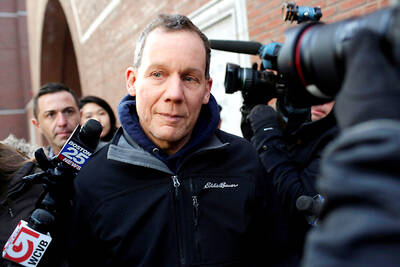
An American scientist convicted of lying to US authorities about payments from China while he was at Harvard University has rebuilt his research lab in Shenzhen, China, to pursue technology the Chinese government has identified as a national priority: embedding electronics into the human brain. Charles Lieber, 67, is among the world’s leading researchers in brain-computer interfaces. The technology has shown promise in treating conditions such as amyotrophic lateral sclerosis and restoring movement in paralyzed people. It also has potential military applications: Scientists at the Chinese People’s Liberation Army have investigated brain interfaces as a way to engineer super soldiers by boosting
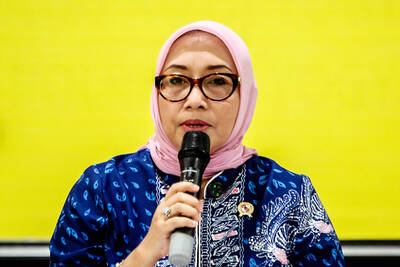
Indonesian police have arrested 13 people after shocking images of alleged abuse against small children at a daycare center went viral, sparking outrage across the nation, officials said on Monday. Police on Friday last week raided Little Aresha, a daycare center in Yogyakarta on Java island, following a report from a former employee. CCTV footage circulating on social media showed children, most younger than two, lying on the floor wearing only diapers, their hands and feet bound with rags. The police have confirmed that the footage is authentic. Police said they also found 20 children crammed into a room just 3m by 3m. “So

From post offices and parks to stations and even the summit of Mount Fuji, Japan’s vending machines are ubiquitous, but with the rapid pace of inflation cooling demand for their drinks, operators are being forced to rethink the business. Last month beverage giant DyDo Group Holdings announced it would remove about 20,000 vending machines — about 7 percent of their stock nationwide — by January next year, to “reconstruct a profitable network.” Pokka Sapporo Food & Beverage, based in Nagoya, also said last month it would sell its 40,000-machine operation to Osaka-based Lifedrink Co. “The strength of the vending machine
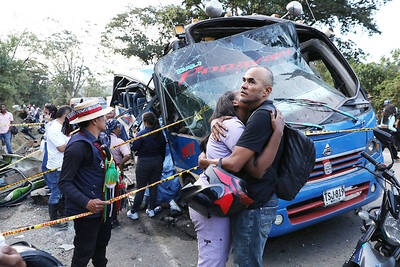
A highway bomb attack in a restive region of southwestern Colombia on Saturday killed 14 people and injured at least 38, the latest spate of violence ahead of next month’s presidential election. Authorities blamed the attack in the Cauca department — a conflict-ridden, coca-growing region — on dissidents of the now-disbanded FARC guerrilla army, who have been sowing violence across the country. “Those who carried out this attack ... are terrorists, fascists and drug traffickers,” Colombian President Gustavo Petro said on social media. “I want our very best soldiers to confront them,” he added. The leftist leader blamed the bombing


 RSS
RSS