


Egypt's top Islamic cleric delivered a fierce sermon against terrorism Friday at the main mosque of Sharm el-Sheik, the Red Sea resort struck in deadly bombings last weekend. Even the Lebanese guerrilla group Hezbollah, branded as terrorist by Washington, says Muslim clerics have to act to curb extremism.
After the bloodshed in Iraq and this month's London bombings, the Sharm attack has deepened what has been in a growing debate in the Arab and Islamic world -- how Islam should deal with terrorists who act in its name and whether intolerance passed on by some clerics encourages radicalism.
Mohammed Sayyed Tantawi, grand imam of Al-Azhar -- one of the Sunni world's most prestigous institutions -- delivered a weekly Friday prayer sermon at the Sharm's "Peace Mosque," which was packed by hundreds of worshippers from the resort, still reeling from last Saturday's bombings.
Tantawi told the worshippers that "even polytheists who come to Egypt to see its civilization, who didn't come to harm you, you have to protect them and treat them in a good way."
The cleric used the Arabic word "mushrikin" -- or "polytheists" -- a word heavy with negative connotations in Islam. The Koran, Islam's holy book, repeatedly denounces "mushrikin," while accepting Jews and Christians as fellow monotheists. Islamic radicals often rail against "shirk" -- polytheism -- and its followers. Those who killed dozens of innocents, "have no justification," and if they claim they are obeying orders of Islam, "then they are liars, liars and charlatans and Islam disavows them," he added.
"The aggressors who blow up themselves, their cars and bombs against innocent men, women, and children will not be given any mercy by God ... they will be cursed by God and his angels," Tantawi said, urging residents of the Sinai to help find the Sharm bombers.
Tantawi has emerged as a strong voice against terrorism in recent months. Early this month, he harshly condemned Islamic insurgents in Iraq -- who even some moderate Muslims feel are fighting for a just cause against the US occupation -- saying all Iraqis and Arabs should unite to purge Iraq of "their filth and viciousness."
Egyptian investigators have been focusing on the likelihood that homegrown Islamic militant cells in Sinai -- possibly with international links -- carried out the Sharm bombings, in which two car bombs and a knapsack bomb ripped through a luxury hotel, a neighborhood full of Egyptians and the entrance to a beach promenade. The official death toll stands at 64, but could rise to 88.
In Lebanon, the militant Shiite Muslim Hezbollah group said immediately after the Sharm attack that "mass murder attacks against innocent people ... require a decisive stance by [Muslim] clerics" against violence. Hezbollah is considered a terrorist organization by the US, which accuses it of supporting Palestinian militants against Israel. But in Lebanon, it's seen as a nationalist force after its long fight against Israeli troops that occupied southern Lebanon until 2000.
The guerrilla group sharply opposes the US troop presence in Iraq -- but with its Iraqi Shiite brethren frequently falling victim in bombings, it has grown more vocal in comdemning the insurgency in Iraq.
Lebanon's most senior Shiite Muslim cleric, Grand Ayatollah Mohammed Hussein Fadlallah said after the Sharm attacks that all Muslims must condemn them, which he blamed on "backward minds that do not understand Islamic texts." But, he said, the "evil phenomenon" of terrorism "stems from the policy of arrogance [by the US and Israel]."
He appealed to his congregation, trying to explain the proper meaning of "jihad" -- a word often translated as "holy war" but more broadly meant as a "struggle" for Islam against oppression.
Jihad, he said, is by word, not by action. "With good words, we can influence and impress the rest of world, not by horrific actions."
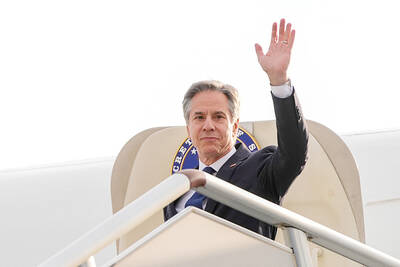
‘IN A DIFFERENT PLACE’: The envoy first visited Shanghai, where he attended a Chinese basketball playoff match, and is to meet top officials in Beijing tomorrow US Secretary of State Antony Blinken yesterday arrived in China on his second visit in a year as the US ramps up pressure on its rival over its support for Russia while also seeking to manage tensions with Beijing. The US diplomat tomorrow is to meet China’s top brass in Beijing, where he is also expected to plead for restraint as Taiwan inaugurates president-elect William Lai (賴清德), and to raise US concerns on Chinese trade practices. However, Blinken is also seeking to stabilize ties, with tensions between the world’s two largest economies easing since his previous visit in June last year. At the
Nearly half of China’s major cities are suffering “moderate to severe” levels of subsidence, putting millions of people at risk of flooding, especially as sea levels rise, according to a study of nationwide satellite data released yesterday. The authors of the paper, published by the journal Science, found that 45 percent of China’s urban land was sinking faster than 3mm per year, with 16 percent at more than 10mm per year, driven not only by declining water tables, but also the sheer weight of the built environment. With China’s urban population already in excess of 900 million people, “even a small portion

UNSETTLING IMAGES: The scene took place in front of TV crews covering the Trump trial, with a CNN anchor calling it an ‘emotional and unbelievably disturbing moment’ A man who doused himself in an accelerant and set himself on fire outside the courthouse where former US president Donald Trump is on trial has died, police said yesterday. The New York City Police Department (NYPD) said the man was declared dead by staff at an area hospital. The man was in Collect Pond Park at about 1:30pm on Friday when he took out pamphlets espousing conspiracy theories, tossed them around, then doused himself in an accelerant and set himself on fire, officials and witnesses said. A large number of police officers were nearby when it happened. Some officers and bystanders rushed

Beijing is continuing to commit genocide and crimes against humanity against Uyghurs and other Muslim minorities in its western Xinjiang province, U.S. Secretary of State Antony Blinken said in a report published on Monday, ahead of his planned visit to China this week. The State Department’s annual human rights report, which documents abuses recorded all over the world during the previous calendar year, repeated language from previous years on the treatment of Muslims in Xinjiang, but the publication raises the issue ahead of delicate talks, including on the war in Ukraine and global trade, between the top U.S. diplomat and Chinese


 RSS
RSS