

Hundreds of thousands of Muslims have thought about leaving Britain after the London bombings, according to a new Guardian/ICM poll. The figure illustrates how widespread fears are of an anti-Muslim backlash following the July 7 bombings carried out by British-born suicide bombers.
The poll also shows that tens of thousands of Muslims have suffered from increased Islamophobia, with one in five saying they or a family member have faced abuse or hostility since the attacks.
Police have recorded more than 1,200 suspected Islamophobic incidents across the country ranging from verbal abuse to one murder in the last three weeks.
The poll suggests the headline figure is a large underestimate. The poll came as British Muslim leaders and police met to try to boost recruitment of Muslim officers, improve efforts to protect Muslims from a backlash, and improve the flow of information from Muslims to the police about suspected terrorist activity.
Nearly two-thirds of Muslims told pollsters that they had thought about their future in Britain after the attacks, with 63 percent saying they had considered whether they wanted to remain in the UK. Older Muslims were more uneasy about their future, with 67 percent of those age 35 or over having contemplated their future home country compared to 61 percent among those 34 or under.
Britain's Muslim population is estimated at 1.6 million, with 1.1 million over 18, meaning more than half a million may have considered the possibility of leaving. Three in 10 are pessimistic about their children's future in Britain, while 56 percent said they were optimistic. Nearly eight in 10 Muslims believe Britain's participation in invading Iraq was a factor leading to the bombings, compared to nearly two-thirds of all Britons surveyed for the Guardian earlier this month.
Prime Minister Tony Blair has repeatedly denied such a link. Muslim clerics' and leaders' failure to root out extremists is a factor behind the attacks identified by 57 percent of Muslims, compared to 68 percent of all Britons, and nearly two-thirds of Muslims identify racist and Islamophobic behavior as the cause compared, to 57 percent of all Britons.
The general population and Muslims apportion virtually the same amount of blame to the bombers and their handlers, with eight in 10 or more citing these as factors.

A Chinese artificial intelligence (AI) cybersecurity tool called ARTEX was used in a spate of recent hacks of Japanese companies, the subsidiary of a major Tokyo-based Internet company yesterday. Dozens of Japanese companies, from restaurant chains to a car hire operator, have disclosed unauthorized access or data breaches in the past weeks — potentially impacting millions of customers. The information security arm of GMO Internet Group said it had “confirmed ARTEX was used” having investigated the attacks in collaboration with external organizations. “It also became clear ... the attacks were almost exclusively targeting Japan,” GMO cybersecurity center director Daiki Fukumori

On his terrace overlooking the forest in eastern Pennsylvania, Ed Negra lays out four letters. All are from a developer promising a US$10,000 check to each household once its data center is running. “I call it a bribe,” the US retiree said. The scene is picture-perfect. Autumn leaves are turning russet, and there is a stunning mountain view in this corner of Pennsylvania, a key state in the US’ upcoming midterm elections. “We thought it was a beautiful place to retire,” said the septuagenarian, who used to manage a large building-supply store in neighboring New Jersey. He and his wife settled in a sprawling
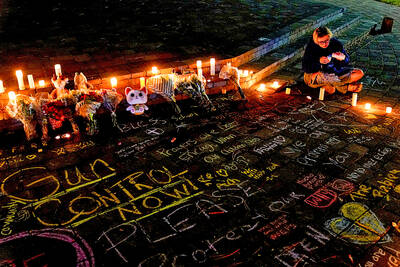
A 16-year-old on Thursday shot his way through locked doors to get into an elementary school in Bend, Oregon, killing three children and a teacher. He was then shot by a person at the scene who followed him inside, authorities said. The suspect was found dead inside the school minutes after the shooting was first reported, Bend Police Chief Mike Krantz said. The three children killed were aged 5, 8 and 11. Another child, 7, and a teacher, 54, were injured and taken to the hospital in critical condition, he said. The first 911 call came just before 1pm from a person in
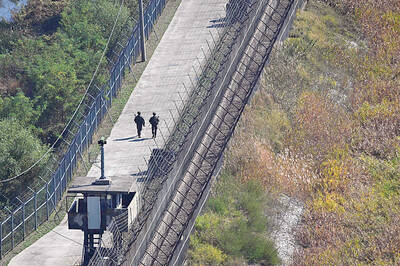
A STEP UP: The moving of small military positions forward should be taken seriously amid the North’s recent demonstrations of its firepower, an analyst said North Korea has moved new units into “firing positions,” the sister of leader Kim Jong-un said yesterday, days after Pyongyang warned it was considering deploying additional strike means to its border with South Korea. Tensions between Seoul and Pyongyang have soared since the South last month blamed an explosion inside the heavily fortified demilitarized zone (DMZ) separating the two countries on landmines laid by North Korea, an accusation it has rejected. “Our military leadership underlined the need to make those rogues aware that our new firepower units have taken their firing positions,” state media cited Kim Yo-jong as saying. Her statement came a


 RSS
RSS