


The administration of US President George W. Bush is looking to scrap a vestige of the Cold War, a half-century of acrimonious relations with India.
Already, however, US officials are signaling that India's prime minister, during his visit to Washington, will get a firm "no" for now to one of his country's top priorities -- a permanent seat on the key Security Council at the UN. The US, Russia, China, Britain and France now hold those spots.
Considering a litany of alleged mismanagement, corruption and other failings at the world body, US officials think an overhaul of UN operations must be under way before reshaping the Security Council can be considered.
Pressure around the meeting was eased somewhat Sunday when foreign ministers of populous India, Brazil, Germany and Japan said they would not seek a change in the council's makeup until the end of July while they negotiate with the 53-nation African Union.
Council membership was likely to be among few negatives to interfere with Prime Minister Manmohan Singh's official visit that started yesterday with an elaborate arrival ceremony on the White House lawn, a meeting and news conference with President Bush and a gala dinner.
Administration officials say the pomp is designed to emphasize the growing importance to the US of India, a rising economic and military power whose newfound affinity for the US is considered by Bush to be a major success of his foreign policy.
India's first prime minister, Jawaharlal Nehru, was a founder of the Cold War's Nonaligned Movement, which Nehru considered a "third way" beyond what he considered the imperialism of both Western capitalism and Soviet-style communism. In practice it gravitated toward the latter, which often put India severely at odds with US policies.
The detente began 18 months ago with signing of the Next Steps in the Strategic Partnership accord. It laid out a path to bring the two democracies into a fully cooperative relationship in economic and military affairs, energy, the environment, space and technology and other matters. A military cooperation agreement was signed this year, and as many as 16 new cooperative arrangements are planned for the Singh visit.
For now, however, the UN question will be a difficult sell for the Indians.
"We believe very strongly that the larger issues of UN reform also have to be addressed; and if we have UN Security Council reform out of phase with the larger UN reforms, then we will not do justice to the organization," Secretary of State Condoleezza Rice told an Indian interviewer during the weekend.
After she spoke, the Bush administration made it even clearer. A senior official said that if the vote on expansion were now, the US would vote against its own position, stated last month, that endorsed an addition of "two or so" permanent members, one of them Japan, without veto power.
At a meeting in New York on Sunday, the foreign ministers of India, Japan, Germany and Brazil acknowledged they lacked the necessary two-thirds majority of the 191-member UN General Assembly for change without the backing of the African nations, which have their own proposal for reorganizing the Security Council.
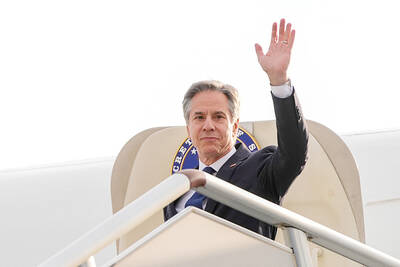
‘IN A DIFFERENT PLACE’: The envoy first visited Shanghai, where he attended a Chinese basketball playoff match, and is to meet top officials in Beijing tomorrow US Secretary of State Antony Blinken yesterday arrived in China on his second visit in a year as the US ramps up pressure on its rival over its support for Russia while also seeking to manage tensions with Beijing. The US diplomat tomorrow is to meet China’s top brass in Beijing, where he is also expected to plead for restraint as Taiwan inaugurates president-elect William Lai (賴清德), and to raise US concerns on Chinese trade practices. However, Blinken is also seeking to stabilize ties, with tensions between the world’s two largest economies easing since his previous visit in June last year. At the
Nearly half of China’s major cities are suffering “moderate to severe” levels of subsidence, putting millions of people at risk of flooding, especially as sea levels rise, according to a study of nationwide satellite data released yesterday. The authors of the paper, published by the journal Science, found that 45 percent of China’s urban land was sinking faster than 3mm per year, with 16 percent at more than 10mm per year, driven not only by declining water tables, but also the sheer weight of the built environment. With China’s urban population already in excess of 900 million people, “even a small portion

UNSETTLING IMAGES: The scene took place in front of TV crews covering the Trump trial, with a CNN anchor calling it an ‘emotional and unbelievably disturbing moment’ A man who doused himself in an accelerant and set himself on fire outside the courthouse where former US president Donald Trump is on trial has died, police said yesterday. The New York City Police Department (NYPD) said the man was declared dead by staff at an area hospital. The man was in Collect Pond Park at about 1:30pm on Friday when he took out pamphlets espousing conspiracy theories, tossed them around, then doused himself in an accelerant and set himself on fire, officials and witnesses said. A large number of police officers were nearby when it happened. Some officers and bystanders rushed

Beijing is continuing to commit genocide and crimes against humanity against Uyghurs and other Muslim minorities in its western Xinjiang province, U.S. Secretary of State Antony Blinken said in a report published on Monday, ahead of his planned visit to China this week. The State Department’s annual human rights report, which documents abuses recorded all over the world during the previous calendar year, repeated language from previous years on the treatment of Muslims in Xinjiang, but the publication raises the issue ahead of delicate talks, including on the war in Ukraine and global trade, between the top U.S. diplomat and Chinese


 RSS
RSS