


As officials across Europe scrambled to beef up security on Friday in the wake of the London bombings, the tension was clearly greatest here in Italy, a country many experts regard as the next terrorism target.
On Thursday night and Friday, leaders of Italy's Parliament, Foreign Ministry, Interior Ministry, Secret Service and military met nearly round the clock, "evaluating the terrorist menace in Italy and strengthening preventive security measures," the Interior Ministry said.
The pace of the meetings was a tacit acknowledgment of what most of the Italian news media highlighted on Friday, in the words of the daily Il Messaggero: "Now an attack in our house is more likely than ever."
The reasons are simple: Italy's prime minister, Silvio Berlusconi, has been one of the US' staunchest allies in Iraq, committing thousands of troops, despite widespread popular opposition. Also, Berlusconi faces a difficult re-election campaign in the coming months. It is the same sort of situation that preceded the train bombings in Madrid in March last year that killed 191 people.
"Obviously, we are a target because we are engaged in Iraq and we have elections in the next year," said Francesco Sidoti, a security expert at the University of L'Aquila. "Everyone is thinking about that."
The Spanish terrorist attack occurred three days before a national election. After the bombings, the Socialist candidate, Jose Luis Rodriguez Zapatero -- who opposed the war in Iraq -- won handily, beating the conservative incumbent. He immediately withdrew Spanish troops.
While some Italian opposition politicians used the occasion to urge Berlusconi to remove troops from Iraq without delay, others said he should stick to the current course. On Friday, he repeated his previously stated intention to begin removing some troops in September.
Though the Italian Interior Ministry did not release any new security plans on Friday, it did reveal for the first time a few components of its evolving anti-terrorism programs. They include, for example, the addition of thousands of police officers and soldiers to guard potential terrorist targets.
At the airport, border agents pored over the passports and suitcases of incoming passengers, especially those arriving from the Middle East. In Rome's subway system, the police were out in larger than usual numbers.
"I hope it won't happen here, but now the only big one missing is Rome," said a security guard at the station under the Spanish Steps, who refused to give his name.
Though anti-terrorism in Italy is largely the responsibility of national officials, the city of Milan was on "maximum" alert, said a spokesman for the Milan Prefecture on Friday.
"We have a plan that we put into place after 9/11 and perfected after Madrid -- when we saw that a European capital could be attacked -- and it calls for more intense patrolling of sensitive targets," he said.
Video cameras already oversee high-risk areas like train stations and "neighborhoods with a high density of immigrants," said the municipal security commissioner.
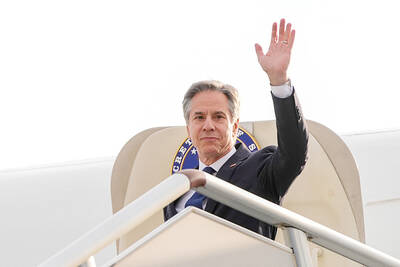
‘IN A DIFFERENT PLACE’: The envoy first visited Shanghai, where he attended a Chinese basketball playoff match, and is to meet top officials in Beijing tomorrow US Secretary of State Antony Blinken yesterday arrived in China on his second visit in a year as the US ramps up pressure on its rival over its support for Russia while also seeking to manage tensions with Beijing. The US diplomat tomorrow is to meet China’s top brass in Beijing, where he is also expected to plead for restraint as Taiwan inaugurates president-elect William Lai (賴清德), and to raise US concerns on Chinese trade practices. However, Blinken is also seeking to stabilize ties, with tensions between the world’s two largest economies easing since his previous visit in June last year. At the
Nearly half of China’s major cities are suffering “moderate to severe” levels of subsidence, putting millions of people at risk of flooding, especially as sea levels rise, according to a study of nationwide satellite data released yesterday. The authors of the paper, published by the journal Science, found that 45 percent of China’s urban land was sinking faster than 3mm per year, with 16 percent at more than 10mm per year, driven not only by declining water tables, but also the sheer weight of the built environment. With China’s urban population already in excess of 900 million people, “even a small portion

UNSETTLING IMAGES: The scene took place in front of TV crews covering the Trump trial, with a CNN anchor calling it an ‘emotional and unbelievably disturbing moment’ A man who doused himself in an accelerant and set himself on fire outside the courthouse where former US president Donald Trump is on trial has died, police said yesterday. The New York City Police Department (NYPD) said the man was declared dead by staff at an area hospital. The man was in Collect Pond Park at about 1:30pm on Friday when he took out pamphlets espousing conspiracy theories, tossed them around, then doused himself in an accelerant and set himself on fire, officials and witnesses said. A large number of police officers were nearby when it happened. Some officers and bystanders rushed
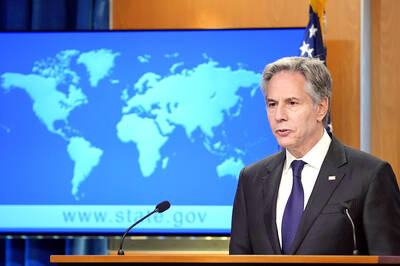
Beijing is continuing to commit genocide and crimes against humanity against Uyghurs and other Muslim minorities in its western Xinjiang province, U.S. Secretary of State Antony Blinken said in a report published on Monday, ahead of his planned visit to China this week. The State Department’s annual human rights report, which documents abuses recorded all over the world during the previous calendar year, repeated language from previous years on the treatment of Muslims in Xinjiang, but the publication raises the issue ahead of delicate talks, including on the war in Ukraine and global trade, between the top U.S. diplomat and Chinese


 RSS
RSS