


Experts looking for lessons from the London attacks will be asking whether more needs to be done, and whether Londoners will accept tighter security in their daily lives.
British Prime Minister Tony Blair has vowed the British lifestyle will not change -- but in an atmosphere of increased threat, authorities could very well feel compelled to tighten surveillance and limit some personal freedoms.
Experts say, however, that even if it were possible to screen every passenger for explosives in a London public transit system heavily used by the city's 8 million residents, that still still wouldn't eliminate the terrorist threat.
Even Israel, which has the world's tightest security, "has not been able in every case to prevent suicide bombers," said Alex Standish, editor of Jane's Intelligence Digest.
"It is absolutely impossible to prevent a determined terrorist -- particularly a suicide bomber," he said.
"The best scenario we can hope for is that the intelligence services are able to infiltrate terrorist groups or intercept their communications and foil their plots," Standish said.
"In the event that somebody gets through that, loss of life and the panic factor is minimized," he said.
In March, the British parliament passed a sweeping Prevention of Terrorism Act which allows authorities to place terror suspects under house arrest and impose travel bans without trial. Blair is now pressing for the legislation to authorize national ID cards.
But no capital can shield itself completely from such attacks, said Charles Blackmore, who heads Vance International, a security and intelligence company.
"Any society, no matter how well prepared, is vulnerable to a sophisticated terrorist with good intelligence," he said.
The al-Qaeda terrorist attack on the rail network in Madrid last year prompted Sir John Stevens, the then Metropolitan Police commissioner, to warn that a terrorist attack in the British capital was "inevitable."
Blackmore said that the London attacks seemed to be the work of someone with good intelligence, reconnaissance and planning.
"The series of attacks today demonstrated that we have a sophisticated terrorist," he said. "They clearly had a very specific intent that was to disable the public infrastructure of London, freeze all movement and have maximum commercial impact."
Intelligence and public awareness are the keys to preventing future attacks, Blackmore said, predicting an increase in the number of police on the streets to reassure the public.
But he added: "If we are facing suicide bombers, it is a very different threat and no one has the answer to that. If this is a suicide bombing, then there is a level of threat we have not faced before."
Standish, who is also a senior research fellow at Durham University, said that police and emergency services appeared to have responded efficiently to the attacks and that the wounded were quickly brought to hospitals.
"Compared with how we would have reacted before 9/11, there has been progress in terms of integration and communication between various emergency services, the police and the anti-terrorism branch," Standish said.
Although the loss of life was "appalling," the death toll could have been even higher considering the bombs were timed to coincide with the morning rush hour, he added.
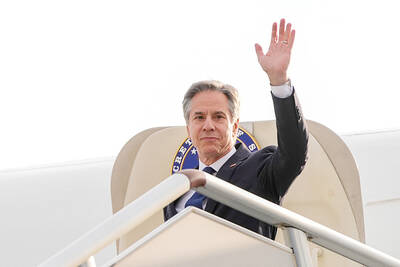
‘IN A DIFFERENT PLACE’: The envoy first visited Shanghai, where he attended a Chinese basketball playoff match, and is to meet top officials in Beijing tomorrow US Secretary of State Antony Blinken yesterday arrived in China on his second visit in a year as the US ramps up pressure on its rival over its support for Russia while also seeking to manage tensions with Beijing. The US diplomat tomorrow is to meet China’s top brass in Beijing, where he is also expected to plead for restraint as Taiwan inaugurates president-elect William Lai (賴清德), and to raise US concerns on Chinese trade practices. However, Blinken is also seeking to stabilize ties, with tensions between the world’s two largest economies easing since his previous visit in June last year. At the
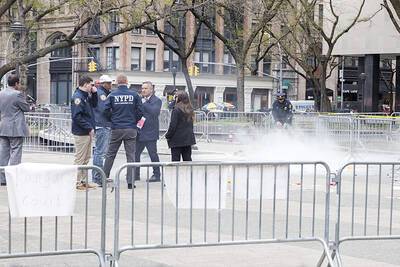
UNSETTLING IMAGES: The scene took place in front of TV crews covering the Trump trial, with a CNN anchor calling it an ‘emotional and unbelievably disturbing moment’ A man who doused himself in an accelerant and set himself on fire outside the courthouse where former US president Donald Trump is on trial has died, police said yesterday. The New York City Police Department (NYPD) said the man was declared dead by staff at an area hospital. The man was in Collect Pond Park at about 1:30pm on Friday when he took out pamphlets espousing conspiracy theories, tossed them around, then doused himself in an accelerant and set himself on fire, officials and witnesses said. A large number of police officers were nearby when it happened. Some officers and bystanders rushed
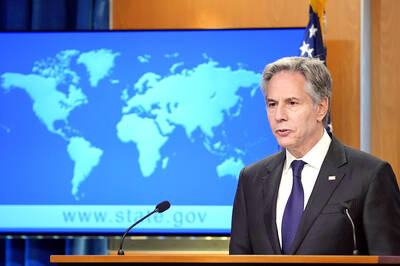
Beijing is continuing to commit genocide and crimes against humanity against Uyghurs and other Muslim minorities in its western Xinjiang province, U.S. Secretary of State Antony Blinken said in a report published on Monday, ahead of his planned visit to China this week. The State Department’s annual human rights report, which documents abuses recorded all over the world during the previous calendar year, repeated language from previous years on the treatment of Muslims in Xinjiang, but the publication raises the issue ahead of delicate talks, including on the war in Ukraine and global trade, between the top U.S. diplomat and Chinese
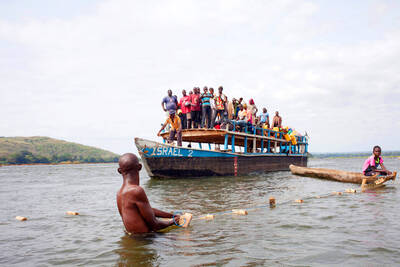
RIVER TRAGEDY: Local fishers and residents helped rescue people after the vessel capsized, while motorbike taxis evacuated some of the injured At least 58 people going to a funeral died after their overloaded river boat capsized in the Central African Republic’s (CAR) capital, Bangui, the head of civil protection said on Saturday. “We were able to extract 58 lifeless bodies,” Thomas Djimasse told Radio Guira. “We don’t know the total number of people who are underwater. According to witnesses and videos on social media, the wooden boat was carrying more than 300 people — some standing and others perched on wooden structures — when it sank on the Mpoko River on Friday. The vessel was heading to the funeral of a village chief in


 RSS
RSS