


Most people know Ray Kurzweil as an information-technology (IT) wizard. Not only did he invent the CCD flatbed scanner, print-to-speech software for the blind and omni-font optical character recognition, but he also created the first commercially marketed, large vocabulary speech recognition software.
As if that wasn't enough, he is also known for his IT predictions. Massachuset's Institute of Technology's Marvin Minsky described Kurzweil as a "leading futurist of our time."
But his latest book is about health and longevity. Kurzweil co-authored Fantastic Voyage -- Live Long Enough to Live Forever with Terry Grossman, founder and medical director of the Frontier Medical Institute, a longevity clinic.
The book purports to make the scientific case that immortality is within our grasp thanks to modern technology, and that it can be reached via three so-called "bridges."
The first bridge relies on the latest medical research into ageing and how to counteract the process of getting older with "nutritionals" (food and food supplements), meditation and exercise.
The second bridge is about bioengineering and how we will soon be able to grow a new heart in situ, or be vaccinated against diseases such as cancer.
The third bridge is about the benefits of technologies such as nanobots, strong artificial intelligence and full-immersion virtual reality, of the kind experienced in the Hollywood blockbuster the Matrix.
Health and technology, it turns out, have been twin passions of Kurzweil's for some time. At the age of 35, he was diagnosed with Type 2 diabetes, and found that the necessary insulin injections made him gain weight, exacerbating his health problems. Being a restless inventor, Kurzweil wasn't about to sit around and let the condition get the better of him.
"I read all the scientific literature and came up with my own approach," Kurzweil says. "I have been free of any indications of diabetes since."
His methods might seem bizarre, but he insists there is solid reasoning behind them: to Kurzweil, reprogramming biochemistry is much the same as reprogramming computers.
"For the first time, we are actually understanding these diseases and ageing processes as information processes," he says.
Watching under a microscope, he saw his own white blood cells surround a pathogen and destroy it. But what struck Kurzweil was the sluggish response: the process of killing a germ takes more than an hour. He believes that in the future, nanobots -- tiny robots implanted in our bodies -- will do the same job in just a few seconds.
Neuronal responses don't impress Kurzweil either. The connections in our brain compute at 200 transactions per second, which might have served the human race well over the years, but is millions of times slower than the electronic circuits that power our computers.
Not only that, but the human body, particularly the heart, breaks down too easily. All these things can be improved, says Kurzweil, and improved through technology.
When we cross the third bridge, he says, nanobots will replace our digestive systems, we will dispense with our heart and -- yes, you guessed it -- replace it with nanobots that shuffle oxygen and carbon dioxide around our bodies.
In Kurzweil's future, we will be able to upgrade our bodies over the Internet, downloading new programs to make us fitter, stronger and healthier.

‘IN A DIFFERENT PLACE’: The envoy first visited Shanghai, where he attended a Chinese basketball playoff match, and is to meet top officials in Beijing tomorrow US Secretary of State Antony Blinken yesterday arrived in China on his second visit in a year as the US ramps up pressure on its rival over its support for Russia while also seeking to manage tensions with Beijing. The US diplomat tomorrow is to meet China’s top brass in Beijing, where he is also expected to plead for restraint as Taiwan inaugurates president-elect William Lai (賴清德), and to raise US concerns on Chinese trade practices. However, Blinken is also seeking to stabilize ties, with tensions between the world’s two largest economies easing since his previous visit in June last year. At the

UNSETTLING IMAGES: The scene took place in front of TV crews covering the Trump trial, with a CNN anchor calling it an ‘emotional and unbelievably disturbing moment’ A man who doused himself in an accelerant and set himself on fire outside the courthouse where former US president Donald Trump is on trial has died, police said yesterday. The New York City Police Department (NYPD) said the man was declared dead by staff at an area hospital. The man was in Collect Pond Park at about 1:30pm on Friday when he took out pamphlets espousing conspiracy theories, tossed them around, then doused himself in an accelerant and set himself on fire, officials and witnesses said. A large number of police officers were nearby when it happened. Some officers and bystanders rushed

Beijing is continuing to commit genocide and crimes against humanity against Uyghurs and other Muslim minorities in its western Xinjiang province, U.S. Secretary of State Antony Blinken said in a report published on Monday, ahead of his planned visit to China this week. The State Department’s annual human rights report, which documents abuses recorded all over the world during the previous calendar year, repeated language from previous years on the treatment of Muslims in Xinjiang, but the publication raises the issue ahead of delicate talks, including on the war in Ukraine and global trade, between the top U.S. diplomat and Chinese
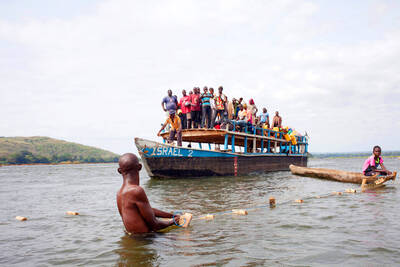
RIVER TRAGEDY: Local fishers and residents helped rescue people after the vessel capsized, while motorbike taxis evacuated some of the injured At least 58 people going to a funeral died after their overloaded river boat capsized in the Central African Republic’s (CAR) capital, Bangui, the head of civil protection said on Saturday. “We were able to extract 58 lifeless bodies,” Thomas Djimasse told Radio Guira. “We don’t know the total number of people who are underwater. According to witnesses and videos on social media, the wooden boat was carrying more than 300 people — some standing and others perched on wooden structures — when it sank on the Mpoko River on Friday. The vessel was heading to the funeral of a village chief in


 RSS
RSS