


In his three-year presidency, Alvaro Uribe and his government, backed with billions in US aid, have re-established security in long-abandoned towns and sharply reduced violence. But the trend is being ruptured by a wave of rebel attacks that have tarnished the president's law-and-order image as he pushes for re-election.
The aid, funneled into counterguerrilla training and helicopters, has transformed the military into a more mobile, offensive-minded force of 380,000, nearly 100,000 more than when Uribe was elected in 2002. The effects are clear: Two hundred towns that lacked a state security presence three years ago now have one, and violent deaths fell 17 percent in the last year.
But Colombia's armed forces still are not large enough to take control of this vast country, where two Marxist rebel groups and a powerful right-wing militia have been battling for four decades. The proof lies in a new wave of rebel attacks. Three hundred soldiers have died just this year, with 25 killed on June 25.
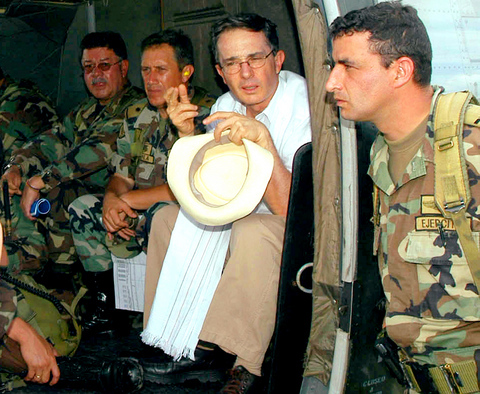
PHOTO: AP
The violence has sent a clear signal that Colombia's largest rebel group, the Revolutionary Armed Forces of Colombia, or FARC, is far from finished. Some analysts say the group may be trying to discredit Uribe, who has an approval rating topping 70 percent. A show of rebel strength could damage his position as front-runner if a law allowing him to run for re-election next year is approved by the Constitutional Court.
"The guerrillas want to show that there is no advance, that nothing is certain and that they still have power," said Martha Lucia Ramirez, a former defense minister.
Many analysts do not believe that the rebels are stronger than before, and some are sure they are weaker. The drug crops that generate FARC's revenues have been sharply curtailed in a Washington-backed fumigation effort, and the group has not found much popular support in a war-ravaged countryside. The military also says it has killed 2,240 guerrillas in the last 18 months.
But an 18-month, 17,000-man offensive in the south, which rooted out guerrillas from hamlets they had held for years, has become bogged down by rebel snipers and mines. New Defense Ministry figures show that 732 soldiers have been killed across the country since January last year, a third of them the victims of land mines.
The attacks, while condemned roundly by Colombians, seem to have hurt the government. A poll released in May showed that 59 percent of Colombians thought Uribe had done a good job bringing security to the country, a drop from 72 percent the year before.
Analysts say a major problem is that while state security services are now a presence in once-forgotten towns, the government has been unable to introduce vital services, like health care and education, that would consolidate its presence.
And in some cases, what little government there is has been hit hard. In Puerto Rico, a guerrilla commando unit stormed into a town council meeting with grenades and assault rifles in May, killing four council members and another town official.

‘IN A DIFFERENT PLACE’: The envoy first visited Shanghai, where he attended a Chinese basketball playoff match, and is to meet top officials in Beijing tomorrow US Secretary of State Antony Blinken yesterday arrived in China on his second visit in a year as the US ramps up pressure on its rival over its support for Russia while also seeking to manage tensions with Beijing. The US diplomat tomorrow is to meet China’s top brass in Beijing, where he is also expected to plead for restraint as Taiwan inaugurates president-elect William Lai (賴清德), and to raise US concerns on Chinese trade practices. However, Blinken is also seeking to stabilize ties, with tensions between the world’s two largest economies easing since his previous visit in June last year. At the

UNSETTLING IMAGES: The scene took place in front of TV crews covering the Trump trial, with a CNN anchor calling it an ‘emotional and unbelievably disturbing moment’ A man who doused himself in an accelerant and set himself on fire outside the courthouse where former US president Donald Trump is on trial has died, police said yesterday. The New York City Police Department (NYPD) said the man was declared dead by staff at an area hospital. The man was in Collect Pond Park at about 1:30pm on Friday when he took out pamphlets espousing conspiracy theories, tossed them around, then doused himself in an accelerant and set himself on fire, officials and witnesses said. A large number of police officers were nearby when it happened. Some officers and bystanders rushed

Beijing is continuing to commit genocide and crimes against humanity against Uyghurs and other Muslim minorities in its western Xinjiang province, U.S. Secretary of State Antony Blinken said in a report published on Monday, ahead of his planned visit to China this week. The State Department’s annual human rights report, which documents abuses recorded all over the world during the previous calendar year, repeated language from previous years on the treatment of Muslims in Xinjiang, but the publication raises the issue ahead of delicate talks, including on the war in Ukraine and global trade, between the top U.S. diplomat and Chinese

RIVER TRAGEDY: Local fishers and residents helped rescue people after the vessel capsized, while motorbike taxis evacuated some of the injured At least 58 people going to a funeral died after their overloaded river boat capsized in the Central African Republic’s (CAR) capital, Bangui, the head of civil protection said on Saturday. “We were able to extract 58 lifeless bodies,” Thomas Djimasse told Radio Guira. “We don’t know the total number of people who are underwater. According to witnesses and videos on social media, the wooden boat was carrying more than 300 people — some standing and others perched on wooden structures — when it sank on the Mpoko River on Friday. The vessel was heading to the funeral of a village chief in


 RSS
RSS