


Killers on motorbikes hunt down their targets everywhere in this strip of Sri Lanka's coastline: In Hindu temples, bus stations or rice fields.
An internationally monitored ceasefire hasn't stopped it. Days ago, gunmen suspected to be Tamil Tiger rebels sprayed three Sri Lankan soldiers with dozens of bullets, killing them as they boarded a motorized rickshaw.
About 90 percent of the 425 such killings reported since the government and the Tamil Tiger rebels signed a Norwegian-brokered 2002 ceasefire have occurred around the eastern town of Batticaloa -- an area that's become a killing ground in the shadow of Sri Lanka's supposedly suspended civil war.
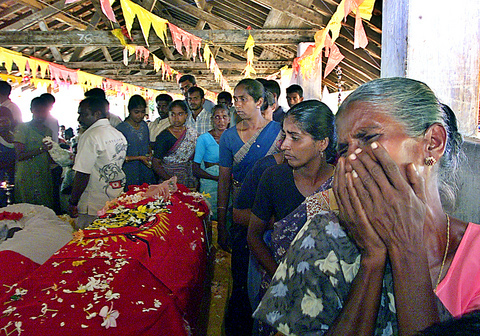
PHOTO: AP
This region saw plenty of violence during the two-decade war between the government and Tigers, but the latest wave has left people here confused and terrified. Who is killing whom? They just don't know.
In theory, the ceasefire means there should be no fatalities. Area residents, mostly farmers, fishermen and traders, had hoped the truce would bring normalcy, and things were quiet for a while.
But then Batticaloa, 225km east of the capital, Colombo, became the center of renewed violence after a split in among the Tamil Tigers in March 2004.
The Batticaloa-based Tigers -- alleging regional discrimination -- rose against the guerrillas' central leadership, based in the north of this island country.
The main group defeated the breakaway faction in brief, bloody fighting. Breakaway leader Vinayagamoorthy Muralitharan escaped, and many believe he is still organizing attacks on main Tigers.
But almost anyone else around Batticaloa can also be a victim -- breakaway rebels, innocent civilians and former militants from nearly a dozen groups that have moved into official politics, said Helen Olafsdottir, a spokeswoman for the Norwegian-led Sri Lanka Monitoring Mission.
Election candidates, university teachers, journalists and government officials have all been targeted.
Media blame the near-daily killings on "unidentified gunmen." No group claims responsibility.
The area has a war-zone feel, with rifle-carrying policemen and government soldiers standing guard in the streets, checking the identity papers of students, shoppers and workers.
The Tamil Tigers fought the government since 1983 to try creating a separate state for minority ethnic Tamils in Sri Lanka's northeast, claiming discrimination by the Sinhalese majority. The war claimed about 65,000 lives before the 2002 ceasefire.
In 1987, every group except the Tigers gave up their arms and joined mainstream politics. The Tigers, who now have their own de facto government in much of Sri Lanka's north and east, have since accused former militants of working with the government.
Human rights groups say the Tigers have killed scores of former militants in revenge.
The ceasefire lets unarmed rebels travel freely for political work. Many military officials say the rebels have taken advantage of that freedom, using it to eliminate opponents.
"The Tigers are after us," said Rasiah Thurairatnam, a local leader of the Eelam People's Revolutionary Liberation Front, a militant group-turned political party.
So former militants mostly remain in their offices and houses, protected by government police or carrying weapons the government gave them for protection.
Truce monitors have warned that continued killings may derail the already-fragile peace process.
"There are a lot of expectations on us. But we can't do policing, nor do we have any executive powers," Olafsdottir said. "When the ceasefire agreement was drafted, no one foresaw these type of killings."
The Tigers haven't acknowledged or denied involvement.
"It is easy for everybody to point the finger at us," said Ilanthirayan, the mainstream rebels' political leader in Batticaloa. He goes by one name.
"For the violence to end, the government and its forces should evict all paramilitary forces from here consistent with their agreement with us," he said. The ceasefire called for disarming all Tamil groups except the Tigers.
Some government officials say the Tigers bear plenty of blame.
Tigers suspected in killings can simply disappear into rebel-controlled territory, where the truce bars government forces, said military spokesman Brigadier Daya Ratnayake.
But the Tigers and their supporters aren't safe either. Ilanthirayan's predecessor, as well as a pro-rebel journalist and many other Tiger supporters have been slain by men believed to be from the breakaway faction.
The spokesman for the breakaway fighters, who uses the pseudonym K. Umarnath Sharma, insists his group does not kill mainstream Tiger supporters except in self-defense.
"We have never been a paramilitary group and never will be one," Sharma said.
Those who suffer most are the victims' families, most of them impoverished.
Samuel Puthalvakumari carries around a photo of happier times with her smiling husband -- a laborer -- and their 15-month-old daughter, both killed by suspected Tigers after visiting a Hindu temple in 2003.
Puthalvakumari can't understand why attackers fired guns and threw a hand grenade at her husband and daughter, who were on a bicycle.
"I did not even look at my daughter's body," she said, weeping. "Relatives said she had no eyes and legs."
Meanwhile, people in Batticaloa whisper about the bloodshed around them, and avoiding going out after dusk.

‘IN A DIFFERENT PLACE’: The envoy first visited Shanghai, where he attended a Chinese basketball playoff match, and is to meet top officials in Beijing tomorrow US Secretary of State Antony Blinken yesterday arrived in China on his second visit in a year as the US ramps up pressure on its rival over its support for Russia while also seeking to manage tensions with Beijing. The US diplomat tomorrow is to meet China’s top brass in Beijing, where he is also expected to plead for restraint as Taiwan inaugurates president-elect William Lai (賴清德), and to raise US concerns on Chinese trade practices. However, Blinken is also seeking to stabilize ties, with tensions between the world’s two largest economies easing since his previous visit in June last year. At the

UNSETTLING IMAGES: The scene took place in front of TV crews covering the Trump trial, with a CNN anchor calling it an ‘emotional and unbelievably disturbing moment’ A man who doused himself in an accelerant and set himself on fire outside the courthouse where former US president Donald Trump is on trial has died, police said yesterday. The New York City Police Department (NYPD) said the man was declared dead by staff at an area hospital. The man was in Collect Pond Park at about 1:30pm on Friday when he took out pamphlets espousing conspiracy theories, tossed them around, then doused himself in an accelerant and set himself on fire, officials and witnesses said. A large number of police officers were nearby when it happened. Some officers and bystanders rushed

Beijing is continuing to commit genocide and crimes against humanity against Uyghurs and other Muslim minorities in its western Xinjiang province, U.S. Secretary of State Antony Blinken said in a report published on Monday, ahead of his planned visit to China this week. The State Department’s annual human rights report, which documents abuses recorded all over the world during the previous calendar year, repeated language from previous years on the treatment of Muslims in Xinjiang, but the publication raises the issue ahead of delicate talks, including on the war in Ukraine and global trade, between the top U.S. diplomat and Chinese
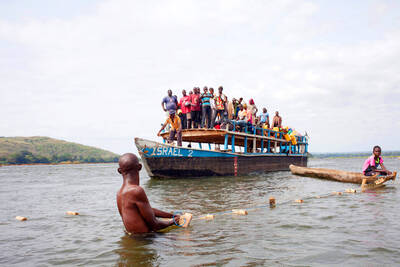
RIVER TRAGEDY: Local fishers and residents helped rescue people after the vessel capsized, while motorbike taxis evacuated some of the injured At least 58 people going to a funeral died after their overloaded river boat capsized in the Central African Republic’s (CAR) capital, Bangui, the head of civil protection said on Saturday. “We were able to extract 58 lifeless bodies,” Thomas Djimasse told Radio Guira. “We don’t know the total number of people who are underwater. According to witnesses and videos on social media, the wooden boat was carrying more than 300 people — some standing and others perched on wooden structures — when it sank on the Mpoko River on Friday. The vessel was heading to the funeral of a village chief in


 RSS
RSS