


The UK failed to persuade the rest of Europe to give in to US pressure and lift the ban on genetically modified crops and food on Friday.
Britain's Elliott Morley warned fellow environment ministers in Brussels that they were going against scientific advice and faced the threat of a trade war with the US over the issue if the ban remained in place, but ministers voted overwhelmingly to continue with it.
The decision was also a blow for the European commission, which told ministers that there was no evidence on health or environmental grounds allowing a legal ban on the crops. The politicians clearly disagreed.
The bans on GM varieties of oil seed rape and maize, imposed on public safety and environmental grounds by Austria, Luxembourg, Germany, France and Greece, should have been backed by scientific evidence but none was produced before yesterday's meeting.
The group's objections were based on fears that genetically manipulated genes could escape into the wider environment and that non-target insects could be destroyed by crops with inbuilt insecticide.
Ministers from the five countries told the meeting that they simply did not accept that GM crops should be released, and the ban drew the backing of a sufficiently large majority of 25 member states to ensure that it remains in place.
In theory, because the bans cannot be legally justified, the commission could overturn them but is unlikely to do so because it fears an angry backlash from member countries and the public.
The US claims that the bans are a barrier to trade and is making them the subject of a complaint to the World Trade Organization, demanding sanctions. The WTO is expected to adjudicate in August.
Morley, who was attacked by environmental groups for his stance, defended the UK's position after the meeting. He told the <
"In this case all these crops had been approved individually by the commission on scientific advice and we felt bound to accept that.
"If any country had come forward with scientific information which showed that in their case, in their country, any individual crops should not be grown we would have listened to the evidence. None came forward with evidence."
Morley said it was quite clear that ministers were reflecting the public concerns in their countries rather than relying on science to inform their decisions. But he did not accept that this helped the US case at the WTO.
"Clearly Europe should be allow to take a precautionary approach to safeguard health and environment. That is not a restraint of trade," he said.
One of the most contentious issues at the meeting was a variety of Bt Maize produced by Monsanto called MON 863, which caused unexplained kidney damage to rats, according to research conducted by the manufacturer.
Monsanto has refused to release all the results of its own tests on the maize, although it has now been ordered to do so by a German court.
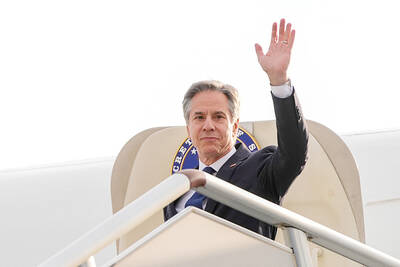
‘IN A DIFFERENT PLACE’: The envoy first visited Shanghai, where he attended a Chinese basketball playoff match, and is to meet top officials in Beijing tomorrow US Secretary of State Antony Blinken yesterday arrived in China on his second visit in a year as the US ramps up pressure on its rival over its support for Russia while also seeking to manage tensions with Beijing. The US diplomat tomorrow is to meet China’s top brass in Beijing, where he is also expected to plead for restraint as Taiwan inaugurates president-elect William Lai (賴清德), and to raise US concerns on Chinese trade practices. However, Blinken is also seeking to stabilize ties, with tensions between the world’s two largest economies easing since his previous visit in June last year. At the

UNSETTLING IMAGES: The scene took place in front of TV crews covering the Trump trial, with a CNN anchor calling it an ‘emotional and unbelievably disturbing moment’ A man who doused himself in an accelerant and set himself on fire outside the courthouse where former US president Donald Trump is on trial has died, police said yesterday. The New York City Police Department (NYPD) said the man was declared dead by staff at an area hospital. The man was in Collect Pond Park at about 1:30pm on Friday when he took out pamphlets espousing conspiracy theories, tossed them around, then doused himself in an accelerant and set himself on fire, officials and witnesses said. A large number of police officers were nearby when it happened. Some officers and bystanders rushed
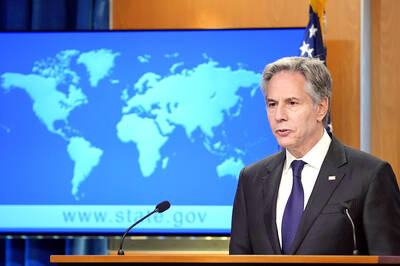
Beijing is continuing to commit genocide and crimes against humanity against Uyghurs and other Muslim minorities in its western Xinjiang province, U.S. Secretary of State Antony Blinken said in a report published on Monday, ahead of his planned visit to China this week. The State Department’s annual human rights report, which documents abuses recorded all over the world during the previous calendar year, repeated language from previous years on the treatment of Muslims in Xinjiang, but the publication raises the issue ahead of delicate talks, including on the war in Ukraine and global trade, between the top U.S. diplomat and Chinese
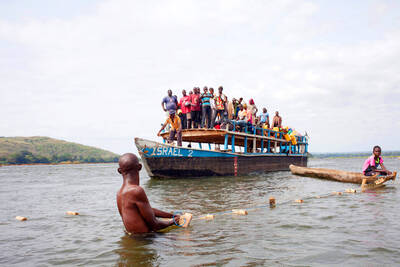
RIVER TRAGEDY: Local fishers and residents helped rescue people after the vessel capsized, while motorbike taxis evacuated some of the injured At least 58 people going to a funeral died after their overloaded river boat capsized in the Central African Republic’s (CAR) capital, Bangui, the head of civil protection said on Saturday. “We were able to extract 58 lifeless bodies,” Thomas Djimasse told Radio Guira. “We don’t know the total number of people who are underwater. According to witnesses and videos on social media, the wooden boat was carrying more than 300 people — some standing and others perched on wooden structures — when it sank on the Mpoko River on Friday. The vessel was heading to the funeral of a village chief in


 RSS
RSS