


North Korea said it wouldn't need any nuclear weapons if the US treated it like a friend as the isolated nation joined South Korea yesterday for high-level reconciliation talks shadowed by the international standoff over the North's nuclear ambitions.
"If the United States treats the North in a friendly manner, we will possess not one nuclear weapon," the North Korean delegation said, according to Kim Chun-shick, spokesman for the South's side.
The statement echoed a pledge by North Korean leader Kim Jong-il who met Friday with visiting South Korean Unification Minister Chung Dong-young and said Pyongyang could return to international nuclear disarmament talks as soon as next month if it gets appropriate respect from Washington.
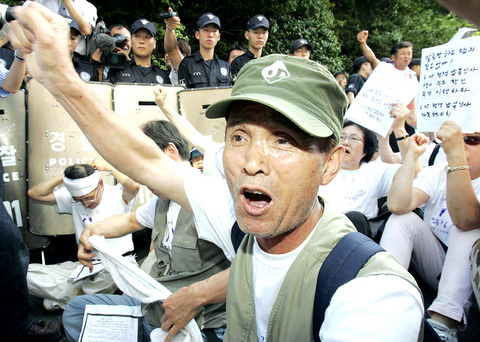
PHOTO: AP
Chung, head of Seoul's delegation, yesterday urged the North to return to the nuclear talks in July, his ministry said in a summary of his remarks.
"The North Korean nuclear issue is a matter between the two Koreas as well as an international one," Kim Chun-shick quoted Chung as saying.
The North has stayed away from six-party talks aimed at persuading it to disarm since June 2004, citing "hostile" US policies, and declared in February that it had nuclear weapons. It has insisted that the nuclear standoff can only be discussed with the United States, and no breakthroughs on the issue were expected at this week's inter-Korean talks.
The two Koreas were instead focusing on aid and cooperative projects to bridge their divided peninsula, including cross-border trade and family reunions among Koreans separated since the end of the 1950-53 Korean War.
At the start of Wednesday's talks, the North requested food aid citing continuing shortages, Kim Chun-shick said. He declined to specify the amount but said it was on par with donations made in previous years.
On Saturday, the North requested 150,000 tons in fertilizer aid from the South, on top of 200,000 tons that it has already received this year. Seoul earlier this year declined to respond to a record request for 500,000 tons, citing previously stalled contacts with the North.
In related news, Kim Jong-il attempted to engage President George W. Bush directly on the nuclear weapons issue three years ago but the administration spurned the overture, two American experts on Asia said on Wednesday.
Writing in the Washington Post, former US ambassador to South Korea Donald Gregg and former journalist Don Oberdorfer expressed concern that Kim's November 2002 initiative was never pursued and urged Bush to respond positively to his current overture, made last week.
When Bush took office in 2001, US officials estimated Pyongyang had fuel for one or two nuclear weapons. Now, that estimate is up to at least half a dozen and, the authors said, "many believe their claim to have fabricated the weapons themselves."
Gregg and Oberdorfer said they visited Pyongyang in November 2002, after then-US Assistant Secretary of State James Kelly was there and accused the North of pursuing a secret program of enriching uranium for nuclear weapons.
Gregg and Oberdorfer said while in Pyongyang "we were given a written personal message from Kim to Bush."
Kim stated if the US recognized the North's sovereignty and provided non-aggression assurances "it is our view that we should be able to find a way to resolve the nuclear issue in compliance with the demands of a new century."
Also in the message, Kim further promised "if the United States makes a bold decision, we will respond accordingly," the authors wrote in an opinion piece.
They said they took the message to senior White House and State Department officials and urged them to follow up on Kim's initiative.
But the administration, then planning for the Iraq invasion, "spurned engagement with North Korea," said Gregg and Oberdorfer.

‘CROSSING THE LINE’: China’s embassy in Seoul criticized US Forces Korea Commander General Xavier Brunson, asking if his ‘hostile’ remarks were authorized by Washington South Korea and the US are in talks over recent public remarks by the commander of US Forces Korea, Seoul’s presidential office said yesterday, after the comments drew sharp criticism from China. In a recent podcast interview, US Forces Korea Commander General Xavier Brunson described South Korea as “the dagger in the heart of Asia” from China’s east coast, prompting the Chinese embassy in Seoul to say that he had “truly crossed the line.” The interview came amid growing speculation that Washington might seek to expand the role of US Forces Korea in countering the growing regional influence of China, a key

SEEKING ORDER: Rodrigo Paz said that ‘anyone who wants to destroy the nation will have to deal with this president and the full force of the constitution’ Bolivian President Rodrigo Paz on Wednesday said that the nation was at a “breaking point” after nearly a month of protests that have caused shortages of food, fuel and medicine. Paz, who took office six months ago amid the worst economic crisis there in four decades, is battling a groundswell of fury over his policies. The political capital, La Paz, has been besieged by low-income workers and members of the indigenous majority calling for his resignation. “The country needs order and is reaching breaking point,” the 58-year-old said at a public event in La Paz, renewing his appeal for dialogue. On Tuesday, the Bolivian

Australian researchers have trained lab-grown brain cells on a silicon computer chip to play the 1990s shooter game Doom and said they are just scratching the surface of what the neurons could be capable of doing. It is the science-fiction work of biotech boffins at Cortical Labs, who researched and developed the technology that harnesses the workings of the brain’s networking system. Each so-called “biological computer” contains about 200,000 living human brain cells, grown from stem cells that were harvested from blood donations. Having mastered the simple computer game Pong, where a paddle is moved up and down to send a ball

Through the noise of rushing papers and whirring belts at a print factory in Kyoto, two creators watch their photo essay come to life in broadsheet form — part of an effort to win new audiences in the age of artificial intelligence (AI). Despite the decline of the publishing industry, self-publication and handmade “zine” magazines are growing in popularity in Japan, reflecting the nation’s enduring love of paper in the digital era. While speaking to Agence France-Presse at the plant, his hands black with ink, one of the creators, Kazuma Obara, said: “I think [paper] is a medium that engages all five


 RSS
RSS