


A suicide car bomber killed at least 15 traffic policemen and wounded about 100 more yesterday outside the unit's headquarters in the northern Kurdish city of Irbil, police and hospital officials said.
Iraq's insurgency appeared unfazed by two massive US-Iraqi military offensives against militant smuggling routes and training centers west and north of Baghdad, mounting attacks that have killed at least 73 in the past two days -- including 27 people yesterday.
The bomber in Irbil wore a police uniform and slammed his car into a gathering of some 200 traffic policemen during morning rollcall in a courtyard behind the headquarters at 8am, police Lieutenant Sulaiman Mohammed said.
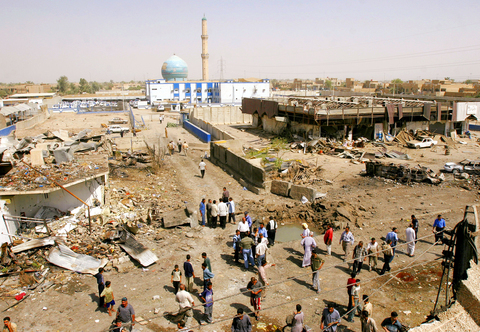
PHOTO: AP
Dr. Mohammed Ali of Irbil General Hospital revised his earlier count of 20 dead to 13, saying he miscounted bodies amid the confusion. Massive car bombs usually scatter limbs and other body parts over wide areas and emergency services often miscount them.
"Everyone was confused in the hospital because we were receiving so many casualties and there was confusion," Ali said.
Dr. Tahseen Hassan reported that Irbil Teaching Hospital received one body from the blast. Another injured man died at yet another hospital.
The attack occurred on a main street that leads to the oil-rich northern Iraqi city of Kirkuk, which is south of Irbil, police said.
Irbil, one of two major cities in Iraq's northern Kurdish region, has enjoyed autonomous rule under Western protection since 1991. The area has been largely sheltered from the incessant violence wracking the remainder of Iraq, but has seen several major bombings blamed on militant Muslim groups.
The attack came a day after a suicide bomber walked into a crowded Baghdad kebab restaurant near the heavily fortified main gate of US and Iraqi government headquarters at the Green Zone, killing at least 23 people including policemen -- the deadliest attack in the capital in just over six weeks. A total of 45 people were killed in insurgent assaults throughout the country on Sunday.
Some extremists have also started threatening fellow Sunni Arabs, who make up the insurgency's core, because some leaders of the minority Muslim sect have expressed a readiness to join the political process. Most Sunnis boycotted January's historic election.
Elsewhere, a band of insurgents launched a bold assault on a Baghdad police station killing at least eight policemen and an 8-month-old baby early yesterday, police said. At least 23 were wounded.
The attack on the Baya police station in southwestern Baghdad began just before dawn and included two car suicide bombs, mortars, rocket-propelled grenades and small arms fire, police Captain Talib Thamir said.
Gunmen killed three members of the Kurdish Peshmerga militia Monday near a camp in the western town of Hit, Dr. Muhanad Jawad said from the capital, where the bodies were brought. Hit is 140 kilometers (85 miles) west of Baghdad.
Separately, a roadside bomb Monday killed a U.S. soldier on patrol near Tal Afar, 150km east of the Syrian border, the military said. The soldier belonged to the 1st Corps Support Command and was not part of the two major US-Iraqi offensives taking part in the western Anbar province.
Operation Spear appeared to be winding down and US Marines reported finding a weapons cache in the town of Karabilah early yesterday, including two dozen RPG launchers, heavy machine guns and equipment to make up to 25 bombs.

‘CROSSING THE LINE’: China’s embassy in Seoul criticized US Forces Korea Commander General Xavier Brunson, asking if his ‘hostile’ remarks were authorized by Washington South Korea and the US are in talks over recent public remarks by the commander of US Forces Korea, Seoul’s presidential office said yesterday, after the comments drew sharp criticism from China. In a recent podcast interview, US Forces Korea Commander General Xavier Brunson described South Korea as “the dagger in the heart of Asia” from China’s east coast, prompting the Chinese embassy in Seoul to say that he had “truly crossed the line.” The interview came amid growing speculation that Washington might seek to expand the role of US Forces Korea in countering the growing regional influence of China, a key

SEEKING ORDER: Rodrigo Paz said that ‘anyone who wants to destroy the nation will have to deal with this president and the full force of the constitution’ Bolivian President Rodrigo Paz on Wednesday said that the nation was at a “breaking point” after nearly a month of protests that have caused shortages of food, fuel and medicine. Paz, who took office six months ago amid the worst economic crisis there in four decades, is battling a groundswell of fury over his policies. The political capital, La Paz, has been besieged by low-income workers and members of the indigenous majority calling for his resignation. “The country needs order and is reaching breaking point,” the 58-year-old said at a public event in La Paz, renewing his appeal for dialogue. On Tuesday, the Bolivian

Australian researchers have trained lab-grown brain cells on a silicon computer chip to play the 1990s shooter game Doom and said they are just scratching the surface of what the neurons could be capable of doing. It is the science-fiction work of biotech boffins at Cortical Labs, who researched and developed the technology that harnesses the workings of the brain’s networking system. Each so-called “biological computer” contains about 200,000 living human brain cells, grown from stem cells that were harvested from blood donations. Having mastered the simple computer game Pong, where a paddle is moved up and down to send a ball

Through the noise of rushing papers and whirring belts at a print factory in Kyoto, two creators watch their photo essay come to life in broadsheet form — part of an effort to win new audiences in the age of artificial intelligence (AI). Despite the decline of the publishing industry, self-publication and handmade “zine” magazines are growing in popularity in Japan, reflecting the nation’s enduring love of paper in the digital era. While speaking to Agence France-Presse at the plant, his hands black with ink, one of the creators, Kazuma Obara, said: “I think [paper] is a medium that engages all five


 RSS
RSS