


The grimmest EU summit in years appeared only to strengthen British Prime Minister Tony Blair's resolve to push for fundamental reforms he takes over the EU presidency on July 1.
The two-day conclave spectacularly broke down in the early hours of Saturday when, having rolled back the deadline to ratify the moribund EU constitution the day before, EU leaders failed to agree the bloc's budget for 2007-13.
A chief stumbling block was Blair's refusal to give up Britain's sancrosanct EU rebate without an iron-clad guarantee of a thorough re-think of the way the EU spends its taxpayers' money.
In Blair's eyes, however, there was a bigger, more profound object at stake -- "reconnecting" Europe with the people who live in it.
"This is a moment of renewal ... I think that if we start to respond to people, even actually if we began a debate that they thought was relevant, it would do us some good," he told reporters.
"We've got the opportunity over the next few months to do that, and maybe some of these problems on the budget will be easier to resolve once you've had that fundamental debate about the future of Europe and its direction."
Blair's overriding concern is that, with double-digit joblessness in France and Germany, the core of the EU lacks what it takes to compete with up-and-coming China and India, let alone the US and Japan.
1He argues that economic reforms, embraced five years ago with the goal to make the EU the world's most competitive economy by 2010, have fallen behind while rigid social policies fail to make the most of Europe's workforce.
Blair's priorities for the British presidency dovetail neatly with his agenda for the July 6-8 summit of the Group of Eight powers -- Britain, Canada, France, Germany, Italy, Japan, Russia and the US -- that he will host at Gleneagles, Scotland.
Global warming is one of his G8 priorities. The other is wiping out chronic poverty in Africa -- poverty blamed in part on farm subsidies which effectively stop African farmers from selling their produce to rich countries.
Sweeping reforms might not sit well with French President Jacques Chirac and German Chancellor Gerhard Schroeder, who fought hard in Brussels to strip Britain of its rebate while keeping the Common Agricultural Policy intact.
But in the end, analysts believe that time and circumstances are on Blair's side as a new generation of EU leaders -- many of them from the enlargement states in the formerly communist eastern Europe -- comes to the fore.
"I think he wins a grudging respect from his opponents," said Alasdair Murray of the Centre for European Reform, a think-tank in London that specializes in EU issues.
"He's in a much more powerful position than before, because he's at least won an election and he's still the master of his own destiny," Murray said by telephone.
"The others are clearly going -- Schroeder quite soon and Chirac in the not too distant future."
Blair's clarion call for debate in Europe echoes the "Big Conversation" that his Labour Party initiated in the months leading up to its re-election last month, quizzing ordinary Britons on what they really wanted.
"In how many countries around the [summit] table today would a referendum [on the constitution] be won?" Blair asked when he met reporters in the wee hours of Saturday, minutes after the summit's collapse.
"I've always believed in Europe because I think that the broad sweep of history is on the side of countries coming together and cooperating in the modern world," he said. "It makes perfect sense. The EU as an idea makes sense in today's world -- but it has constantly to have the ability and energy to renew itself."
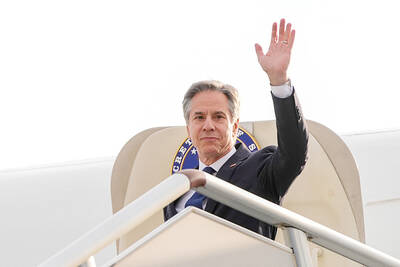
‘IN A DIFFERENT PLACE’: The envoy first visited Shanghai, where he attended a Chinese basketball playoff match, and is to meet top officials in Beijing tomorrow US Secretary of State Antony Blinken yesterday arrived in China on his second visit in a year as the US ramps up pressure on its rival over its support for Russia while also seeking to manage tensions with Beijing. The US diplomat tomorrow is to meet China’s top brass in Beijing, where he is also expected to plead for restraint as Taiwan inaugurates president-elect William Lai (賴清德), and to raise US concerns on Chinese trade practices. However, Blinken is also seeking to stabilize ties, with tensions between the world’s two largest economies easing since his previous visit in June last year. At the

UNSETTLING IMAGES: The scene took place in front of TV crews covering the Trump trial, with a CNN anchor calling it an ‘emotional and unbelievably disturbing moment’ A man who doused himself in an accelerant and set himself on fire outside the courthouse where former US president Donald Trump is on trial has died, police said yesterday. The New York City Police Department (NYPD) said the man was declared dead by staff at an area hospital. The man was in Collect Pond Park at about 1:30pm on Friday when he took out pamphlets espousing conspiracy theories, tossed them around, then doused himself in an accelerant and set himself on fire, officials and witnesses said. A large number of police officers were nearby when it happened. Some officers and bystanders rushed
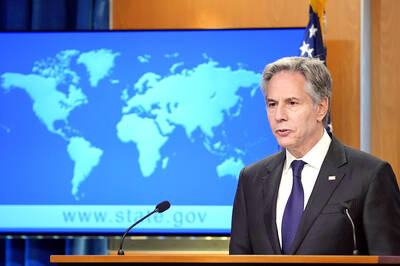
Beijing is continuing to commit genocide and crimes against humanity against Uyghurs and other Muslim minorities in its western Xinjiang province, U.S. Secretary of State Antony Blinken said in a report published on Monday, ahead of his planned visit to China this week. The State Department’s annual human rights report, which documents abuses recorded all over the world during the previous calendar year, repeated language from previous years on the treatment of Muslims in Xinjiang, but the publication raises the issue ahead of delicate talks, including on the war in Ukraine and global trade, between the top U.S. diplomat and Chinese
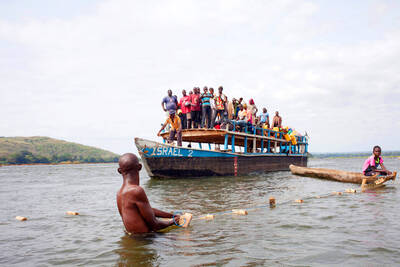
RIVER TRAGEDY: Local fishers and residents helped rescue people after the vessel capsized, while motorbike taxis evacuated some of the injured At least 58 people going to a funeral died after their overloaded river boat capsized in the Central African Republic’s (CAR) capital, Bangui, the head of civil protection said on Saturday. “We were able to extract 58 lifeless bodies,” Thomas Djimasse told Radio Guira. “We don’t know the total number of people who are underwater. According to witnesses and videos on social media, the wooden boat was carrying more than 300 people — some standing and others perched on wooden structures — when it sank on the Mpoko River on Friday. The vessel was heading to the funeral of a village chief in


 RSS
RSS