


Vietnamese Prime Minister Phan Van Khai departed yesterday on a groundbreaking visit to the United States, seeking closer ties with Washington and support for Vietnam's bid to join the WTO.
Khai's June 19-25 visit to the US is the first by a Vietnamese prime minister since the Vietnam War ended 30 years ago. Khai said in an interview with The Associated Press last week that his presence in the US would symbolize that the two countries have put resentments over the war "behind us."
Khai departed just after dawn on a Vietnam Airlines jet bound first for Seattle, where he was to oversee the purchase of four Boeing jetliners by Vietnam Airlines and meet with business leaders including Microsoft Corp. Chairman Bill Gates.
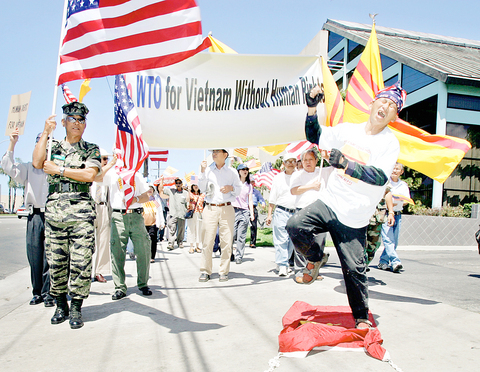
PHOTO: AP
Following his summit with President George W. Bush tomorrow, Khai will travel to New York, where he will ring in the session at the New York Stock Exchange.
He will end his trip with a stop in Boston to hold talks with the presidents of Harvard University and the Massachusetts Institute of Technology on expanding educational exchanges.
In last week's interview, Khai, 71, said economic and social reforms in Vietnam -- along with increased trade, defense and diplomatic cooperation with the US -- had converged to produce the best timing for the visit.
The United States has become Vietnam's top trading partner since the two established diplomatic ties a decade ago. Two-way trade totaled US$6.4 billion last year, while investment in Vietnam by US firms has risen 27 percent per year since a bilateral trade agreement was signed in 2001.
US Navy ships have visited Vietnamese ports, and the two countries have exchanged high-level delegations of officers.
Khai, a Soviet-trained economist, said Hanoi is aiming for an agreement with Washington on Vietnam's WTO bid "as soon as possible."
They're also set to talk about democratic reforms in Vietnam, religious rights, and stepped-up military cooperation.
Washington has often been critical of the communist government's record of restricting political and religious freedoms, although it wasn't clear whether Bush would raise such issues with Khai.
Hundreds of Vietnamese political dissidents have been jailed for urging democratic and religious reforms, often using the Internet, according to New York-based monitoring group Human Rights Watch.
The group claims religious dissidents have been harassed and minority hill tribes who follow churches not recognized by the state have been forced to recant their faith.
"America's political and business leaders should not assume that a stronger Vietnamese economy has brought greater respect for human rights," Brad Adams, the group's director for Asia, said in a statement e-mailed to reporters.
"US relations with Vietnam cannot flourish unless economic liberalization is accompanied by human rights reforms," Adams said.
Despite potential for such disagreements, Khai said that his visit alone symbolized a major improvement in relations.

‘IN A DIFFERENT PLACE’: The envoy first visited Shanghai, where he attended a Chinese basketball playoff match, and is to meet top officials in Beijing tomorrow US Secretary of State Antony Blinken yesterday arrived in China on his second visit in a year as the US ramps up pressure on its rival over its support for Russia while also seeking to manage tensions with Beijing. The US diplomat tomorrow is to meet China’s top brass in Beijing, where he is also expected to plead for restraint as Taiwan inaugurates president-elect William Lai (賴清德), and to raise US concerns on Chinese trade practices. However, Blinken is also seeking to stabilize ties, with tensions between the world’s two largest economies easing since his previous visit in June last year. At the

UNSETTLING IMAGES: The scene took place in front of TV crews covering the Trump trial, with a CNN anchor calling it an ‘emotional and unbelievably disturbing moment’ A man who doused himself in an accelerant and set himself on fire outside the courthouse where former US president Donald Trump is on trial has died, police said yesterday. The New York City Police Department (NYPD) said the man was declared dead by staff at an area hospital. The man was in Collect Pond Park at about 1:30pm on Friday when he took out pamphlets espousing conspiracy theories, tossed them around, then doused himself in an accelerant and set himself on fire, officials and witnesses said. A large number of police officers were nearby when it happened. Some officers and bystanders rushed

Beijing is continuing to commit genocide and crimes against humanity against Uyghurs and other Muslim minorities in its western Xinjiang province, U.S. Secretary of State Antony Blinken said in a report published on Monday, ahead of his planned visit to China this week. The State Department’s annual human rights report, which documents abuses recorded all over the world during the previous calendar year, repeated language from previous years on the treatment of Muslims in Xinjiang, but the publication raises the issue ahead of delicate talks, including on the war in Ukraine and global trade, between the top U.S. diplomat and Chinese
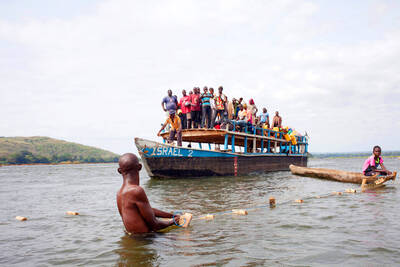
RIVER TRAGEDY: Local fishers and residents helped rescue people after the vessel capsized, while motorbike taxis evacuated some of the injured At least 58 people going to a funeral died after their overloaded river boat capsized in the Central African Republic’s (CAR) capital, Bangui, the head of civil protection said on Saturday. “We were able to extract 58 lifeless bodies,” Thomas Djimasse told Radio Guira. “We don’t know the total number of people who are underwater. According to witnesses and videos on social media, the wooden boat was carrying more than 300 people — some standing and others perched on wooden structures — when it sank on the Mpoko River on Friday. The vessel was heading to the funeral of a village chief in


 RSS
RSS