


A right-wing paramilitary warlord considered one of Colombia's biggest drug traffickers was expected to demobilize his troops under a much-criticized peace deal that could allow him to escape the full weight of the law.
More than 400 outlawed fighters from Diego Murillo's "Heroes of Tolova" faction of the United Self-Defense Forces (AUC) have gathered at a remote hamlet in Colombia's northwest ahead of a ceremony yesterday where they were to formally lay down their arms.
Critics say the disarmament process will bring neither peace nor justice and have demanded that Murillo, who is expected to attend the ceremony in La Rusia Ocho, some 450km northwest of Bogota, be put behind bars.
The former head of a team of assassins linked to slain drug kingpin Pablo Escobar's Medellin cocaine cartel, Murillo has been described by the US as "the top leader of one of the world's largest cocaine cartels."
Murillo joined the AUC four years ago, helping him to avoid capture and extradition to the US even though he was seen as more involved in cocaine trafficking than fighting Marxist rebels.
Though funded through drugs and extortion, the paramilitaries have justified their existence as protecting the property of wealthy ranchers and businessmen from the guerrillas in the absence of state authority.
Adam Isacson, a Colombia expert with the Center for International Policy in Washington, said Murillo has "virtually no background" as an AUC member and his participation in the talks exposes the many flaws in the process.
Murillo now stands to benefit from an amnesty bill pushed by President Alvaro Uribe.
The legislation, which is expected to be passed in Congress later this month, would limit prison sentences for AUC leaders to eight years, and does not force them to return the plundered goods or the millions of dollars earned through illegal activities.
The portly, mustachioed Murillo, who also goes by the alias Don Berna, was taken into custody last month on suspicion he ordered the murder of a state congressman and two companions on April 10.
After a nationwide manhunt, Murillo surrendered, but not before the government agreed to certain conditions.
Rather than a regular jail, Murillo is being held under armed guard at a country house in his northwestern fiefdom, where he was seen Tuesday relaxing on the lawn.
Although Murillo only recently became involved with the AUC, he has a long history in Colombia's protracted drug war.
After working for years at Escobar's side, bloody infighting erupted and Murillo became one of Escobar's enemies.
In the best-selling book Killing Pablo, journalist Mark Bowden wrote that Murillo helped US anti-narcotics agents in the hunt for Escobar and met with them often to discuss strategy.
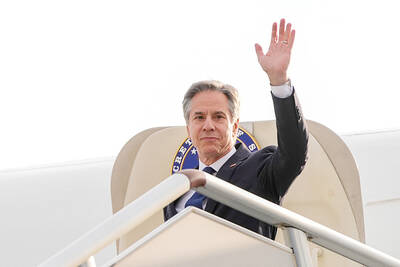
‘IN A DIFFERENT PLACE’: The envoy first visited Shanghai, where he attended a Chinese basketball playoff match, and is to meet top officials in Beijing tomorrow US Secretary of State Antony Blinken yesterday arrived in China on his second visit in a year as the US ramps up pressure on its rival over its support for Russia while also seeking to manage tensions with Beijing. The US diplomat tomorrow is to meet China’s top brass in Beijing, where he is also expected to plead for restraint as Taiwan inaugurates president-elect William Lai (賴清德), and to raise US concerns on Chinese trade practices. However, Blinken is also seeking to stabilize ties, with tensions between the world’s two largest economies easing since his previous visit in June last year. At the

UNSETTLING IMAGES: The scene took place in front of TV crews covering the Trump trial, with a CNN anchor calling it an ‘emotional and unbelievably disturbing moment’ A man who doused himself in an accelerant and set himself on fire outside the courthouse where former US president Donald Trump is on trial has died, police said yesterday. The New York City Police Department (NYPD) said the man was declared dead by staff at an area hospital. The man was in Collect Pond Park at about 1:30pm on Friday when he took out pamphlets espousing conspiracy theories, tossed them around, then doused himself in an accelerant and set himself on fire, officials and witnesses said. A large number of police officers were nearby when it happened. Some officers and bystanders rushed

Beijing is continuing to commit genocide and crimes against humanity against Uyghurs and other Muslim minorities in its western Xinjiang province, U.S. Secretary of State Antony Blinken said in a report published on Monday, ahead of his planned visit to China this week. The State Department’s annual human rights report, which documents abuses recorded all over the world during the previous calendar year, repeated language from previous years on the treatment of Muslims in Xinjiang, but the publication raises the issue ahead of delicate talks, including on the war in Ukraine and global trade, between the top U.S. diplomat and Chinese
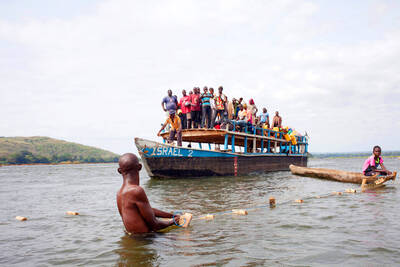
RIVER TRAGEDY: Local fishers and residents helped rescue people after the vessel capsized, while motorbike taxis evacuated some of the injured At least 58 people going to a funeral died after their overloaded river boat capsized in the Central African Republic’s (CAR) capital, Bangui, the head of civil protection said on Saturday. “We were able to extract 58 lifeless bodies,” Thomas Djimasse told Radio Guira. “We don’t know the total number of people who are underwater. According to witnesses and videos on social media, the wooden boat was carrying more than 300 people — some standing and others perched on wooden structures — when it sank on the Mpoko River on Friday. The vessel was heading to the funeral of a village chief in


 RSS
RSS